


Late pickups destroy ratios, force overtime, and burn out your best teachers. Most centers try random fixes—earlier reminders, bigger signs, stern conversations—without ever knowing what actually works. The solution isn't guessing; it's systematic testing of reminder timing, fee messaging, and escalation sequences to find what drives parent behavior at your specific center.
Every late pickup creates a cascade of operational problems that compound throughout your center. When parents arrive 15 minutes late, you're not just dealing with one inconvenience—you're watching your carefully planned ratios collapse as teachers clock unnecessary overtime while other staff members can't leave their assigned rooms to help.
The financial damage adds up faster than most directors realize. A center with 80 enrolled families experiencing just three late pickups per week burns through an extra $8,000-12,000 annually in overtime costs alone. That doesn't include teacher frustration, parent complaints about inconsistent enforcement, or the administrative burden of tracking and billing late fees that half the time never get collected.
The Hidden Operational Cost of Late Pickups
What makes this problem particularly frustrating: most centers have no idea which interventions actually reduce late pickups versus which ones just create more friction without changing behavior. You implement a new reminder system, late pickups drop for two weeks, then creep back up. Was it the reminder? The time of year? Pure coincidence? Without controlled testing, you're flying blind.
Every late pickup creates a cascade of operational problems that compound throughout your center. When parents arrive 15 minutes late, you're not just dealing with one inconvenience—you're watching your carefully planned ratios collapse as teachers clock unnecessary overtime while other staff members can't leave their assigned rooms to help.
The financial damage adds up faster than most directors realize. A center with 80 enrolled families experiencing just three late pickups per week burns through an extra $8,000-12,000 annually in overtime costs alone. That doesn't include teacher frustration, parent complaints about inconsistent enforcement, or the administrative burden of tracking and billing late fees that half the time never get collected.
Why Traditional Approaches Fail
Centers typically cycle through the same ineffective strategies. First comes the policy update—increase late fees from $1 per minute to $2 per minute. Parents grumble, behavior changes briefly, then returns to baseline within a month. Next, you try earlier reminders. Send pickup alerts at 3 PM instead of 4 PM. No measurable change.
Eliminate administrative bottlenecks.
Carexly helps you manage enrollments, attendance, and staff schedules effortlessly.
- Streamlined child enrollment
- Automated parent notifications
- Staff shift and activity scheduling
No credit card required
Then frustration sets in and enforcement gets aggressive. Teachers start documenting every late pickup, directors have uncomfortable conversations, relationships strain. Some parents improve temporarily out of embarrassment, others get defensive and the problem persists while the center atmosphere becomes increasingly tense.
The fundamental issue isn't that these interventions can't work—it's that centers implement them blindly without understanding which specific elements drive behavior change for their particular parent population. A fee structure that transforms pickup behavior at a suburban center might have zero impact at an urban location where parents face different transportation challenges. Reminder timing that works perfectly for professional parents with flexible schedules might fail completely for shift workers or parents dependent on public transit.
Building Your Testing Framework
Effective testing starts with segmenting your parent population into behavioral groups. Track pickup patterns for two weeks without any intervention to establish your baseline. You'll typically find three distinct segments:
Chronic late arrivals (10-15% of families): These parents are late multiple times per week, often by 15+ minutes. They've normalized late pickup as part of their routine.
Occasional offenders (25-30% of families): Late once or twice per month, usually by 5-10 minutes. Often apologetic but behavior doesn't change.
Borderline families (20-25% of families): Consistently arrive within 1-2 minutes of closing time, technically on time but cutting it close enough that any small delay pushes them late.
Each segment requires different intervention strategies, which is why blanket approaches fail. Your testing protocol needs to account for these differences.
Test Variable 1: Reminder Timing Optimization
Start with your largest segment—usually the occasional offenders—and run a four-week A/B test on reminder timing. Divide this group randomly into three test cells:
Cell A - Early afternoon reminder (1 PM): "Friendly reminder: [Child's name] pickup time is 5:30 PM today. Please plan to arrive by 5:25 PM to gather belongings."
Cell B - Two-hour warning (3:30 PM): "Pickup reminder: [Child's name] should be picked up in 2 hours (5:30 PM). Traffic is typically heavy on Main Street around this time."
Cell C - Cascade sequence:
-
2 PM
"Daily pickup time confirmation: 5:30 PM for [Child's name]"
-
4
30 PM: "One hour until pickup (5:30 PM)"
-
5
15 PM: "15-minute pickup window now open"
Track late pickups by cell for four weeks. Running this across multiple centers, Cell B (two-hour warning) typically reduces late pickups by 20-30% for occasional offenders, while the cascade sequence in Cell C often creates reminder fatigue and actually increases late arrivals as parents start ignoring all messages.
Test Variable 2: Fee Messaging Psychology
How you frame late fees matters more than the actual amount. Run a three-week test with your chronic late arrival segment, keeping the fee structure identical ($15 for first 10 minutes, $1/minute after) but varying the messaging:
Version 1 - Penalty framing: "Late pickup fees apply after 5:30 PM: $15 for the first 10 minutes, then $1 per minute. Fees are automatically added to your next invoice."
Version 2 - Staff overtime framing: "When pickups occur after 5:30 PM, staff overtime costs require a $15 contribution for the first 10 minutes, then $1/minute to cover additional wages."
Version 3 - Opportunity cost framing: "After 5:30 PM, your child's teacher cannot prepare tomorrow's activities. A $15 extended care fee applies for the first 10 minutes, then $1/minute."
Centers testing these variations report dramatically different results. Version 2 (staff overtime framing) typically reduces chronic late pickups by 35-40%, while Version 1 (penalty framing) often triggers defensiveness and payment disputes. Version 3 works particularly well with education-focused parents who value preparation time.
Test Variable 3: Escalation Sequences
For families who don't respond to reminders or fee adjustments, you need a structured escalation protocol. Test these three approaches with your non-responsive families:
Soft escalation pathway:
-
Week 1-2
Standard reminders and fees
-
Week 3
Personal text from lead teacher expressing concern
-
Week 4
Optional earlier pickup time offered (5:15 PM) to help family establish buffer
-
Week 5
Director meeting to create "pickup success plan"
Accountability escalation pathway:
-
Week 1-2
Standard reminders and fees
-
Week 3
Required signature on late pickup log
-
Week 4
Posted pickup times in classroom (all families see pickup schedule)
-
Week 5
Formal warning letter with enrollment review notice
Support escalation pathway:
-
Week 1-2
Standard reminders and fees
-
Week 3
Survey about pickup challenges
-
Week 4
Alternative solutions offered (carpool matching, extended care option, flexible pickup window)
-
Week 5
Family support meeting to address underlying issues
The support escalation pathway seems counterintuitive—you're offering help instead of consequences—but it consistently outperforms punitive approaches, reducing chronic late pickups by 45-50% versus 20-25% for accountability-based escalation.
Creating Your Testing Protocol
Systematic testing generates measurable results when you follow this approach:
Week 1-2: Baseline measurement
Document every pickup time without any intervention. Create simple tracking sheet with family name, scheduled pickup time, actual arrival time, day of week, weather conditions, and who picked up (parent, grandparent, nanny, etc.).
Week 3-4: Segment analysis
Group families into behavioral segments based on patterns. Look for correlations with day of week (Fridays worse? Mondays?), pickup person (certain caregivers always late?), weather impact, and age group/classroom.
Week 5-8: Primary test
Run your first A/B test on largest problem segment. Keep everything else constant—don't change multiple variables simultaneously or you won't know what worked.
Week 9-10: Analysis and rollout
Calculate improvement by test cell. If one approach shows 25%+ improvement, roll out to entire segment. If results are mixed, design follow-up test with refined variables.
Week 11-14: Secondary test
Test different variable with different segment. Don't test reminder timing with same group that just completed fee messaging test—contamination makes results unreliable.
Week 15-16: Full implementation
Combine successful interventions into comprehensive protocol.
Visual workflow of the testing cycle:
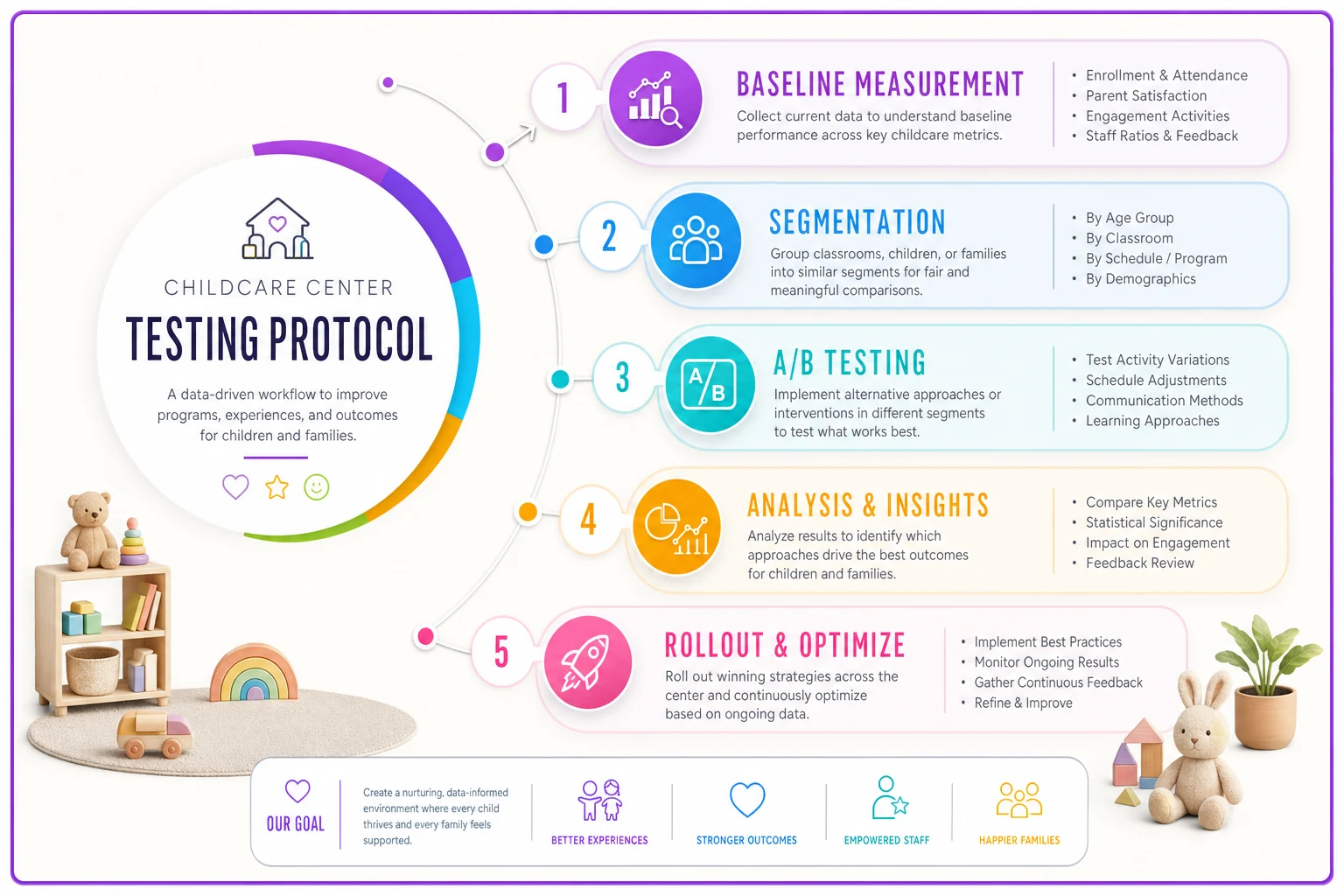
Follow the weeks in sequence and avoid changing multiple variables at once to keep results clear.
Measuring What Matters
Track these metrics throughout your testing:
| Metric Type | Specific Measurements |
|---|---|
| Primary metrics | Late pickup frequency (incidents per week), Late pickup duration (average minutes late), Chronic offender count (families late 3+ times per week) |
| Secondary metrics | Staff overtime hours, Late fee collection rate, Parent complaints/feedback, Teacher satisfaction scores |
| Leading indicators | Reminder open rates, Response rates to check-in messages, Families arriving in final 5 minutes before cutoff |
Centers often focus exclusively on late pickup counts without tracking duration or patterns. A family that improves from 20 minutes late to 5 minutes late represents meaningful progress even if they're still technically late. Your testing should capture these nuances.
Scripts That Actually Work
Ineffective reminder: "Don't forget pickup is at 5:30 PM!"
Effective reminder: "Hi Sarah, confirming 5:30 PM pickup for Emma today. The classroom is working on art projects until 5:15 if you'd like to arrive early to see her work."
Ineffective escalation: "This is your third late pickup this month. Per our policy, continued late pickups may result in enrollment termination."
Effective escalation: "We've noticed pickup has been challenging lately. Could we schedule a brief call to discuss whether a different pickup time or arrangement might work better for your family?"
Ineffective fee notice: "You owe $45 in late pickup fees from last week."
Effective fee notice: "Your account shows a $45 balance for extended staff time last week (Monday 15 min, Wednesday 10 min, Friday 20 min). This will appear on your Friday auto-payment unless you'd prefer to handle it separately."
Building Staff Buy-In
Your testing protocol will fail without consistent staff execution. Teachers need to understand they're not being mean by enforcing pickup times—they're helping establish patterns that benefit everyone.
Keep the pickup log simple—pre-printed 5-minute increments on a clipboard encourages consistent teacher use.
Create a simple tracking system that doesn't burden teachers. A clipboard by the door with pre-printed times in 5-minute increments lets them quickly circle actual pickup time without stopping their workflow. Avoid complex apps or multi-step documentation that won't get completed consistently.
Share testing results with staff weekly. When they see that changing reminder timing from 4 PM to 2 PM reduced late pickups by 30%, they understand their participation drives real improvement. This transparency transforms compliance from obligation into contribution.
The Technology Component
Manual testing becomes overwhelming beyond 20-30 families. AI-powered operational software makes the difference between running one successful test and building a culture of continuous improvement.
These platforms handle the complex logistics of A/B testing automatically. They segment families, randomize test groups, send varied messages, track responses, and calculate statistical significance without anyone managing spreadsheets or manually sending reminders. The same system that sends routine communications becomes your testing laboratory.
More importantly, these platforms identify patterns humans miss. They'll notice that families who pay through auto-pay are 40% less likely to pickup late, or that late pickups spike 3x when the previous day had weather delays. These insights inform which tests to run next.
The most successful centers use their operational software to run continuous micro-tests. Instead of one major test per quarter, they're constantly testing small variations—emoji vs no emoji in reminders, teacher name vs center name as sender, requesting confirmation vs purely informational messages. Small improvements compound into dramatic operational gains.
Real-World Results
A 120-child center in Michigan ran this exact testing protocol over four months. Their baseline: 18 late pickups per week, averaging 12 minutes late, creating 3.6 hours of weekly overtime.
First test: Reminder timing for occasional offenders. Moving from 4 PM reminder to 2 PM reminder reduced their late pickups by 4 per week.
Second test: Fee messaging for chronic offenders. Switching from penalty framing to overtime coverage framing reduced chronic late pickups from 8 families to 3 families.
Third test: Escalation pathway for remaining problems. Support-based escalation resolved issues for 2 of the 3 remaining chronic families.
Final result: 6 late pickups per week (67% reduction), averaging 7 minutes late (42% reduction), creating 0.7 hours of weekly overtime (81% reduction). Annual savings: approximately $11,000 in reduced overtime plus immeasurable improvement in staff morale and parent relationships.
Making It Sustainable
The biggest mistake centers make is treating testing as a one-time project instead of an ongoing practice. Parent populations change, family circumstances shift, and what works today might not work next year.
Build testing into your quarterly planning. Every quarter, identify one operational friction point and design a test to address it. Late pickups this quarter, enrollment communication next quarter, payment reminders the following quarter. This systematic approach to improvement transforms operations gradually but permanently.
Document everything. Create a simple "test log" that captures what you tested, when, with whom, and what happened. This institutional knowledge prevents repeating failed experiments and helps new staff understand why certain procedures exist.
Most importantly, celebrate improvements publicly. When testing reduces late pickups by 40%, share that victory with parents. Explain that their cooperation helped identify better reminder timing that works for everyone. This transparency builds trust and increases participation in future improvements.
The Path Forward
Late pickups aren't inevitable. They're a solvable operational problem that responds predictably to the right interventions delivered in the right way to the right families. Centers that struggle with chronic late pickups aren't lacking strict enough policies or high enough fees—they're lacking data about what actually changes behavior in their specific parent population.
Start small. Pick your five most chronically late families and test one variable. Track the results for two weeks. Learn what works. Then expand gradually. Within three months, you'll have actionable data that transforms an ongoing frustration into a solved problem.
The difference between centers that struggle with late pickups and those that don't isn't about parent quality or location or socioeconomics. It's about whether the center systematically tests solutions or simply hopes the problem resolves itself. Testing gives you control. Everything else is just wishful thinking.
Start small. Pick your five most chronically late families and test one variable. Track the results for two weeks. Learn what works. Then expand gradually. Within three months, you'll have actionable data that transforms an ongoing frustration into a solved problem.
Ready to transform your daycare operations?
Join hundreds of daycare centers using Carexly to save time, improve communication, and enhance child care quality.