



A daycare owner stares at a lawsuit filing that started with what seemed like a minor incident eight months ago. A toddler bumped their head on a bookshelf corner. The teacher filled out an incident report that said "Emma hit head on shelf at 2:15pm. Ice applied. Parents notified." That was it.
Now the parents' attorney is asking why the report didn't mention the water spill on the floor from a knocked-over sippy cup. Why it didn't document that another child had moved a chair blocking the normal pathway. Why there was no mention that the safety gate to that area was propped open during naptime transitions. The security footage shows all of this. The incident report shows none of it.
This owner just learned that incomplete incident documentation isn't sloppy paperwork — it's handing ammunition to opposing counsel while undermining your own defense.
The operational breakdown hiding in plain sight
Most daycare centers treat incident reports like an afterthought. Teacher sees incident, grabs a form, scribbles basic details, hands copy to parent at pickup. The form gets filed somewhere. Maybe it gets entered into a spreadsheet later.
You're creating legal exposure with every incomplete report while missing critical patterns that could prevent future incidents.
The typical daycare incident reporting workflow: generic paper forms sitting in classrooms, teachers filling them out between diaper changes, directors reviewing them maybe once a week, parents getting photocopies hours after incidents happen. No escalation triggers. No pattern tracking. No legal defensibility built into the process.
Your current incident forms probably ask for child's name, date, time, what happened, action taken. Standard stuff that state regulations require. But state minimum requirements and legal defensibility are completely different standards.
A legally defensible incident report captures environmental factors, witness perspectives, preceding events, exact locations with reference points, response timeline down to the minute, and creates an escalation cascade based on incident severity. Your two-paragraph form doesn't cut it when an attorney starts asking questions.
Why minimum-data capture maximizes risk
Most operators view incident documentation as compliance paperwork — something you have to do to check a box. But incident reports serve three critical operational functions that go way beyond compliance.
Eliminate administrative bottlenecks.
Carexly helps you manage enrollments, attendance, and staff schedules effortlessly.
- Streamlined child enrollment
- Automated parent notifications
- Staff shift and activity scheduling
No credit card required
First, they're your legal defense documentation. When a parent files a claim six months later, your incident report becomes primary evidence. If it says "child fell" but doesn't mention the toy left in the walkway, you've essentially admitted negligence through omission.
Second, they're pattern detection tools. Three kids tripping in the same spot over two weeks tells you something about your environment. But if three different teachers write "fell down" without location specifics, you miss the pattern entirely.
Third, they drive your escalation and communication protocols. A scraped knee needs different handling than a head injury. But if your forms don't trigger different workflows based on incident type, everything gets the same delayed, generic response.
A typical scenario: An incident occurs at 10:30am. Teacher fills out basic form at naptime around 12:45pm, already forgetting details. Director reviews it at 3pm. Parent gets generic "Emma had a small accident today" message at 4:30pm pickup. By the time anyone realizes this needed immediate escalation, it's been six hours.
Meanwhile, the parent posts in the neighborhood Facebook group asking if anyone else's kid got hurt at your center. Three other parents chime in with their own incident stories. Now you're managing a PR crisis that started with poor documentation.
Building rapid-capture with legal depth
The incident reports that hold up legally share specific characteristics. They're completed within 10 minutes of the incident. They include environmental documentation. They trigger automatic escalations. They generate parent communications based on severity.
The minimum data set that actually protects you legally:
Environmental factors (often missed):
-
Exact location with permanent reference points (not just "playground")
-
Weather/lighting conditions if relevant
-
Presence or absence of required safety equipment
-
Any environmental hazards present (wet floors, moved furniture, broken equipment)
-
Number of children and staff in immediate area
Incident specifics (beyond the basics):
-
Preceding activity (what was child doing before incident)
-
Mechanism of injury (fell forward, backward, from what height)
-
Body part affected with left/right specification
-
Visible marks/symptoms described objectively
-
Child's immediate reaction and verbalization
Response documentation:
-
Time incident observed (not reported)
-
First aid started time
-
Parent notification attempt time
-
Parent contact achieved time
-
Director notified time
-
Additional medical consultation time if applicable
Witness information:
-
Staff who observed incident
-
Staff who provided care
-
Other children who witnessed (names, not details)
-
Any visiting adults present
This seems like a lot, but with the right form design, it takes maybe four minutes to capture versus two minutes for a useless report that won't protect you later.
The escalation matrix that actually works
Not every incident needs the same response, but without clear escalation rules, teachers either over-react to everything or under-respond to serious issues. You need automatic triggers based on incident type, not subjective judgment.
An escalation framework that maps incident types to required actions:
| Escalation | Examples |
|---|---|
| Immediate Director + Parent notification (within 15 minutes) | Any head injury regardless of severity; Any injury requiring more than basic first aid; Any incident involving blood; Biting incidents (both children's parents); Any incident where child is inconsolable after 5 minutes; Any incident requiring ice or bandaging; Allergic reactions of any type |
| Standard notification (within 2 hours) | Minor scrapes/bruises; Behavioral incidents without injury; Toilet accidents requiring full clothing change; Minor conflicts between children |
| End-of-day notification (at pickup) | Near-miss incidents (almost fell, almost hit); Minor behavioral notes; Small scratches discovered without known cause |
Most centers create the matrix but don't build it into their actual workflow. Teachers still have to remember what requires immediate escalation. They still have to track notification times manually. They still have to generate different parent messages based on severity.
Parent communication scripts that prevent escalation
The message you send about an incident determines whether a parent feels informed and reassured or panicked and litigious. Most centers wing it with parent communications, leading to inconsistent messaging that creates more problems than it solves.
The communication usually fails in three ways: too vague ("had a little accident"), too alarming ("emergency at school"), or too late (finding out at pickup about morning incident).
A communication framework organized by incident severity:
For immediate notification incidents:
Initial notification (within 15 minutes):
"Hi [Parent], [Child] bumped their head on the playground at 10:47am. They're doing fine now - alert, talking normally, and playing with blocks. We've applied ice and are monitoring closely. No signs of concern, but wanted you aware immediately. Should I send updates every 30 minutes or would you prefer to call/visit?"
Follow-up (every 30 minutes if requested):
"11:20am update: [Child] ate full snack, participated in story time, no complaints of pain. Still alert and acting normally."
Pickup documentation:
Written report with all details, photo of affected area if visible mark, specific home monitoring instructions
For standard notification incidents:
Notification (within 2 hours):
"Hi [Parent], wanted to let you know [Child] scraped their knee on the playground at 2:15pm. We cleaned it with soap and water, applied antibiotic ointment and a bandage. They were upset initially but returned to play within 5 minutes. Will have full written report at pickup."
For end-of-day incidents:
At pickup only:
"[Child] had a small scratch on their arm we noticed after lunch. Not sure exactly when it happened - might have been during morning outdoor play. We cleaned and monitored it, no other concerns."
Notice how each script includes specific times, exact care provided, child's current status, and clear next steps. This prevents parent panic while demonstrating professional response.
The legally defensible workflow in practice
What this actually looks like operationally when done right.
Tuesday, 10:15am: A three-year-old named Marcus trips over a toy truck and hits his forehead on a cubby edge.
10:16am: Teacher Sarah grabs her tablet with the incident form already loaded. While her assistant applies ice, she documents: "Marcus tripped over red toy truck left in walkway between reading corner and cubbies. Fell forward, hitting left side of forehead on corner of cubby unit #3. Immediate red mark appearing, no break in skin."
10:18am: Form prompts environmental check. Sarah notes: "Toy truck was outside designated play area. Three children and two staff present. Normal classroom lighting. No other hazards observed."
10:19am: System recognizes "head" + "hit" keywords, triggers immediate escalation. Director gets alert. Parent communication template loads.
10:20am: Parent receives text with initial notification. Director reviews submitted form via tablet, adds investigation note: "Reviewing why toys were in walkway during transition time."
10:45am: Thirty-minute follow-up sent to parent with Marcus's status.
11:00am: Director completes environmental review, finds transition procedure gap, documents corrective action.
2:00pm: Weekly pattern report flags this as second walkway trip incident this month.
4:30pm: Parent picks up Marcus, receives printed report with photos of area, ice pack log, and home monitoring instructions.
Wednesday morning: Follow-up check-in with parent about Marcus's evening and night.
Total time invested: maybe 8 minutes across all staff. But now you have legally defensible documentation, pattern detection, proper escalation, and a parent who feels informed rather than surprised.
Common documentation mistakes that destroy legal defense
Even when centers try to improve their incident reporting, they often make critical errors that undermine their legal position. Patterns that consistently cause problems:
-
Using subjective language Writing "child was being careless" or "wasn't paying attention" assigns blame and admits supervision failure. Stick to objective observations: "Child was running when they tripped."
-
Documenting assumptions "Must have happened on playground" when you didn't actually see it. If you didn't observe it, write "discovered scratch on arm at 2pm, origin unknown."
-
Inconsistent timing Report says incident at 2pm, parent notification shows 2:15pm, but security footage shows incident at 1:45pm. These discrepancies destroy credibility.
-
Missing environmental updates Incident report from January mentions broken gate latch. Same gate causes incident in March, but January corrective action was never documented. Now you have proven negligence.
-
Vague location descriptions "In classroom" versus "between reading corner and bathroom door." Specificity matters for pattern detection and legal accuracy.
-
Incomplete witness lists Only listing the reporting teacher when three staff members were present. Other witnesses may have crucial observations.
Specificity matters for pattern detection and legal accuracy.
When automation changes the game
The operational complexity of proper incident documentation is where AI-powered operational software transforms a broken process into a protective asset. Not buzzword AI that promises to revolutionize everything, but practical automation that handles the repetitive parts so your staff can focus on the children.
Modern incident reporting platforms recognize patterns humans miss. When three different teachers document separate incidents, the system identifies that all three happened in the same location during transition times. It flags the pattern and suggests environmental or procedural reviews.
The automation handles tedious parts: triggering escalations based on keyword combinations, generating parent messages from templates, scheduling follow-ups, creating pattern reports, maintaining audit logs with timestamps. Your teachers document what happened. The system handles the workflow cascade.
Some centers have reduced their incident-to-parent-notification time from hours to minutes just by automating the escalation triggers. When a teacher submits a head injury report, the director and parent get notified simultaneously. No remembering who to tell when.
The legal protection comes from consistency. Every incident gets the same thorough documentation. Every escalation follows the same triggers. Every parent communication uses approved language. The automation removes the human variables that create legal exposure.
Building your minimum-data rapid-response workflow
Start by auditing your last 20 incident reports. How many could defend against a legal claim? How many captured enough detail to identify patterns? How many triggered appropriate escalations? If the answer isn't "all of them," you need a new workflow.
Design your forms for speed but depth. Group fields logically: incident details, environmental factors, response documentation, witness information. Use checkboxes and dropdown menus where possible. Only use text fields for descriptions that truly need narrative.
Create your escalation matrix based on your actual incidents, not theoretical scenarios. Review your past year's reports. What types of incidents do you actually see? What should trigger immediate versus standard notification? Build rules around your reality.
Write your parent communication templates when you're calm, not when you're managing a crisis. Have them reviewed by your insurance carrier or attorney. Load them into whatever system you use so they're ready when needed.
Train your staff on the why, not just the how. When teachers understand that complete documentation protects them personally from liability, they document better. When they see how patterns prevent future incidents, they include more detail.
Test your workflow under stress. Run drills where someone simulates an incident and everyone practices the response cascade. Time how long each step takes. Identify where the workflow breaks. Fix it before a real incident exposes the gaps.
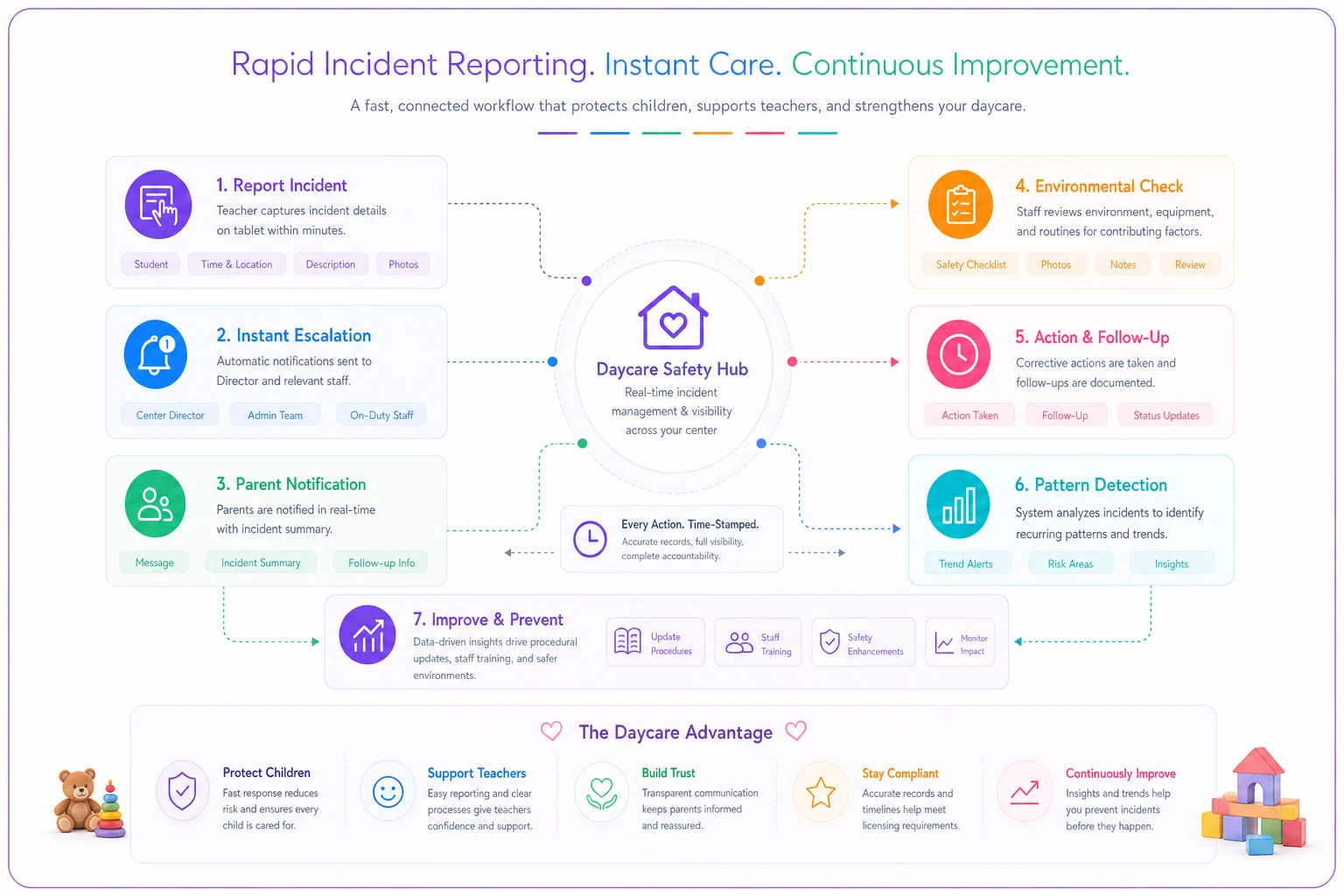
A simple visual of the rapid-capture → escalate → communicate → analyze loop.
The next time a child bumps their head, you want a workflow that protects everyone involved. The form that takes four minutes to complete properly could save you from four years of legal battles. Build the workflow now, before you need it.
Ready to transform your daycare operations?
Join hundreds of daycare centers using Carexly to save time, improve communication, and enhance child care quality.