



Your preschool room runs at 95% capacity. Parents call daily asking about spots for their 3-year-olds. Meanwhile, your infant room sits half-empty, burning through $4,800 monthly in underutilized teacher salaries.
This imbalance shows up at centers everywhere. Not because parents don't need infant care — they desperately do. The problem runs deeper in your enrollment operations. Your intake process treats every age group identically, your follow-up sequences ignore the different decision timelines parents face, and your handoff between tour and enrollment loses track of which classrooms actually need filling.
The gap between a daycare enrollment funnel that randomly fills rooms versus one that strategically balances capacity comes down to operational structure. Not marketing spend, prettier facilities, or better teachers. Pure enrollment workflow design.
Why standard enrollment processes create age-group imbalances
Your staff unconsciously takes the path of least resistance. Preschool parents show up, tour once, decide within a week. Infant parents? They call six months pregnant, tour while still figuring out maternity leave, then disappear into radio silence for months.
When I track enrollment data across different centers, the pattern stays consistent. Infant inquiries get initial enthusiasm, then get buried under newer, faster conversions. Your enrollment coordinator celebrates closing three preschool spots this week while those two infant families from March sit in limbo.
Parents seeking infant care often start their search during pregnancy. They research multiple centers, join waitlists at half a dozen places, and make decisions based on which spot becomes available first. Parents hunting for preschool spots typically start looking 30-45 days out, tour maybe three centers, and decide within a week.
Push both groups through identical workflows and the system naturally favors easier wins. The infant inquiries get lost in longer decision cycles and inadequate follow-up sequences that don't match their timeline.
This compounds over months. Your team fills the pre-K room while the infant room revenue gap grows. You throw more marketing money at infant family attraction, but the fundamental process flaw remains unchanged.
The hidden economics of unbalanced classrooms
Empty infant spots cost way more than empty preschool spots. Infant ratios run 1:4 or 1:3 depending on your state. Preschool ratios stretch to 1:10 or 1:12. When you carry an underutilized infant room teacher, you're paying for capacity that generates zero revenue.
Eliminate administrative bottlenecks.
Carexly helps you manage enrollments, attendance, and staff schedules effortlessly.
- Streamlined child enrollment
- Automated parent notifications
- Staff shift and activity scheduling
No credit card required
Take a typical 8-infant room with two teachers earning $15/hour each. Running at 50% capacity means $2,400 monthly in wages supporting just four enrolled infants. Those same wages in a preschool room would support 10-12 children. The per-child cost differential destroys margins.
Beyond direct costs, imbalanced enrollment creates cascading problems. Teachers in underutilized rooms lose morale — they know their room bleeds money. Parents in overcrowded rooms notice the disparity and question resource allocation. Your ability to maintain consistent quality deteriorates when some rooms overflow while others sit empty.
The enrollment imbalance also disrupts your pipeline planning. Today's empty infant room becomes tomorrow's empty toddler room as children age up through your center. You end up with rolling capacity problems that follow cohorts through their entire enrollment lifecycle.
Different parent journeys require different approaches
Infant parents typically begin their search during pregnancy, often second trimester. They're not shopping for curriculum or enrichment programs. They want safety, cleanliness, and trust. Their primary concerns center on feeding schedules, sleep routines, and caregiver consistency.
These parents need longer relationship building before committing. They'll likely tour when their child is still months from starting, meaning your follow-up sequence must sustain engagement over extended periods without being pushy.
Toddler parents often arrive in crisis mode. Their current care arrangement fell through, they're returning to work after extended leave, or their child aged out of their previous setting. These parents need quick decisions and immediate availability. They care about potty training support, social development, and outdoor play space.
Preschool parents shop like education consumers. They compare curricula, evaluate kindergarten readiness programs, and seek specific learning outcomes. They often tour multiple centers in rapid succession, make spreadsheets comparing options, and involve spouses or grandparents in decisions.
Each journey requires different intake scripts, tour emphasis points, follow-up timing, and enrollment incentives. A single generic process satisfies none of these groups optimally.
Age-specific intake scripts that actually work
Your first parent contact shapes everything that follows. Generic intake scripts waste this critical touchpoint by failing to identify and respond to age-specific needs and timelines.
For infant inquiries:
"When are you hoping to start care? I ask because our infant program has specific enrollment windows based on teacher scheduling and room ratios."
"What's your biggest concern about starting infant care? Every parent worries about something different, and I find it helps to address that upfront."
Log timeline cues from the first call so infant families get placed on the correct long-nurture sequence immediately.
For toddler inquiries:
"How soon do you need care to begin? We sometimes have immediate openings in our toddler rooms that I could check for you."
"Is your child currently in another care setting? Understanding their routine helps us plan the smoothest transition."
For preschool inquiries:
"What are your goals for your child before kindergarten? Academic readiness, social skills, or finding the right balance?"
"Have you toured other centers? What questions are still unanswered after those visits?"
These differentiated scripts do more than gather information. They position your center as sophisticated enough to recognize that different age groups need different approaches. Parents immediately feel understood rather than processed through a generic system.
Train intake staff to listen for timeline cues and urgency markers. An infant parent mentioning returning to work in four months requires completely different handling than one starting a new job next month.
Handoff protocols that don't lose families
The gap between tour and enrollment kills more enrollments than any other single point in your funnel. This becomes especially critical when managing age-specific enrollment goals.
Most centers run informal handoffs. Tour guide mentions the family to enrollment coordinator in passing. Maybe leaves a note, perhaps sends an email. This casual approach loses critical context about the family's specific needs, timeline, and which classroom you're actually trying to fill.
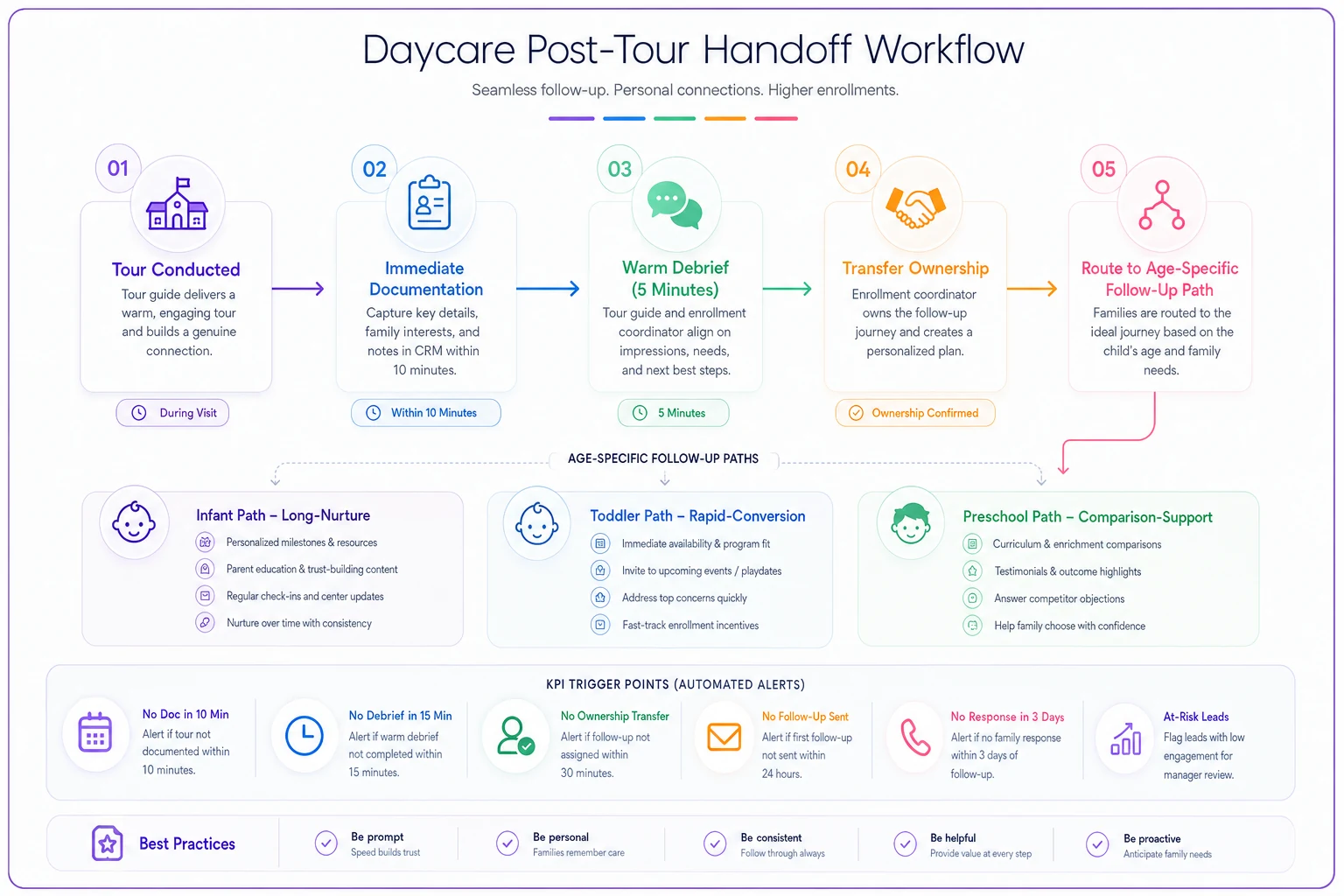
Immediate post-tour documentation (within 10 minutes):
-
Age group and specific classroom toured
-
Parent's stated timeline for starting care
-
Primary concerns or objections raised during tour
-
Competing centers mentioned
-
Decision-making dynamics observed
-
Enrollment probability rating (1-5 scale)
-
Specific follow-up actions promised
Same-day warm handoff process:
Tour guide schedules 5-minute debrief with enrollment coordinator before end of shift. This conversation transfers emotional context that written notes miss. The enrollment coordinator asks clarifying questions and confirms follow-up ownership.
Age-group specific handoff priorities:
For infant tours, emphasize building long-term nurture sequences. These families need patience and consistent touchpoints over potentially months.
For toddler tours, stress urgency and availability. If space exists, enrollment coordinator should attempt same-day enrollment conversation.
For preschool tours, highlight differentiation points and competitive positioning. These families are actively comparing options and need concrete reasons to choose you.
Here's a quick visual of the post-tour handoff workflow.
For infant tours, emphasize building long-term nurture sequences. These families need patience and consistent touchpoints over potentially months.
KPI triggers that catch problems early
Standard enrollment metrics track overall conversion rates and total enrollment. These aggregate numbers hide age-group imbalances until they become crisis-level problems.
Inquiry distribution monitoring:
Track inquiry percentages by age group weekly. If infant inquiries drop below 25% of total inquiries for two consecutive weeks, trigger marketing audit and community outreach review.
Tour-to-enrollment conversion by age:
Measure conversion rates separately for each age group. Infant conversion typically runs lower (25-35%) than preschool (40-55%) due to longer decision cycles. When infant conversion drops below 20% or preschool exceeds 60%, investigate process breakdowns.
Capacity utilization targets:
-
Infant rooms
75% minimum (6 of 8 spots filled)
-
Toddler rooms
80% minimum
-
Preschool
85% minimum
| Metric | Target |
|---|---|
| Infant rooms | 75% minimum (6 of 8 spots filled) |
| Toddler rooms | 80% minimum |
| Preschool | 85% minimum |
| Pipeline coverage | Maintain roughly 3x pipeline coverage for infant spots versus 2x for preschool. |
Pipeline coverage ratios:
Maintain roughly 3x pipeline coverage for infant spots versus 2x for preschool. The longer decision cycle requires deeper pipeline to ensure consistent filling.
Build escalation protocols when triggers fire. Initial trigger prompts enrollment coordinator review. Second trigger escalates to director. Third trigger initiates full enrollment audit with potential process redesign.
Automated follow-up that matches parent timelines
Generic follow-up sequences treat the pregnant mother exploring options the same as the parent starting a new job Monday. This misalignment kills enrollment momentum for both.
Infant long-nurture sequence (3-6 month timeline):
-
Day 1
Thank you for touring, PDF with infant daily schedule
-
Day 4
Email about our infant teacher credentials and training
-
Day 10
Text check-in about questions since tour
-
Week 3
Infant development milestone guide relevant to their child's age
-
Week 5
Invitation to attend infant room parent coffee morning
-
Week 8
Enrollment deadline reminder if applicable
-
Week 12
Personal call from director about enrollment plans
-
Monthly thereafter
Newsletter with infant room updates and openings
Toddler rapid-conversion sequence (1-2 week timeline):
-
Day 1 (2 hours post-tour)
Call to answer immediate questions
-
Day 2
Email with enrollment paperwork and start date options
-
Day 3
Text about current openings update
-
Day 5
Call from enrolled toddler parent as reference
-
Day 7
Final availability notice with urgency message
-
Day 10
Last chance communication before moving to waitlist
Preschool comparison-support sequence (2-4 week timeline):
-
Day 1
Email with curriculum overview and kindergarten readiness data
-
Day 3
Comparison chart versus other centers they mentioned
-
Day 5
Video testimonial from current preschool parent
-
Week 2
Invitation to observe preschool circle time
-
Week 3
Enrollment incentive offer with deadline
-
Week 4
Personal outreach from lead preschool teacher
These sequences run automatically once configured, but require human monitoring for engagement signals. When an infant parent suddenly engages after two months of silence, shift them to rapid conversion mode.
How one center actually fixed their infant room problem
Bright Beginnings Learning Center in suburban Minneapolis struggled with chronic infant room underutilization for eighteen months. Their infant room averaged 40% capacity while maintaining waitlists for preschool.
Sarah, their enrollment coordinator, admits she was part of the problem. "I'd get an infant inquiry, schedule the tour, then get distracted by three preschool families who wanted to enroll immediately. By the time I remembered to follow up with the infant family, they'd already enrolled somewhere else."
The center director, Maria, finally noticed the pattern during a particularly brutal financial review. "We were hemorrhaging money on infant room salaries while turning away preschool families. Something had to change."
They rebuilt their system with age-group awareness:
First, they assigned their most patient staff member as the infant enrollment specialist. This person owned all infant inquiries from first call through enrollment, eliminating handoff losses.
Second, they created an infant-specific tour highlighting their low ratios, teacher consistency, and developmental approach. They stopped mentioning preschool curriculum during infant tours.
Third, they built a 16-week nurture sequence for infant families including monthly "pregnancy and parenting" workshops that kept long-timeline families engaged.
Within four months, infant enrollment climbed to 85% capacity. They didn't increase marketing spend or change pricing. They simply stopped losing infant families to process misalignment.
Maria's takeaway: "Infant enrollment requires completely different operational support than preschool enrollment. Our one-size-fits-all approach was systematically failing one age group."
Technology that supports balanced enrollment
Manual tracking of differentiated enrollment processes becomes overwhelming as your center grows. Spreadsheets can't handle parallel nurture tracks, automated follow-up, and real-time capacity balancing.
Your technology needs include:
-
CRM with age-group segmentation Track each family's age group, timeline, and stage in their specific journey. Set automated reminders for timeline-based follow-up. Flag when families in long nurture sequences show engagement spikes.
-
Automated communication sequences Build and trigger age-appropriate follow-up without manual intervention. Include escape conditions when families show ready-to-enroll signals.
-
Capacity dashboard with alerts Visual representation of enrollment by room with automatic alerts when imbalances emerge. Historical trending helps identify seasonal patterns.
-
Tour scheduling with context When families book tours, capture age group and timeline upfront. Route to appropriate tour guides. Pre-populate tour checklists with age-relevant talking points.
The right operational platform transforms enrollment from reactive scrambling to proactive capacity management. Instead of discovering empty infant rooms at month-end financial review, you spot developing imbalances weeks in advance.
AI automation enhances these systems by identifying patterns humans miss. When infant inquiry quality drops, automated analysis flags the trend before it impacts enrollment. When certain follow-up messages consistently trigger preschool enrollment, the system suggests expanding their use.
The technology doesn't replace human judgment about which families to prioritize or how to handle sensitive situations. It provides the operational infrastructure to execute sophisticated age-group strategies consistently.
Don't overcorrect your way into new problems
Once centers recognize their enrollment imbalances, they often swing too far in the opposite direction. They shift all resources to struggling age groups while previously successful areas deteriorate.
Balance remains critical. Filling your infant room shouldn't mean emptying your preschool room. Building age-specific processes shouldn't eliminate flexibility for unique situations.
Set minimum attention thresholds for each age group regardless of current capacity. Even when your infant room is full, maintain basic nurture sequences for future pipeline building.
Create override protocols for exceptional situations. When a family needs immediate infant care due to crisis, bypass the long nurture sequence. When a preschool family needs extended decision time due to complex custody arrangements, shift them to patient handling.
Review age-group strategies quarterly, not weekly. Enrollment patterns show natural variation. Constant adjustment creates chaos rather than improvement.
The path forward
Imbalanced enrollment isn't a marketing problem or a demand problem. It's an operational problem that requires systematic solutions.
Your daycare enrollment funnel must recognize that different age groups follow different decision journeys, require different nurture approaches, and respond to different triggers. One generic process will always favor certain age groups while underserving others.
Start with one underperforming age group. Map their specific journey from inquiry through enrollment. Identify where your current process fails them. Build targeted improvements for that single group. Once you see improvement, expand the approach to other age groups.
The centers that master balanced enrollment don't just fill more spots — they create predictable revenue streams that support better staffing, improved programs, and sustainable growth across all age groups.
Ready to transform your daycare operations?
Join hundreds of daycare centers using Carexly to save time, improve communication, and enhance child care quality.