



Most families decide whether they trust you within the first three weeks — and most centers don't reach out until something's already wrong.
The families who leave in month two rarely leave over tuition. They leave because the first 90 days felt uncertain. The tour was warm, the paperwork got done, and then silence. Nobody told them their kid cried less on Thursday. Nobody warned them the lead teacher would be out. By the time they say "we're going to try somewhere closer to home," the decision had already been made — quietly, across a dozen small moments nobody at the center ever caught.
Early churn hides in the gap between "enrolled" and "settled." A center can run solid enrollment numbers and still bleed families before month four. This post lays out a concrete onboarding structure — week 0 through month 3 — with the actual communications, the feedback checkpoints, and the retention numbers worth watching. The goal isn't to send more emails. It's to close the gap of uncertainty that sends new parents back to browsing.
Why Early Churn Happens Even When Nothing Goes Wrong
New families churn on perceived risk, not actual problems. That distinction matters before you build any timeline.
A parent handing over an 18-month-old is running a low-grade anxiety loop all day. Every unanswered question, every "I'll have to check on that," every pickup where nothing specific gets said — it quietly feeds a story that maybe this isn't the right fit. Nothing dramatic happens. The kid is fine. But the parent never got the signals that would let them exhale.
This usually surfaces in the 30–60 day window. The week-one honeymoon fades, and if the center hasn't replaced novelty with confidence, the family becomes shoppable again. Centers with low early churn aren't necessarily better at care — they're just better at narrating that care in a way parents can actually feel.
The other silent killer is the handoff drop. A family gets plenty of warmth during the tour and enrollment process, then gets passed to a classroom team that has no idea what was promised, what the parent is anxious about, or sometimes that the family even started today. The warmth disappears at exactly the moment trust is most fragile.
The 90-Day Structure at a Glance
Before the scripts, here's the shape of the whole thing. Each phase has a different job.
Eliminate administrative bottlenecks.
Carexly helps you manage enrollments, attendance, and staff schedules effortlessly.
- Streamlined child enrollment
- Automated parent notifications
- Staff shift and activity scheduling
No credit card required
| Phase | Primary Goal | Parent's Underlying Question | Main Touchpoints |
|---|---|---|---|
| Week 0 (pre-start) | Remove day-one anxiety | "Did I make the right choice?" | Welcome sequence, teacher intro, day-one prep note |
| Weeks 1–4 | Build daily confidence | "Is my kid actually okay here?" | Daily specifics, day-3 check-in, week-2 call, end-of-month recap |
| Months 2–3 | Convert confidence into commitment | "Is this our long-term place?" | Development snapshot, feedback survey, milestone note, re-enrollment signal |
The mistake most centers make is front-loading everything into week 0 and then going quiet. The heavier lift should sit in weeks 2–4, because that's when initial excitement fades and doubt starts creeping in.
This diagram shows the phases and key touchpoints across the 90-day onboarding timeline.
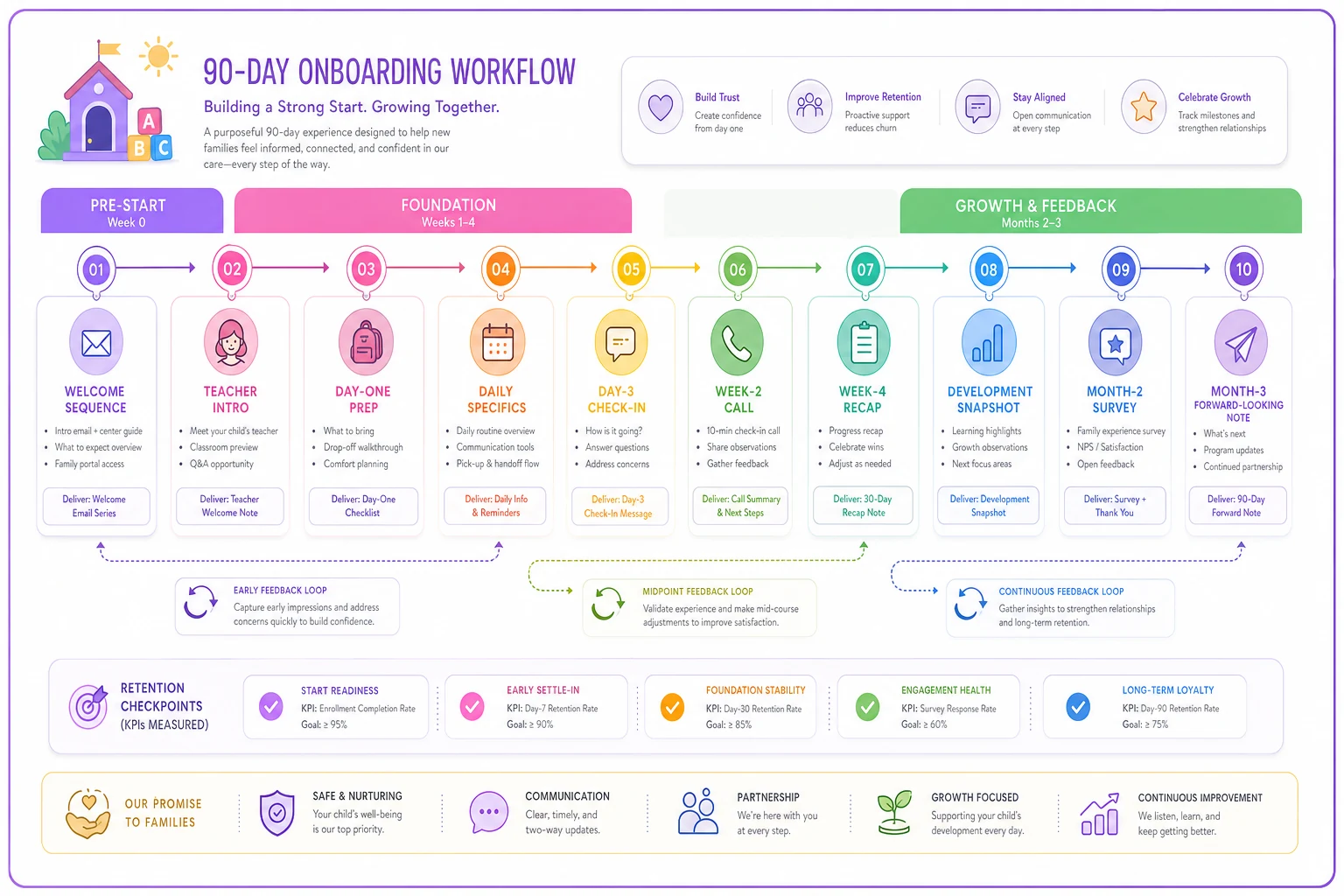
Use the timeline to plan which team owns each touchpoint and when you'll measure the key retention signals.
Week 0: The Pre-Start Window Most Centers Waste
The days between signing and the first drop-off are the cheapest trust you'll ever buy. The family already said yes. Your only job now is to make sure day one feels handled.
What to send, and roughly when:
-
Within 24 hours of enrollment — a warm confirmation that names the specific classroom and lead teacher. Not a generic "welcome to the family." Something like: "Maya's spot in the Sunflower Room is confirmed for her start on the 14th. Her lead teacher, Denise, has been with us four years and already has Maya's name on the cubby list." Specificity kills anxiety.
-
Three to four days before start — a "what day one looks like" note. When to arrive, what to pack, where to park, how drop-off tends to go, and one honest sentence about crying being normal. Parents who know their kid might cry — and that it's expected — don't panic when it happens.
-
A short intro from the actual teacher. Even two lines. A parent who has "met" the teacher, even just by message, walks in less guarded. This is the single most underused move in daycare onboarding, and it costs nothing.
Week 0 communication isn't really about information transfer. The parent already has the handbook. It's about making a nervous person feel expected. Being expected is a completely different feeling than being enrolled.
Weeks 1–4: Where Retention Is Actually Won or Lost
This is the stretch most centers underserve. The family is now living the reality daily, and every pickup is a small referendum.
The Daily Specific
For the first two weeks, the parent needs at least one concrete thing per day. Not "had a great day!" — every parent knows that's the default. Something real: "Maya ate all her peas today (shocking to us too) and figured out the shape sorter with the star piece." One specific detail does more for retention than a monthly newsletter.
If teachers are stretched, a shared simple logging sheet in the classroom where staff jot one observation per child makes daily specifics reliable without extra admin.
This doesn't require much — it requires classroom staff to jot one observation per child during the day. That's where it quietly falls apart when teachers are stretched. Centers that keep it consistent usually have some structured way for teachers to log a quick note that actually reaches the parent, rather than someone trying to write personalized emails at 5:45pm. The value isn't the system itself. It's that the specific detail reaches the parent every day instead of most days.
The Scripted Check-In Points
-
Day 3 — the quick pulse. A short message from the front desk or director: "How's the first few days feeling from your side? Anything Maya's mentioned at home, or anything you're wondering about?" This surfaces problems while they're still small. A mildly worried parent will tell you on day 3. By day 30, they've made up their mind quietly.
-
Week 2 — a real conversation. A two-minute call or a genuine at-pickup chat with the director, not a form. Ask specifically: is drop-off getting easier or harder? Is there anything that would make mornings smoother? Harder drop-offs at week 2 are a churn flag worth acting on immediately.
-
End of week 4 — the first recap. A short written summary
how the child is settling, one or two things they're enjoying, one thing the team is still working on with them. This is where the parent should feel seen as a partner, not just a customer.
The Feedback Loop That Actually Closes Collecting feedback is easy. The part centers skip is closing the loop visibly. If a parent mentions at the week-2 check that mornings are chaotic because of the coat area, and two weeks later someone tells them "we moved the cubbies after your note" — that parent is now much harder to lose. Acted-on feedback is one of the strongest retention signals there is.
Months 2–3: Turning "Settled" Into "Staying"
By now the child is comfortable and the parent has stopped worrying daily. Which is exactly when centers tend to relax — and where the second churn window quietly opens. The parent isn't anxious anymore, so if the center goes quiet, there's nothing keeping them emotionally invested. "Somewhere closer" or "a little cheaper" starts to sound more reasonable.
-
Around week 6–8 — a small development snapshot. Two or three specific things the child has grown into since starting. Parents stay where they can see growth they attribute to the center. That's your evidence that switching would cost their kid something.
-
Around month 2 — a short feedback survey, five questions max, with one open box. Include the question that most directly predicts churn: "How likely are you to recommend us to another family?" Anyone below the top tier gets a personal follow-up, not a thank-you email.
-
Month 3 — a forward-looking note. What's coming next for their child's group, any milestones on the horizon, a genuine "we're glad you're part of this" from the director. If your center runs re-enrollment cycles, this is the natural moment to plant that seed while the relationship is warm.
Month 2–3 churn is a neglect problem, not a quality problem. Families rarely leave a place where they feel their kid's progress is being tracked and acknowledged.
Retention KPIs Worth Tracking During the 90 Days
You can't manage early churn on instinct. A handful of numbers will tell you which families are drifting before they say anything.
-
90-day retention rate — what percentage of families who start are still enrolled at day 90. This is your headline number.
-
Time-to-first-specific-message — how fast a new family gets a concrete, personalized note after day one. Speed here correlates strongly with lower early drop-off rates.
-
Check-in completion rate — did the day-3, week-2, and week-4 touchpoints actually happen, or did they slip? Missed check-ins are early warning signs, not just admin oversights.
-
Feedback response and resolution rate — how many concerns got raised and closed during onboarding.
-
Drop-off difficulty trend — a simple teacher-logged "smooth / rough" note on morning arrivals, tracked over the first month.
A workable target for most centers: keep 90-day retention of new starts above the high-80s to low-90s percent range, and treat any new family with two consecutive rough drop-offs plus a skipped check-in as an at-risk flag that warrants a director conversation that week.
A Real Scenario
A mid-sized center — around 70 kids across five rooms — kept losing roughly three to four new families per quarter within the first two months. Enrollment was strong, so on paper things looked fine, but they were essentially refilling a leaky bucket and burning through tour capacity to do it.
The fix wasn't complicated. They built exactly the timeline above: a named-teacher welcome in week 0, one specific daily note for the first two weeks, scheduled day-3 and week-2 check-ins, and a month-2 survey with personal follow-ups on lukewarm scores. The biggest operational shift was making the daily specific consistent — teachers logged one quick observation per child during the day rather than hoping to piece together messages after closing.
Over the following couple of quarters, early departures dropped to roughly one per quarter, and the tone of pickup conversations shifted — parents were volunteering that they felt "in the loop." The director's own take was that they weren't caring for kids any better than before; they'd just stopped letting good care go unnoticed.
When a Formal 90-Day Script Is Overkill
This structure earns its keep at scale. If you're running a small in-home program with eight kids and personally handing off every child at pickup, you're probably already delivering most of this in person — formalizing it into scripts might just add busywork.
It also doesn't make sense to bolt this on if your underlying care has real problems. No onboarding sequence fixes chronic understaffing or a room with high teacher turnover. A smooth first month followed by three lead-teacher changes will still lose the family. Get consistency right first, then layer the communication rhythm on top.
Where it genuinely pays off: multi-room centers, anyone enrolling more than a handful of new families a month, and any center where the person who does the tour isn't the person who cares for the child. That handoff gap is exactly where structured, tracked onboarding does its best work.
The Takeaway
Early churn feels mysterious because the families who leave rarely tell you the real reason. But the mechanism is straightforward and fixable: uncertainty in the first 90 days that nobody replaced with confidence.
A pre-start welcome that makes families feel expected, a first month with specific daily proof that their kid is doing well, feedback you visibly act on, and a month-2/3 rhythm that shows growth — that's the whole game. You don't need more enrollments to grow if you stop losing the families you already earned.
Build the timeline, track the handful of numbers that predict drift, and act on at-risk signals while they're still small. The families deciding whether to stay are giving you signs every single week. The only real question is whether anyone at your center is set up to catch them.
Build the timeline, track the handful of numbers that predict drift, and act on at-risk signals while they're still small.
Ready to transform your daycare operations?
Join hundreds of daycare centers using Carexly to save time, improve communication, and enhance child care quality.