


Most daycare scheduling software treats ratios like a static number you punch in once. But anyone running a center knows the real challenge happens between 7:15 and 8:45 AM when parents drop off in waves, or during that 2-4 PM window when toddlers wake from naps while preschoolers need snack supervision and infants have staggered bottle schedules.
The math looks simple on paper. Infants need 1:4 ratios, toddlers 1:6, preschoolers 1:10. State regulations spell it out clearly. Yet centers consistently blow their payroll budgets trying to maintain compliance during transition periods while half their staff stands around during stable mid-morning blocks.
The problem isn't understanding ratios—it's mapping them to actual daily patterns. A center with 42 enrolled kids might need anywhere from 4 to 9 staff depending on the hour, but traditional scheduling treats every hour the same. That disconnect creates the two problems killing profitability: overstaffing during stable periods and panic-hiring floaters to cover transitions.
Why ratio breaks happen during predictable daily patterns
Centers typically see three distinct operational phases each day, and ratio requirements shift dramatically between them. Morning arrival spans roughly 6:30 to 9:00 AM, with families arriving in unpredictable clusters. One minute you have adequate coverage, the next minute three toddler families walk in simultaneously and suddenly you're scrambling.
The stable mid-day period from about 9:30 AM to 2:30 PM should theoretically be your most efficient staffing window. Kids are in their assigned rooms, activities follow predictable schedules, and ratio requirements stabilize. Yet many centers maintain peak staffing levels straight through lunch and nap time because they schedule in blocks rather than patterns.
Afternoon transition from 2:30 to 6:00 PM creates different pressure. Naps end at staggered times, older kids need homework help while younger ones need diaper changes, and early pickups create constantly shifting room counts. Standard 8-hour shifts that made sense on paper leave you either overstaffed or scrambling.
The regulatory piece makes this worse. State inspectors don't care that you were properly staffed 95% of the day—they care about that 15-minute window when you had 7 toddlers with one teacher. A single violation can trigger fines, reputation damage, and in severe cases, license suspension. Directors overstaff as insurance, destroying their margins in the process.
Traditional scheduling approaches fail because they assume static patterns. They slot teachers into standard shifts—opening, mid-day, closing—without accounting for the actual ebb and flow of children throughout the day. The result is either blown budgets from overstaffing or compliance risks from understaffing, with very few centers finding that profitable middle ground.
The hidden cost multiplication of poor ratio management
Take a typical 60-child center operating with traditional shift blocks. They schedule 12 full-time staff members across standard 8-hour shifts to ensure coverage. Simple math suggests this handles their ratios with room to spare. But their actual daily pattern might look like:
Eliminate administrative bottlenecks.
Carexly helps you manage enrollments, attendance, and staff schedules effortlessly.
- Streamlined child enrollment
- Automated parent notifications
- Staff shift and activity scheduling
No credit card required
6:30-7:30 AM: 8 children arrive (mostly infants/toddlers) 7:30-8:30 AM: 35 children present (mixed ages) 8:30-9:00 AM: Final 17 children arrive 9:00 AM-3:00 PM: Full enrollment, stable rooms 3:00-4:00 PM: 12 early pickups 4:00-5:30 PM: 31 children remain 5:30-6:00 PM: Final 17 children picked up
During that 6:30-7:30 AM window, you need maybe 2-3 teachers. But if you've scheduled standard 6:30 AM start times for your opening crew, you might have 5 teachers clocked in. That's 2-3 hours of unnecessary payroll every single morning.
The afternoon creates similar waste. If closing staff arrives at 2:00 PM for standard late shifts, you're potentially overstaffed from 2:00-4:00 PM while children nap or get picked up early. Those "just in case" hours add up fast.
Let's put real numbers on this. Unnecessary staffing of 3 teachers for 2 hours each morning and afternoon, at $15/hour, costs $180 daily. Across a 260-day operating year, that's $46,800 in pure waste. For a center with $600,000 annual revenue, you just lost nearly 8% of gross revenue to scheduling inefficiency.
But the real killer is when directors try to cut back and guess wrong. One surprise early arrival when you're running skeleton crew, one teacher calls in sick during transition time, one room has multiple behavioral incidents requiring additional support—suddenly you're out of ratio. The state fine might run $500-1,500 per incident. The reputation damage when parents see chaos costs far more.
Mapping age-group patterns to build ratio-compliant templates
The solution starts with understanding your center's actual flow patterns, not theoretical enrollment numbers. Most centers follow predictable arrival and departure curves that vary by age group. Infants typically arrive earlier (parents dropping off before longer commutes) and leave later. Preschoolers often have more varied schedules with part-time enrollment mixing with full-time.
Building templates that actually work:
-
70% of infants arrive by 7
45 AM
-
Toddler arrivals spike 8
00-8:30 AM
-
Preschool has two waves
early (7:00-7:30) and late (8:30-9:00)
Step 2: Calculate ratio requirements in 30-minute increments
| Time | Infants Present | Teachers Needed | Toddlers Present | Teachers Needed | Preschool Present | Teachers Needed | Total Staff Required |
|---|---|---|---|---|---|---|---|
| 7:00 AM | 4 | 1 | 3 | 1 | 5 | 1 | 3 |
| 7:30 AM | 8 | 2 | 9 | 2 | 12 | 2 | 6 |
| 8:00 AM | 11 | 3 | 15 | 3 | 22 | 3 | 9 |
| 8:30 AM | 12 | 3 | 18 | 3 | 28 | 3 | 9 |
| 9:00 AM | 12 | 3 | 18 | 3 | 30 | 3 | 9 |
Step 3: Design staggered shifts around transition points
-
Early opener
6:30 AM - 12:30 PM (handles initial arrivals)
-
Staggered opener A
7:00 AM - 3:00 PM (arrives as numbers build)
-
Staggered opener B
7:30 AM - 3:30 PM (covers main arrival rush)
-
Mid-day floater
8:30 AM - 4:30 PM (peak coverage period)
-
Afternoon transition
12:00 PM - 6:00 PM (handles lunch through pickup)
-
Staggered closer
2:00 PM - 6:00 PM (manages final pickups)
This staggering naturally builds coverage during high-ratio periods while avoiding overstaffing during stable blocks.
Here's a visual workflow for building the templates.
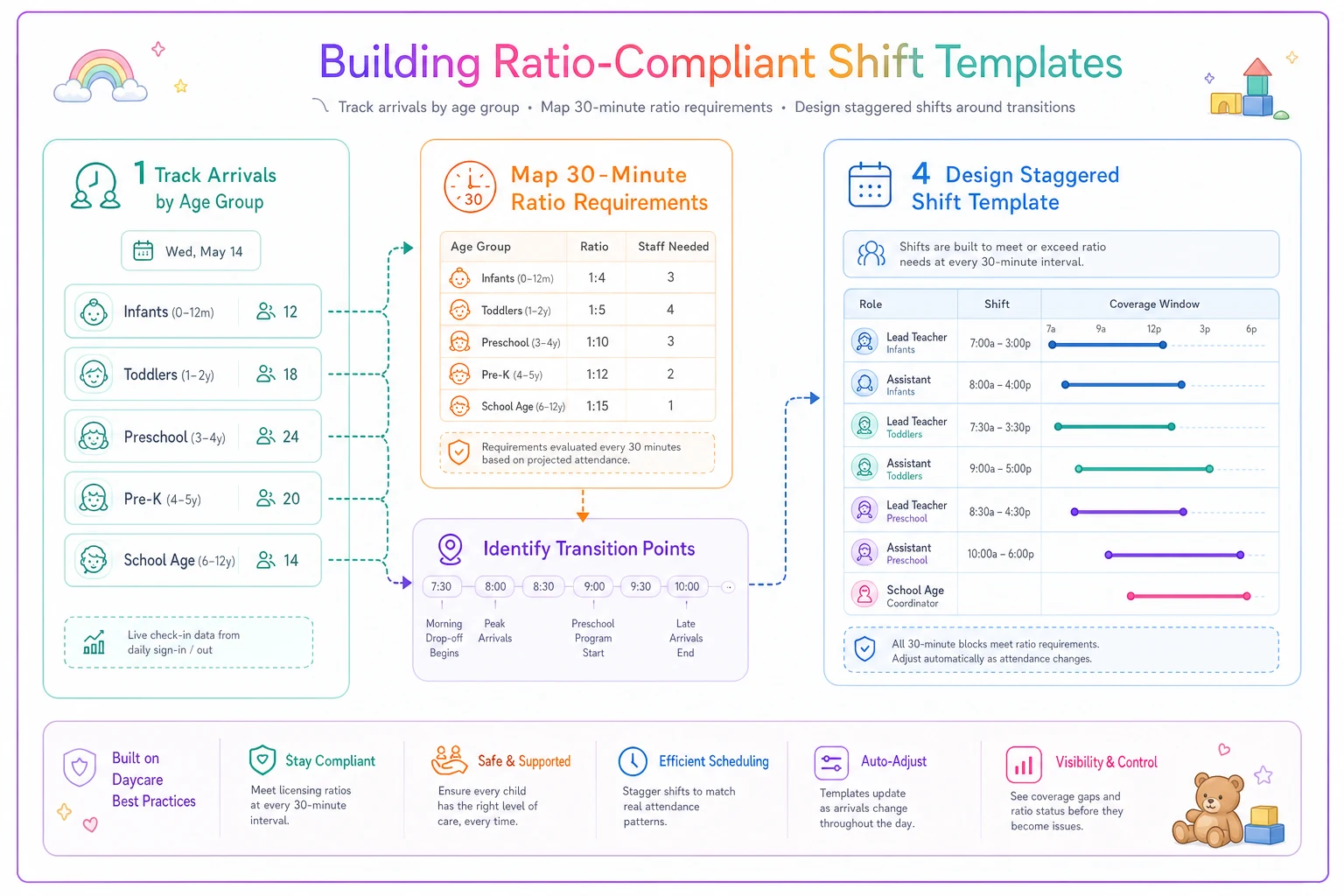
Use this to guide your template design and align shifts to real transitions.
Creating float positions that actually prevent violations
Float teachers often become expensive Band-Aids rather than strategic assets. Centers hire floaters to "help where needed" but without clear protocols, they end up doing busy work during calm periods or missing critical coverage moments because nobody communicated the need.
Effective float coverage requires explicit triggers and zones. Map out exactly when and where floaters deploy:
Morning float protocol (7:00-10:00 AM):
-
Primary zone
Infant room until 7:45 AM
-
Transition trigger
When toddler count exceeds 6, shift to toddler room
-
Secondary trigger
If preschool exceeds 20 before 8:30 AM, split time between toddler and preschool
-
Stable period assignment (9
00-10:00 AM): Prep activities, bathroom breaks for lead teachers
Afternoon float protocol (2:00-5:00 PM):
-
Nap coverage
2:00-3:00 PM, rotate through rooms as children wake
-
Transition support
3:00-4:00 PM, focus on toddler room during diaper changes and snack
-
Pickup assistance
4:00-5:00 PM, consolidate rooms as ratios allow
The key is making these movements systematic, not reactive. Floaters should know exactly where they're supposed to be at each time block based on typical patterns, with flexibility to adjust for unusual situations.
Some centers have found success with a "zone defense" approach where floaters own specific transitions. For example, one floater might specifically handle all bathroom breaks between 9:30-11:00 AM, rotating through rooms on a set schedule. This ensures lead teachers get breaks while maintaining ratios, and everyone knows exactly when relief is coming.
Calculating true utilization rates
Most centers track basic metrics like enrollment percentage or staff-to-child ratios, but these miss the real profitability drivers. True utilization means measuring how efficiently you're deploying staff hours against actual need.
Required Staff Hours = Sum of (Children present each 30 minutes ÷ Required ratio)
Actual Staff Hours = Total hours worked by all staff
Utilization Rate = Required Staff Hours ÷ Actual Staff Hours
A center might be 95% enrolled but only running 70% staff utilization because they're scheduling for peak moments instead of average flow. That 30% gap represents pure profit loss.
Track this weekly and you'll spot patterns. Maybe Tuesday mornings consistently run 60% utilization because several part-time families don't come that day. That's when you schedule staff training, deep cleaning, or curriculum prep—tasks that need doing anyway but usually require overtime or substitutes.
Real example: A 45-child center tracked utilization for a month and discovered their Thursday afternoon utilization was only 58% because of early pickups for swimming lessons and soccer practice. They shifted one teacher's Thursday schedule from 8:00 AM - 4:00 PM to 9:00 AM - 5:00 PM, maintaining compliance while cutting 8 weekly payroll hours. Annual savings: roughly $6,200.
When ratio-based scheduling makes sense (and when it doesn't)
This approach works best for centers with relatively stable enrollment and predictable patterns. If you have 40+ children with consistent attendance, the investment in mapping patterns and creating templates pays off quickly. The larger your center, the more dramatic the savings—a 100-child center might save $60,000-80,000 annually through better utilization.
Centers with highly variable enrollment need different strategies. If your daily attendance swings by 30% or more, rigid templates break down. These centers benefit more from flexible pool scheduling where part-time staff fill gaps as needed. The math gets more complex, but the principle remains: match staffing to actual need, not theoretical capacity.
Small centers under 30 children often can't achieve the economies of scale that make complex scheduling worthwhile. With only 4-5 total staff, the overhead of managing staggered shifts might exceed the savings. These centers do better with simple morning/afternoon splits and one reliable floater.
The regulatory environment matters too. Some states allow ratio averaging across age groups or have provisions for brief transition periods. Others require strict adherence every moment of operation. Know your specific requirements before building templates—what works in Texas might earn violations in Massachusetts.
Consider your staff pool as well. Staggered shifts work great in urban areas with robust public transportation. But if your teachers all drive 20-30 minutes to work, asking someone to come in for a 4-hour mid-day shift might mean constant turnover. Sometimes paying for slight overstaffing beats constantly recruiting and training new teachers.
Building sustainable templates your staff will actually follow
The best ratio-based schedule means nothing if teachers ignore it or directors can't maintain it. Implementation requires balancing operational efficiency with human needs.
Start by involving your lead teachers in pattern mapping. They know when their rooms get chaotic and when things calm down. Their buy-in makes the difference between a schedule that works on paper and one that works in practice.
Create simple visual references that show coverage throughout the day. A wall chart in the staff room displaying who's where and when prevents confusion during transitions. Color-code by room or role so everyone can quickly identify coverage gaps or overlaps.
Build in flexibility for real life. Teachers get sick, cars break down, children have meltdowns requiring extra attention. Your template should identify who can flex to cover common scenarios. Maybe your afternoon floater can arrive 30 minutes early if the morning floater calls in sick. Maybe lead teachers can temporarily combine rooms during bathroom breaks. Document these contingencies so substitute directors or assistant managers can maintain operations without you.
Rotate preferred schedules monthly or quarterly.
Fairness across your team matters. If certain teachers always get the "good" shifts (9:00 AM - 5:00 PM with full lunch break) while others constantly work splits or early mornings, resentment builds. Rotate preferred schedules monthly or quarterly. Let teachers trade shifts within reason as long as ratios remain covered.
The software piece becomes valuable here. Manual scheduling means constantly recalculating ratios as things change. Someone requests vacation, another needs to leave early for an appointment, enrollment shifts between rooms—suddenly your carefully planned template falls apart. AI-powered scheduling platforms can automatically adjust shifts while maintaining compliance, flagging potential violations before they happen. Instead of spending Sunday nights juggling spreadsheets, directors can focus on curriculum planning or family engagement.
These systems also track actual versus planned attendance, building better predictions over time. They notice patterns humans might miss, like how ratio requirements shift when specific children are absent (the child who requires constant one-on-one attention, for instance). That intelligence helps create increasingly accurate templates that reduce both overstaffing and compliance risk.
Making the math work for your center
The gap between theory and reality in daycare scheduling costs centers thousands monthly. Every hour you're overstaffed is money lost. Every ratio violation risks fines and reputation. But the solution isn't complicated—it's about matching your staffing to how children actually move through your center.
Start simple. Track your patterns for two weeks. Build one staggered shift template for your highest-volume day. Test it for a month and measure the impact. Most centers see immediate payroll reductions of 8-12% without any service quality loss.
The centers thriving despite tight margins aren't lucky—they're intentional about optimization. They know Tuesday afternoons run light so they schedule accordingly. They know arrival patterns by age group and build coverage to match. They treat scheduling as a strategic function, not an administrative task.
Whether you're mapping shifts manually or leveraging operational platforms to automate the process, the principle remains constant: your staffing should mirror your actual operational flow, not theoretical capacity. Make that shift, and watch both compliance rates and profit margins improve.
Ready to transform your daycare operations?
Join hundreds of daycare centers using Carexly to save time, improve communication, and enhance child care quality.