

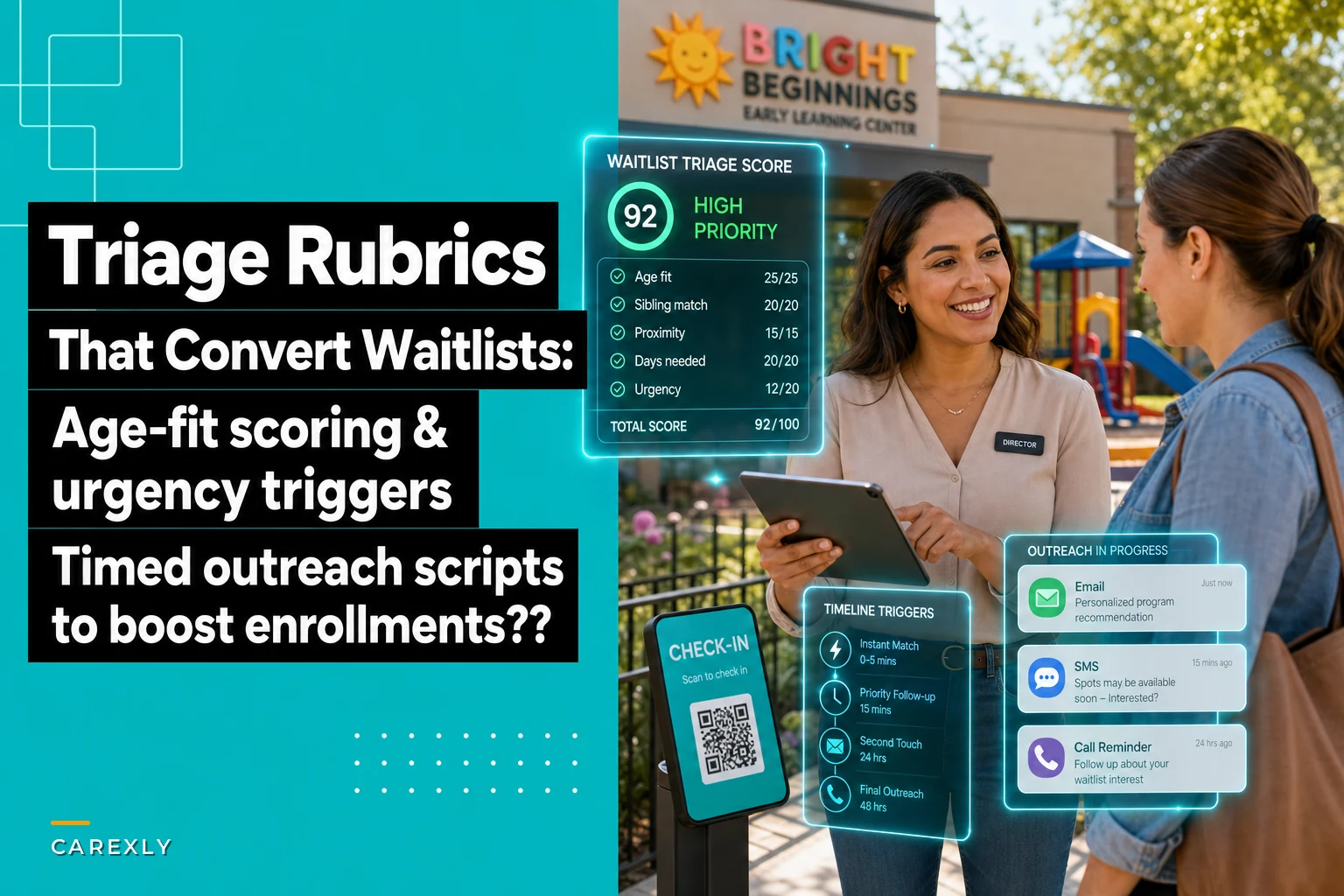

Every childcare center has a waitlist. But what separates centers converting most of their prospects from those stuck watching families disappear? They stopped treating their waitlist like a passive queue and started managing it like an actual enrollment funnel.
It's not about fancy marketing or discounts. Just scoring families properly, knowing when to reach out, and following up in a way that moves people from interested to enrolled.
Most centers lose families for totally preventable reasons. They wait weeks to follow up. They contact families who won't enroll for months while missing ones ready to start immediately. They send those "just checking in" emails that everyone ignores. They have no clue which families are serious versus just shopping around.
Why traditional waitlist management falls apart
The typical center waitlist looks familiar: an Excel sheet or paper list with family names, contact info, desired start date, maybe the child's age. When a spot opens, someone calls down the list until they find someone who'll take it.
This works fine with 20 families. Around 40-50, you start missing obvious matches. A family needing care in two weeks gets buried under 15 families not starting until fall. A sibling who should get priority placement sits at position #47. Someone willing to pay full tuition waits behind three families needing subsidies you don't have available.
The time drain gets ridiculous. Directors spend entire mornings managing waitlist communications. They make the same calls repeatedly because nobody can remember who they spoke with last week. Families get frustrated waiting months without updates, then enroll somewhere else. Rooms sit at 80% capacity because the "right" child for that Tuesday/Thursday toddler spot is sitting at position #32, and nobody got to them in time.
Treating your waitlist as a scored pipeline with automated triggers actually works. It's not complicated — just organized.
Building your triage scoring system
A working triage system assigns each family a priority score based on factors that predict enrollment likelihood and operational fit. The score determines their position in your outreach queue and which communication track they receive.
Eliminate administrative bottlenecks.
Carexly helps you manage enrollments, attendance, and staff schedules effortlessly.
- Streamlined child enrollment
- Automated parent notifications
- Staff shift and activity scheduling
No credit card required
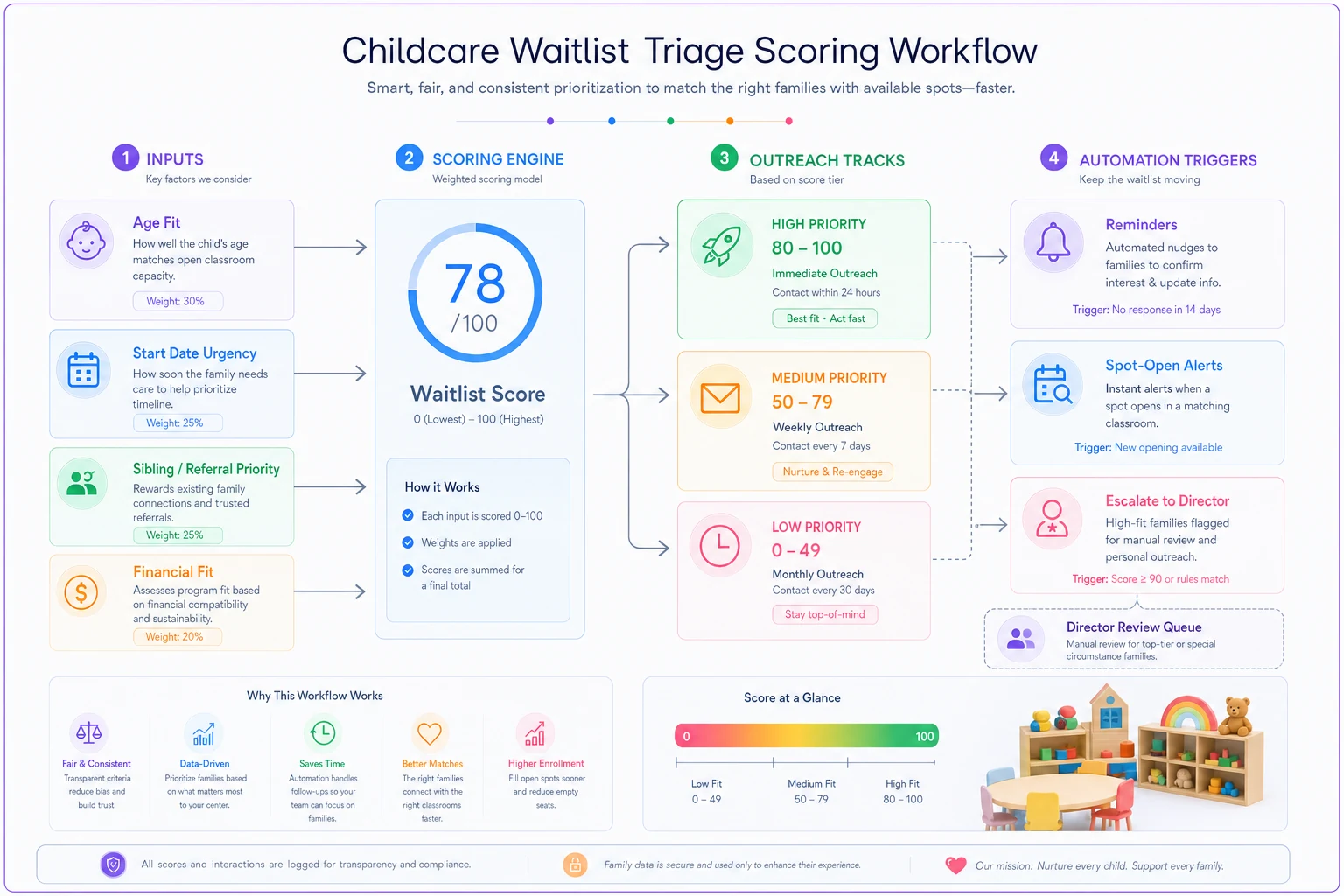
Age-fit scoring (0-40 points) Start with your current capacity gaps. If you have three open toddler spots but a full infant room, families with 18-month-olds score higher than those with 3-month-olds. Score based on immediate fit (40 points), fit within 30 days (30 points), fit within 60 days (20 points), or no current fit (0 points).
Start-date urgency (0-30 points) Families starting within 2 weeks: 30 points Starting within 4 weeks: 20 points Starting within 8 weeks: 10 points Starting in 3+ months: 0 points
Sibling/referral priority (0-20 points) Current family with sibling enrolling: 20 points Direct referral from current family: 15 points Alumni family returning: 10 points New family, no connection: 0 points
Financial fit (0-10 points) Full-pay private: 10 points Partial subsidy with copay: 5 points Full subsidy: 0-3 points (based on your subsidy capacity)
Add these four components for a 0-100 score. Families scoring 70+ get immediate outreach. Scores of 50-69 get weekly check-ins. Below 50 gets monthly updates unless their situation changes.
Here's a quick visual of the scoring-to-outreach workflow.
Most centers don't do this. They just work down their list chronologically, calling families with infants when they only have preschool spots available.
The outreach cadence that works
Even perfectly scored waitlists fail without consistent follow-up. Families forget they're on your list. Their needs change. They find other arrangements. You need a communication rhythm that keeps them engaged without being annoying.
-
Day 0 (Initial inquiry)
Immediate confirmation email with expected timeline
-
Day 7
Personal check-in call or text
-
Day 14
Availability update and program highlights
-
Day 30
Enrollment readiness check
-
Day 60
Final interest confirmation or removal notice
The key is matching message urgency to their timeline. Someone starting next week gets daily updates. Someone starting in six months gets monthly touchpoints.
Test sending Day 7 messages in evening instead of morning.
Track response rates at each stage. If families don't respond to the Day 7 check-in, their score drops 10 points. No response to Day 14? Another 10-point drop. This naturally filters engaged families to the top while letting tire-kickers sink.
Communication templates that actually get responses
Day 7 Check-in (Text preferred): "Hi Sarah! Following up on your interest in our toddler program starting Jan 15. We currently have 2 spots available for that date. Would you like to schedule a tour this week? I have Thursday at 10am or Friday at 3pm open." Notice: specific dates, specific availability, specific call-to-action. No vague "let me know if you're still interested" language.
Day 14 Update (Email with subject "Your spot status + what's new"): "Quick update on your January 15 start date: We still have availability and I'm holding a spot for Emma while you decide. Two things that might interest you:
-
We just added a new outdoor learning space (photos attached)
-
Our toddler teacher Ms. Jennifer just completed her nature-based curriculum certification
Current families starting in January are also enrolling in our optional music program (Tuesdays, $45/month). Should I add Emma to that list? Let me know if you'd like to tour or have questions. My direct line is 555-0100."
Day 30 Readiness Check (Call script): "Hi Sarah, quick call about Emma's January 15 start date. We're finalizing enrollment for that week and I wanted to check if you're ready to move forward. I can send the enrollment packet today and we'd just need it back by Friday to secure the spot. Should I send that over?" Binary choice. Clear deadline. Assumes the sale while giving an out.
High-urgency spot-opened message (Text, for scores 70+): "Hi! A spot just opened in our toddler room for immediate start. Based on your timeline, thought you'd want first dibs. Can you let me know by 5pm today? Otherwise I'll need to offer it to the next family." Real deadline. Real scarcity. Real opportunity.
Tracking what actually matters
You can't improve what you don't measure. Most centers track overall waitlist size but miss the metrics that actually drive enrollment.
| Metric | What to Track | Why it Matters |
|---|---|---|
| Conversion by Score | High-score families (70+) vs low-score (40-) | Validates scoring accuracy |
| Response Rate by Stage | Day 7, 14, 30 message response % | Identifies communication weak points |
| Time to Enrollment | Days from inquiry to enrollment | Measures process efficiency |
| Exit Reasons | Why families leave waitlist | Reveals competitive gaps |
Conversion rate by score tier should show high-score families converting at much higher rates. If they're not, your scoring model needs adjustment. Maybe you're overweighting age-fit when urgency matters more for your market.
Response rate by outreach stage tells you where families disengage. Day 7 messages should get most families to respond. Day 14 should still see decent engagement. Day 30 separates serious families from browsers.
Low response rates usually mean your messages are too generic or your timing is off. Test sending Day 7 messages in evening instead of morning. Try texts instead of calls.
Days on waitlist before enrollment/exit reveals process bottlenecks. If average time-to-enrollment exceeds 6-8 weeks, you're likely losing families to competitors with faster processes.
Score accuracy compares initial scores to actual enrollment. If families scoring 40-50 enroll at similar rates to those scoring 70-80, your scoring weights need recalibration.
Mistakes that kill conversions
Treating all waitlist positions equally — A family at position #3 who needs care in 6 months is less valuable than the family at position #15 who needs care Monday. Dynamic scoring fixes this.
Waiting for families to contact you — Families assume no news means no availability. They enroll elsewhere. Proactive outreach at set intervals keeps you top-of-mind.
Not tracking why families leave your waitlist — When someone says "we found other care," ask where and why. Was it faster enrollment? Lower price? Better location? This intelligence shapes your process.
Overpromising timeline — Telling everyone they'll likely get a spot "within 2-3 months" when your real timeline is 6+ months creates frustration. Give realistic estimates based on actual turnover data.
Not removing dead leads — Families who don't respond to three outreach attempts should be marked inactive. Keeping them inflates your waitlist and wastes outreach time.
When automation becomes essential
Manual waitlist management works until about 75 families, then becomes unsustainable. Beyond that, you need systematic help.
AI-powered operational software can automatically score families based on your criteria, trigger outreach at set intervals, track response rates, and escalate high-priority opportunities to directors. Instead of spending entire days on waitlist calls, directors spend 30 minutes reviewing automated reports and handling only the highest-value conversations.
The automation handles repetitive parts: sending Day 7 check-ins, updating families when spots open in their age group, removing non-responsive leads after three attempts. Your team focuses on tours, closing conversations, and relationship building — the human elements that actually drive enrollment.
For centers managing 100+ waitlist families, the difference is significant. Response rates increase because outreach happens consistently. Conversion rates improve because high-score families get immediate attention. Directors reclaim hours each week for program improvement instead of list management.
Making it stick
Your waitlist represents future revenue sitting idle. Every family on that list chose you over competitors, at least initially. They raised their hand. They want what you offer. Whether your process converts their interest into enrollment before someone else does is up to you.
Centers filling spots quickly don't have better programs or fancier facilities. They have better operational discipline. They score families systematically. They follow up consistently. They communicate clearly. They track what works and adjust what doesn't.
Stop treating your waitlist like a passive queue. Start treating it like the active revenue pipeline it should be. Score every family. Trigger outreach automatically. Track conversion by segment. Remove dead leads ruthlessly.
The math is straightforward: improving waitlist conversion on a 100-family list by even 15-20 percentage points means dozens of additional enrollments per year. At typical tuition rates, that's hundreds of thousands in additional annual revenue from families already interested in your program. You can implement a basic triage system this month or keep letting families slip away while you're "getting around to it."
Ready to transform your daycare operations?
Join hundreds of daycare centers using Carexly to save time, improve communication, and enhance child care quality.