



Walk into any daycare center during state inspection week and you'll see controlled chaos. The director digs through filing cabinets hunting for vaccination records from three months ago. Teachers abandon lesson plans to find emergency contact forms that should've been updated last quarter. Meanwhile, the assistant director discovers half the staff training certificates expired two weeks ago—something nobody noticed because Sarah tracks them in her planner, Marcus uses a spreadsheet, and the director thought the wall calendar in the break room was current.
This isn't incompetence. It's what happens when compliance documentation lives across seventeen different systems, three personal notebooks, and whoever remembers what needs doing when.
The real damage happens between inspections. Parents wait days for enrollment paperwork because nobody knows who has the latest forms. Staff meetings turn into arguments about whose job it was to update allergy lists. Teachers spend their planning periods filling out redundant incident reports because the morning shift and afternoon shift use different templates.
A center with 45 children and 12 staff members typically manages around 400 active compliance documents at any given moment. Medication authorizations, incident reports, daily health checks, cleaning logs, attendance records, emergency drills, staff certifications, child assessments, parent communications, licensing documents—all needing updates on different schedules by different people.
When I mapped out the documentation workflow at a mid-sized center in Ohio, we counted 73 distinct compliance tasks spread across daily, weekly, monthly, quarterly, and annual schedules. The director was personally responsible for remembering 31 of them. No wonder she worked until 7 PM every night.
Why traditional compliance systems break at exactly the wrong moment
Most daycare centers build their compliance systems backwards. They start with the state requirements checklist, create some forms, stick them in binders, and hope everyone fills them out correctly. Six months later, they're frantically preparing for inspection by reverse-engineering three months of missing documentation.
The fundamental problem: compliance gets treated as an event rather than an operational workflow. Centers prepare for inspections the way students cram for finals—massive effort, temporary success, immediate knowledge dump afterward.
In the weeks before inspection, the director sends panicked emails requesting updated certifications. Teachers stay late completing backdated observation forms. The cook suddenly discovers they never documented refrigerator temperatures for the past month. Parents receive urgent requests for immunization updates that should've been collected at enrollment.
This reactive scramble creates cascading operational failures. While staff chase paperwork, actual childcare quality drops. Lesson planning gets rushed. Parent communication becomes transactional. Professional development gets postponed. The center essentially stops improving to focus on proving they meet minimum standards.
The inspection passes, everyone celebrates, and within two weeks the same documentation gaps start forming again. The problem was never about meeting requirements—it was about lacking a sustainable system for maintaining compliance as part of daily operations.
Even well-run centers struggle when their documentation system depends on individual knowledge rather than defined processes. The lead teacher who always remembered to file incident reports within 24 hours goes on maternity leave. Her replacement doesn't know the requirement exists. Three months later, during inspection, the missing reports trigger a violation that threatens the center's license.
The multiplication effect: how 12 staff members create 73 compliance failure points
A typical daycare center operates with overlapping compliance responsibilities that nobody fully maps until something breaks. The director assumes teachers handle classroom documentation. Teachers think the assistant director manages staff records. The assistant director believes the director oversees everything licensing-related.
Eliminate administrative bottlenecks.
Carexly helps you manage enrollments, attendance, and staff schedules effortlessly.
- Streamlined child enrollment
- Automated parent notifications
- Staff shift and activity scheduling
No credit card required
Consider medication administration alone. Parent provides medication with written authorization. Front desk logs receipt and stores it properly. Lead teacher reviews instructions during morning briefing. Assigned teacher administers medication at specified time. Administration gets documented on medication log. Leftover medication gets returned to parent at pickup. Log gets filed for state records.
Seven steps, potentially four different staff members, multiple handoffs, zero room for error. Miss any step and you've created a compliance violation that could shut down your center.
Health and Safety Documentation
Daily health checks for 45 children require morning staff to complete observations within the first 30 minutes of arrival. But morning shift starts at 6:30 AM with two teachers handling drop-offs, breakfast prep, and upset children simultaneously. By 8 AM when the third teacher arrives, half the health checks are missing or incomplete. The afternoon shift has no idea which children were checked properly.
Staff Qualification Tracking
Twelve staff members each need current CPR certification, first aid training, mandated reporter training, annual professional development hours, background checks every five years, health screenings, and TB tests. That's 84 individual certifications with different expiration dates. The office manager tracks some in a spreadsheet. The director keeps others in personnel files. Several teachers manage their own. Nobody has a complete picture until something expires.
Incident and Accident Reporting
Every bump, scrape, bite, or behavioral incident needs documentation within 24 hours. But incidents happen during playground time when teachers juggle supervision ratios. The teacher who witnessed it might leave before completing paperwork. The afternoon teacher filling out the form wasn't present during the incident. Parents receive incomplete information. The state receives inaccurate reports.
Parent Communication Requirements
State regulations mandate specific parent notifications for everything from menu changes to curriculum updates to policy modifications. These requirements scatter across enrollment packets, parent handbooks, bulletin boards, email lists, and verbal communications. No single person owns the complete communication workflow. Messages get missed, parents feel uninformed, compliance suffers.
The multiplication happens because each task connects to multiple roles, each role handles multiple tasks, and nobody owns the complete workflow. A center with 12 staff members doesn't have 12 potential failure points—they have 73 or more, depending on how tasks overlap and handoffs occur.
Building an audit-ready workflow that runs itself
The solution isn't more forms or stricter policies. It's creating a compliance workflow that integrates into daily operations rather than interrupting them. This means assigning clear ownership, establishing sustainable schedules, and using templates that actually match how work gets done.
Start with role-based task assignment. Not "someone needs to check temperatures"—but "the opening cook checks and logs all refrigerator temperatures between 6:00-6:15 AM using the kitchen compliance tablet." Specificity eliminates confusion and creates accountability.
Assign tasks with exact windows (e.g., 6:00-6:15 AM) rather than vague timing to make handoffs auditable and measurable.
-
Morning Shift Lead Teacher (6
30 AM - 3:00 PM)
- Complete daily health checks for early arrivals (6:30-7:30 AM) -
Update attendance system by 9
00 AM
-
Document any overnight incidents reported by parents
-
Submit medication logs by 2
00 PM
-
Brief afternoon lead during 2
30 PM transition
-
Afternoon Shift Lead Teacher (10
00 AM - 6:30 PM)
- Review morning documentation for gaps -
Complete second attendance verification at 3
00 PM
-
Document all afternoon incidents before 5
00 PM
-
Prepare next-day compliance checklist
-
File all daily documents before close
-
Assistant Director
-
Monday
Review all previous week's documentation. Tuesday: Update staff certification tracker. Wednesday: Audit emergency contact forms. Thursday: Check parent communication compliance. Friday: Prepare weekly compliance report for director.
-
Director
-
Monthly
Review all compliance metrics with management team. Quarterly: Conduct internal compliance audit. Annually: Complete comprehensive compliance assessment.
This structure transforms compliance from a collection of random tasks into a predictable operational rhythm. Everyone knows their responsibilities, when they occur, and how they connect to the broader workflow.
Below is a simple workflow diagram showing role-based tasks, handoffs, and audit checkpoints to help visualize the process.
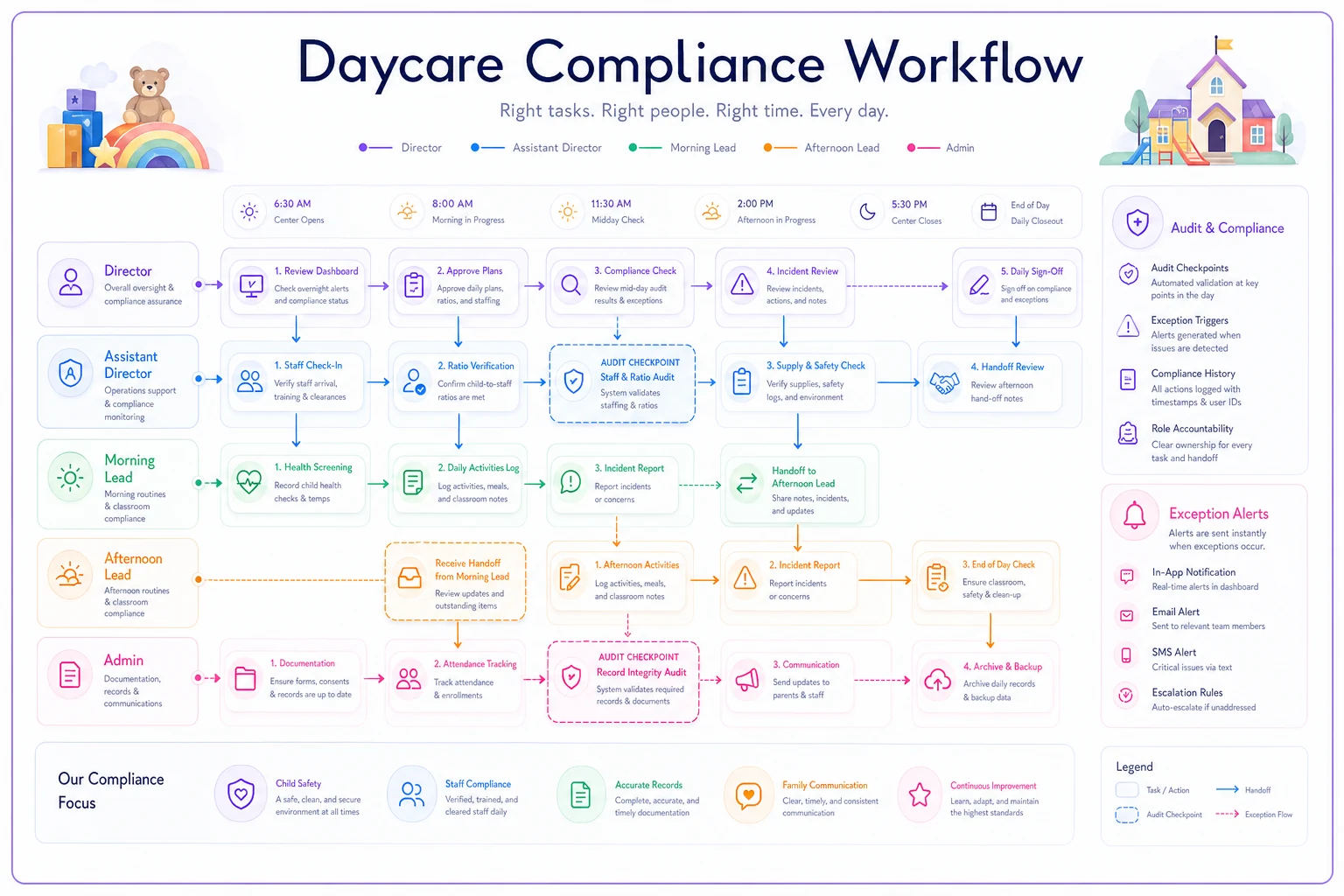
Use the diagram to map your center's tasks and identify where automated alerts and handoff confirmations are most needed.
Digital templates that match actual workflows (not theoretical ones)
Generic compliance templates fail because they assume perfect conditions. They expect teachers to write detailed narratives while managing twelve toddlers. They require directors to complete comprehensive assessments during enrollment rushes. They pretend documentation happens in quiet offices rather than chaotic classrooms.
Effective templates match the reality of when and how documentation actually occurs. A teacher supervising playground time needs a template they can complete on a tablet with one hand while maintaining visual supervision. A director conducting enrollment needs forms that auto-populate recurring information rather than requiring redundant data entry.
Traditional Incident Report Template:
Child's full name, date of birth, date of incident, time of incident, location (describe in detail), description of incident (narrative), witnesses present, actions taken, parent notification details, follow-up required, staff signature, director signature.
Workflow-Optimized Digital Template:
Child name (dropdown from enrollment system), incident type (quick-select buttons: fall, collision, bite, other), location (visual map selector), severity (green/yellow/red), immediate action (checkbox options), photo attachment option, parent notification (SMS/call/in-person toggles), quick voice note for details, auto-timestamp and staff ID.
The optimized version takes 30 seconds to complete accurately. The traditional form takes 10 minutes and often gets filled out hours later when details are fuzzy.
Digital templates should also enforce compliance workflows automatically. When a teacher submits an incident report marked "yellow" or "red" severity, the system immediately notifies the director and requires parent contact within one hour. No remembering required, no manual follow-up needed.
Creating your compliance assignment matrix
Building a comprehensive compliance workflow starts with mapping every documentation requirement to specific roles and schedules. This isn't about distributing work evenly—it's about aligning tasks with operational reality.
| Task Category | Responsible Role | Frequency | Time Required | Digital Tool Needed |
|---|---|---|---|---|
| Health Checks | Opening Teachers | Daily, 6:30-8:00 AM | 2 min/child | Tablet with checklist app |
| Attendance Verification | Lead Teachers | Twice daily | 5 minutes | Automated attendance system |
| Medication Administration | Designated Med Staff | As needed | 3 min/dose | Secure med log system |
| Incident Documentation | Witnessing Teacher | Within 1 hour | 2-5 minutes | Mobile incident form |
| Cleaning Logs | Assigned Area Staff | Per schedule | 1 minute | QR code checklist |
| Parent Communications | Admin/Director | Weekly/As needed | 15-30 minutes | Automated messaging |
| Certification Tracking | Assistant Director | Weekly review | 30 minutes | HR compliance dashboard |
| Regulatory Updates | Director | Monthly | 2 hours | Compliance tracking system |
Notice how each task includes not just who and when, but realistic time requirements and specific tools. This prevents the common mistake of assigning tasks without providing the means to complete them efficiently.
The cascade failure pattern: why one missing document threatens everything
Compliance violations rarely happen in isolation. One missing document typically triggers a cascade of related failures that compound during inspection. Understanding these cascade patterns helps you build redundancies into your workflow.
A real example from a center in Pennsylvania: A teacher's CPR certification expired in January. The center didn't notice because they only checked certifications quarterly. In March, that teacher was alone with children during naptime when another staff member called in sick. This created a ratio violation because uncertified staff can't be counted for supervision requirements.
During inspection in April, the investigator discovered not just the expired certification, but also three months of invalid ratio documentation, failure to maintain qualified staff requirements, inadequate coverage during high-risk periods, missing documentation of the violation in internal reviews, and no corrective action plan on file.
What started as one expired certificate became five major violations that nearly cost them their license.
These cascades happen because compliance requirements interconnect. Staff certifications affect ratios. Ratios affect supervision plans. Supervision plans affect activity permissions. Activity permissions affect parent consent requirements. Pull one thread and the entire fabric unravels.
Your workflow needs circuit breakers that stop cascades before they spread. When a certification approaches expiration, multiple alerts go to different people. When ratios drop below requirements, activities automatically adjust. When documentation gaps appear, the system prevents dependent tasks from proceeding until resolved.
When "good enough" compliance becomes a liability lawsuit
Directors often ask me what level of documentation is "good enough" to pass inspection. Wrong question. The right question is what level of documentation protects you when something goes wrong—because eventually, something will.
A toddler breaks their arm on the playground. Parents sue claiming inadequate supervision. Your defense depends entirely on documentation showing proper ratios, equipment inspections, staff positioning, and incident response. "We usually maintain proper ratios" means nothing without timestamped records proving it that specific day at that specific time.
A child has an allergic reaction despite dietary restrictions on file. The investigation examines not just the allergy form, but the entire communication chain—from enrollment to kitchen to classroom to serving. One missing link in that documentation chain shifts liability to your center.
Compliance documentation isn't just about meeting state minimums. It's about creating an audit trail that demonstrates professional operation and reasonable care. This protection only exists if your documentation is contemporaneous, complete, consistent, and credible.
This level of documentation only happens through systematic workflow, not heroic individual effort.
The technology stack for a bulletproof compliance system
Managing compliance through paper forms and Excel sheets guarantees failure at scale. But throwing technology at the problem without proper workflow design just digitizes chaos. Choose tools that enforce your compliance workflow rather than just storing documents.
A functional compliance technology stack for a 45-child center might include a base layer child management system that centralizes enrollment data, attendance tracking, and parent information. A documentation layer with digital forms platform replaces paper forms with mobile-friendly templates. A communication layer maintains audit trail of all parent communications. A monitoring layer compliance dashboard aggregates all documentation into real-time compliance status. A workflow layer task management system assigns compliance tasks based on role and schedule.
The integration between layers matters more than individual features. When a parent updates their emergency contacts in the engagement app, the change should flow through to attendance sheets, emergency cards, and authorized pickup lists automatically. When a teacher documents an incident, parent notification, internal review, and regulatory reporting should trigger without manual intervention.
This connected approach transforms compliance from a series of discrete tasks into an integrated operational workflow. Staff stop thinking about compliance as extra work because it's embedded in their daily routine.
From inspection panic to operational excellence
The difference between centers that panic before inspections and those that barely notice them isn't about having better staff or more resources. It's about building compliance into operational workflow rather than treating it as an add-on requirement.
When compliance becomes part of daily rhythm, several transformations occur: Staff stress decreases because everyone knows their responsibilities and has tools to meet them efficiently. Instead of dreading documentation, they complete it naturally as part of their routine.
Parent satisfaction improves because communication becomes consistent and reliable. They receive timely updates, accurate information, and proper notifications without having to chase staff for answers.
Actual care quality increases because time previously spent scrambling for paperwork gets redirected to children. Teachers focus on teaching. Directors focus on leading. Everyone focuses on their actual job rather than compliance theater.
Most importantly, the center builds institutional knowledge that survives staff turnover. New employees inherit a functional system rather than tribal knowledge. The workflow continues regardless of who's present on any given day.
Making the transition without disrupting operations
The path from compliance chaos to systematic workflow can't happen overnight without disrupting operations. Centers need a staged approach that builds momentum without overwhelming staff.
Start with one critical workflow—usually medication administration or incident reporting since these have immediate safety implications and clear regulatory requirements. Design the role assignments, create the templates, implement the tools, and run it for a month before adding the next workflow.
A center in Michigan restructured their compliance system over four months. Month 1: Implemented digital incident reporting. Reduced documentation time by 75% and eliminated parent notification delays. Month 2: Added medication administration workflow. Achieved 100% documentation compliance and zero medication errors. Month 3: Launched certification tracking system. Discovered three expired certifications they'd missed and prevented four upcoming expirations. Month 4: Integrated parent communication workflow. Parent satisfaction scores increased 22% due to consistent, timely updates.
By month five, they passed their inspection with zero violations for the first time in three years. More importantly, maintaining compliance required less effort than their old system of inspection cramming.
The ROI calculation most directors miss
Directors often resist systematic compliance workflows because they see only the costs—software subscriptions, training time, process changes. They miss the massive hidden costs of reactive compliance management.
Consider the real numbers from a 50-child center: Director spending 10 hours weekly on compliance tasks costs roughly $15,000 annually. Teachers spending 5 hours weekly on redundant documentation costs another $18,000 annually. Last-minute inspection preparation with overtime and temps runs about $3,000 per inspection. One moderate violation fine ranges from $500-2,000. Reputation damage from public violations is unmeasurable.
Against those costs, a comprehensive compliance workflow system running around $300 monthly seems reasonable. But the real value isn't cost savings—it's operational transformation that creates sustainable growth.
Against those costs, a comprehensive compliance workflow system running around $300 monthly seems reasonable. But the real value isn't cost savings—it's operational transformation that creates sustainable growth.
Ready to transform your daycare operations?
Join hundreds of daycare centers using Carexly to save time, improve communication, and enhance child care quality.