

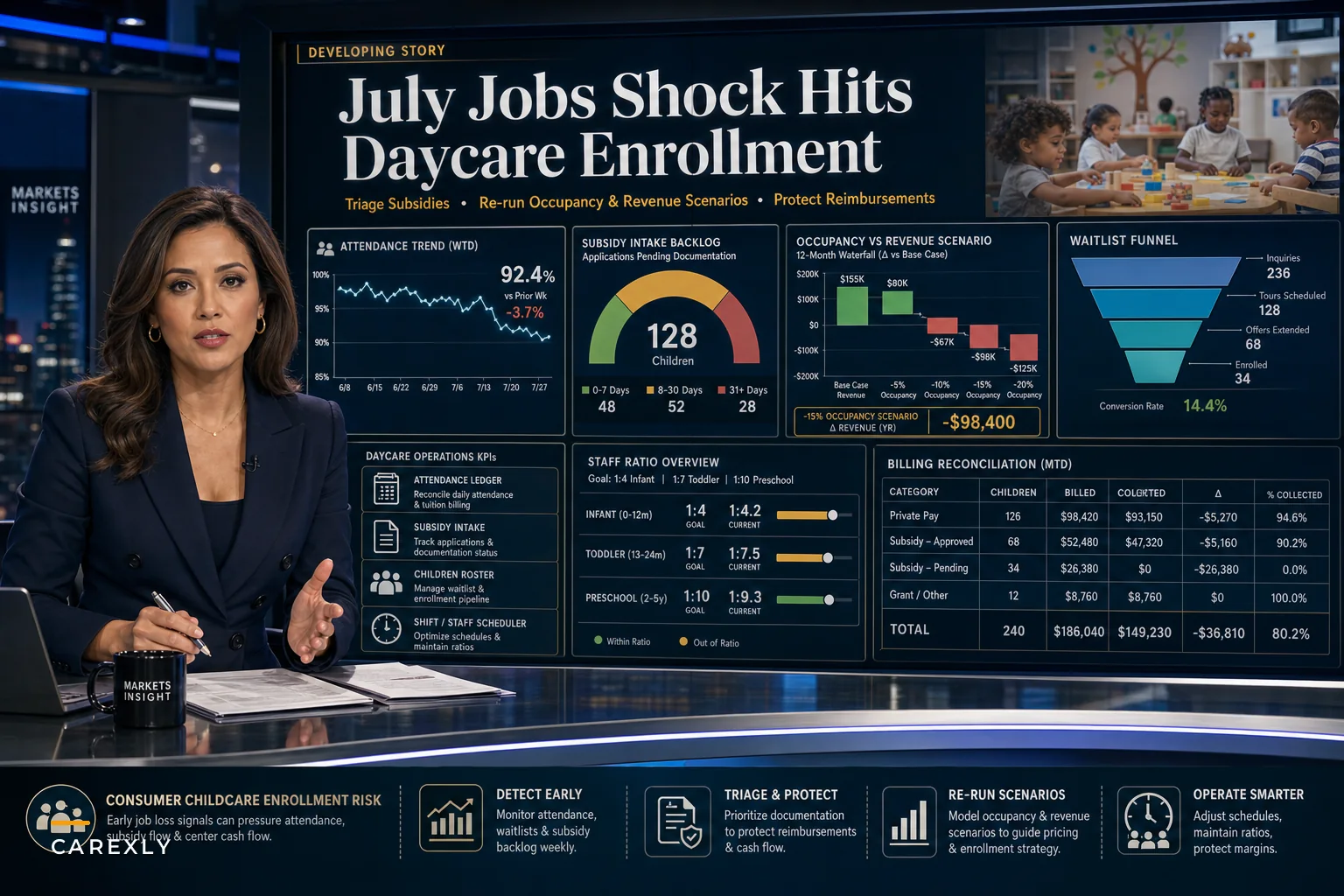

The July jobs report caught almost everyone off guard. Nonfarm payrolls fell by 23,000 — the first outright decline in a while — and while the unemployment rate actually eased slightly, the drop in participation is what matters for anyone running a childcare center. Reuters noted that the softening looks less like a temporary blip and more like households genuinely pulling back. CNBC's coverage framed it as a cooling labor market rather than a crash — which is honestly the more dangerous scenario for daycares, because slow bleeds are harder to catch than sudden shocks.
Here's why this lands on your desk faster than almost any other small business. A parent who loses hours, gets furloughed, or shifts to part-time doesn't wait until end of quarter to change their childcare arrangement. They call you within a week or two. They ask to drop from five days to three. They ask about your subsidy paperwork. They quietly stop showing up on Fridays. The revenue forecast you built in June is already wrong — you just don't know by how much yet.
This isn't a piece about the economy. It's about the specific operational scramble you should run right now to figure out how exposed you actually are before that exposure turns into a cashflow surprise.
The forecast you're running is probably lying to you
Most centers forecast revenue off enrollment headcount. That's the flaw. Headcount is a lagging, blunt number. It tells you who's technically enrolled — not who's paying full tuition, who's on reduced hours, who's 30 days behind, or whose employment situation just changed.
When the labor market softens, the gap between "enrolled" and "actually generating revenue" widens fast. A center can hold steady at 82 kids on the roster and still watch monthly revenue slide by several thousand dollars because the mix underneath shifted — full-time to part-time, private-pay to subsidy, on-time to payment-plan.
Childcare enrollment risk almost never shows up as a wave of formal withdrawals. It shows up as erosion inside your existing roster. That's the part owners consistently underestimate.
A useful way to think about it: your enrollment number is a photo, but your revenue is a video. Right now you need the video.
The three erosion patterns that show up first
-
Hour reduction requests. Parents ask to drop days before they withdraw entirely. This is the earliest signal and the easiest to miss because the child is still on your roster.
-
Subsidy inquiries from existing private-pay families. A family that never needed assistance suddenly asks about your paperwork. That's an employment-status change in disguise.
-
Payment timing slippage. Invoices that used to clear on the 1st start clearing on the 8th, then the 12th. Aging receivables creep before anyone formally asks for a payment plan.
If you're only watching for withdrawal notices, you're watching for the last stage of a process that's already three steps along.
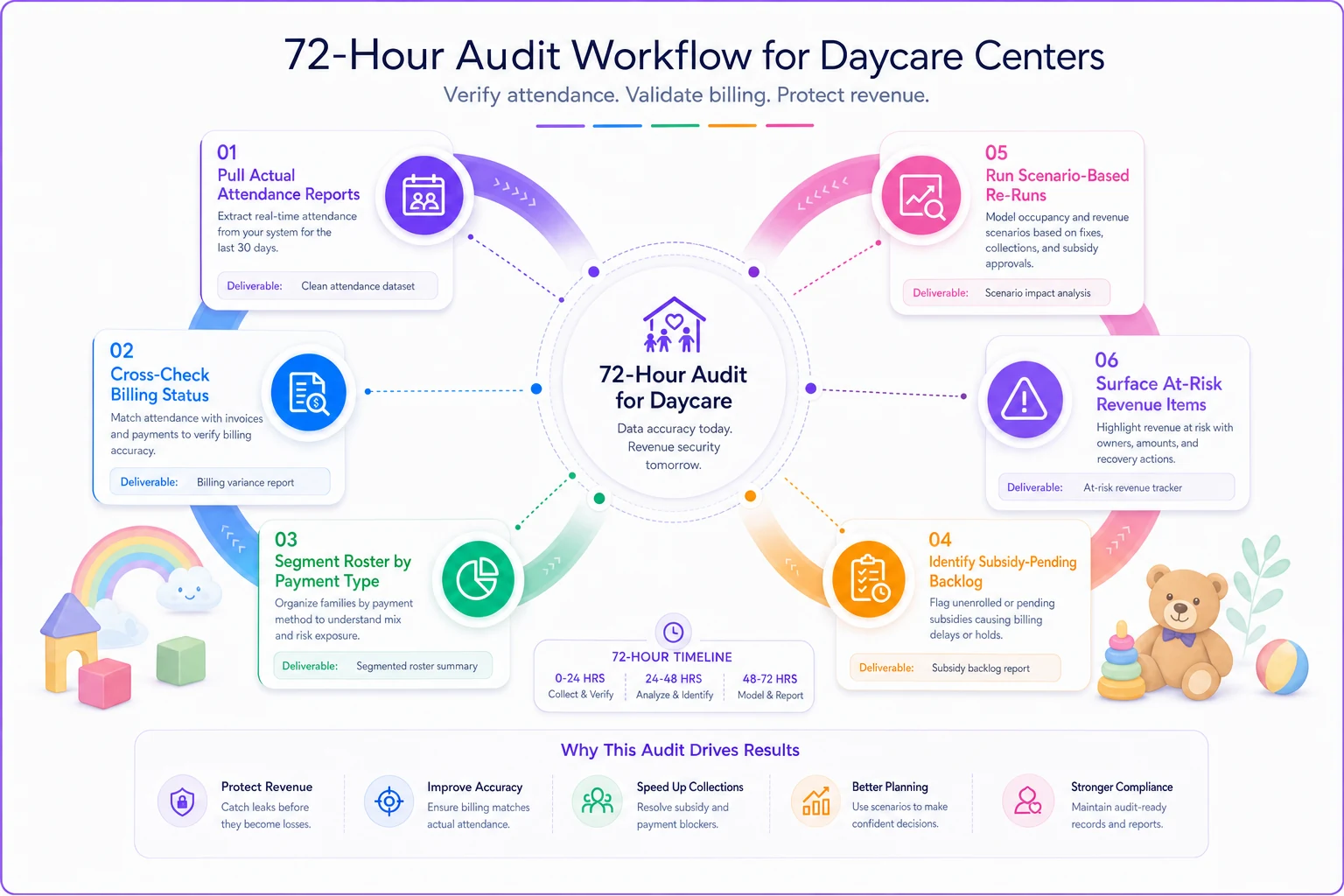
Run a 72-hour enrollment and revenue audit
You don't need a full financial review. You need a fast, structured pass across three data sets — enrollment, billing, and subsidy — reconciled against each other. The goal isn't precision to the dollar. It's finding the mismatches, because that's where the risk hides.
Eliminate administrative bottlenecks.
Carexly helps you manage enrollments, attendance, and staff schedules effortlessly.
- Streamlined child enrollment
- Automated parent notifications
- Staff shift and activity scheduling
No credit card required
-
Pull an actual-vs-enrolled attendance report for the last 30 days. Not scheduled attendance — actual. Flag any child attending fewer days than their contract states. Those are your silent hour-reductions.
-
Cross-check billing status against that list. Any child in the "attending less than contracted" group who's also aging past 30 days is a compound risk. Prioritize those families for outreach today.
-
Segment your roster by payment type. Private-pay full-time, private-pay part-time, subsidy, and subsidy-pending. You want to know exactly what share of revenue sits in each bucket, because each bucket reacts to a downturn differently.
-
Identify your subsidy-pending backlog. Every family stuck in "pending" is revenue you've likely already delivered service against but haven't been paid for. In a downturn, this backlog balloons — more families apply, approvals slow down.
-
Re-run occupancy against three scenarios, not one.
A simple three-scenario revenue table
Don't forecast a single number. Build a range so you can see how much room you actually have before margins break.
Visualize the 72-hour audit workflow to help teams run it quickly.
| Scenario | Assumption | Effect on monthly revenue | What it triggers |
|---|---|---|---|
| Hold | No further hour reductions; subsidy approvals stay on pace | Roughly flat | Normal operations |
| Soft slide | ~10–15% of full-time families drop to part-time; subsidy approvals slow | Down about $4k–$7k/mo for a mid-size center | Waitlist activation, schedule tightening |
| Sharp slide | Hour reductions plus 3–5 withdrawals plus a growing subsidy-pending backlog | Down $10k+/mo | Staffing re-plan, cashflow buffer review |
The exact dollars depend on your size and rates. The point of the table isn't the numbers — it's forcing yourself to name the triggers before you hit them, so you're not improvising when a family calls.
The subsidy intake problem gets worse exactly when you need it most
A softening labor market does two things at once: it increases subsidy demand and it slows subsidy processing, because the agencies handling those applications get flooded too. So the families who most need help to stay enrolled are the ones stuck longest in "pending" — and you're carrying the cost of their care while the reimbursement sits in a queue.
Treat your subsidy intake process as a front-line retention tool right now, not a back-office chore.
If a family's application bounces back for a missing income document or an expired eligibility form, that's not a paperwork annoyance anymore. That's a family who might withdraw and a reimbursement you may never collect for services already delivered. Clean intake means faster approvals, which means families stay, which means your revenue holds. If your intake checklist is loose — if it depends on one staff member remembering which documents which agency wants — this is the week to tighten it. The mechanics of building an intake process that actually passes audits and doesn't leak reimbursements are worth working through carefully; there's a full breakdown in this subsidy intake checklist that pairs well with what you're doing here.
A quick subsidy-readiness checklist
-
Income verification current and matching the agency's required format
-
Eligibility/redetermination dates flagged 30 days ahead of expiration
-
Attendance records reconciled with what's been submitted for reimbursement
-
One named owner per application — someone accountable for follow-up, not "the front desk"
-
A weekly review of every application older than 14 days
The families you save from falling out of the subsidy pipeline are usually cheaper to keep than the ones you'd have to replace off a cold waitlist.
A real scenario
A mid-size center — around 70 kids, mostly private-pay with a smaller subsidy segment — noticed something odd in late summer. Enrollment looked stable on paper. But their bookkeeper flagged that monthly revenue had dipped roughly $5k over two months with no formal withdrawals to explain it.
When they ran the actual-vs-contracted attendance pass, the picture cleared up fast. About nine families had quietly shifted from five days to three or four. Two more were riding 40-plus days past due. And their subsidy-pending pile had grown from a handful of applications to over a dozen, several stalled on a single missing income form. None of that showed up in headcount. All of it showed up in the bank account.
Once they had the actual list, the response was pretty straightforward: they called the hour-reduction families directly to understand what was happening — a couple came back to full-time once offered a slightly flexible schedule — chased the two document-blocked subsidy apps to completion within the week, and activated their waitlist to backfill classrooms that now had capacity. Revenue recovered most of the gap within about six weeks. Not because the market improved, but because they finally had accurate information to act on.
They weren't losing families to a crisis. They were losing revenue to a blind spot.
Where centralized data stops being optional
The reason most centers can't run the audit above quickly is that their information lives in four places. Attendance in one system, billing in another, subsidy paperwork in a shared drive or a filing cabinet, and the real-time truth about a family's situation in a director's head.
When you have to manually reconcile all of that to answer a simple question — how much of our revenue is actually at risk this month? — you can't do it fast enough to matter. By the time you've stitched the picture together, another family has already dropped days.
This is the genuine case for AI-assisted operational software in a childcare setting: not flashy automation, just enrollment, attendance, and billing reconciled in one place so that when actual attendance drifts from a contract, or a subsidy application stalls past two weeks, the system surfaces it instead of waiting for someone to notice. In a stable market you can get away with manual reconciliation. In a cooling one, the lag between "something changed" and "we noticed" is exactly where the money leaks out.
The value isn't the technology. It's compressing the time between a family's situation changing and you knowing about it.
When this level of monitoring makes sense — and when it doesn't
If you're a single center under 30 kids, mostly private-pay, with a director who genuinely knows every family's situation, a tight weekly manual review may be enough. You probably don't need heavy tooling — you need discipline and a recurring calendar block.
If you're running 60-plus kids, multiple classrooms, or a meaningful subsidy segment, manual reconciliation is where risk accumulates unseen. That's the profile where centralized, monitored data pays for itself — and where a downturn is most likely to catch you flat-footed.
Multi-site operations are a different problem entirely. Doing this manually across locations during a soft market is close to impossible. You simply can't hold three centers' revenue-at-risk picture in your head at once.
What to actually do this week
Don't wait for "more clarity" from the economy. The clarity you need is inside your own data, and it's already there.
Pull the actual attendance report. Reconcile it against billing. Segment your roster by payment type. Get eyes on your subsidy-pending backlog and clear the ones blocked by a single document. Build the three-scenario forecast so you know your triggers before you hit them. Then call the families showing early erosion signals — the hour-reductions and the slow payers — before they make a decision without you.
A cooling labor market doesn't have to translate into a revenue problem for your center. But it will if you're forecasting off headcount and finding out about erosion only when the withdrawal notices arrive. The centers that come through soft markets in decent shape aren't the ones with the most families. They're the ones who see the change first and move while there's still room to move.
Ready to transform your daycare operations?
Join hundreds of daycare centers using Carexly to save time, improve communication, and enhance child care quality.