


Most reimbursement losses don't happen at billing. They happen weeks earlier, at the intake desk, when a family enrolls with a subsidy and half the required documents never make it into the file. By the time the state runs its eligibility check or an auditor pulls the folder, the missing income verification or the expired authorization letter isn't fixable — it's a clawback.
If you run a center that takes state childcare subsidies, CCDF vouchers, county assistance, or any patchwork of local funding programs, you already know the rules don't line up neatly. One program wants proof of income re-verified every six months. Another wants it annually. One counts the authorization start date; another counts the date you received the notice. A solid daycare subsidy intake checklist isn't about paperwork for its own sake — it's the thing standing between you and money you already earned by providing care.
This is the piece most centers skip, because it feels administrative and low-stakes until a $9k recovery notice shows up.
Why fragmented rules quietly break your intake
Subsidy rules feel fragmented because they are fragmented. You're not dealing with one payer — you're dealing with several, each with its own documentation window, redetermination cycle, and definition of "complete."
Here's how it actually falls apart in a real center:
A family enrolls mid-month with a county voucher. Your front desk collects the authorization letter and gets the child into the classroom the same day, because that's the priority and that's the humane thing to do. The income verification is "coming next week." The parent's work schedule form is verbal — they said 32 hours, nobody wrote it down in the required format. Three weeks pass. The child is attending, meals are served, staff time is allocated. Then the county runs its check and finds the authorization only covers 25 hours a week, not full-time. You've been billing full-time for three weeks.
Nobody made a big mistake. The intake person did what intake people do — they prioritized getting the kid enrolled. The fragmentation did the rest. Different programs use different clocks, and when your intake process treats them all the same, you inherit the gaps.
The pattern that shows up most often: centers have a strong enrollment process and almost no documentation deadline process. Enrollment ends when the child walks in. Documentation, from the payer's point of view, is only just beginning.
What a real reimbursement loss looks like
A mid-size center — around 90 slots, maybe 60 of them subsidy-funded across two county programs — ran fine for years on a shared spreadsheet and a filing cabinet. No single person owned the subsidy files. The director "kept an eye on it."
Eliminate administrative bottlenecks.
Carexly helps you manage enrollments, attendance, and staff schedules effortlessly.
- Streamlined child enrollment
- Automated parent notifications
- Staff shift and activity scheduling
No credit card required
When the state did a routine records review, they sampled 20 subsidy files. Six were missing current income verification. Four had authorization letters that had expired one to two months earlier but the child was still attending and still being billed. Two had no signed parent work-schedule attestation at all.
The recovery came out to roughly $11k–$13k across the flagged period, plus the center landed on a heightened-monitoring list, which meant more frequent reviews for the next year. The actual care was never in question. The kids were there, the staff was there, the service was delivered. They lost the money purely because the file couldn't prove eligibility at the moment the payer checked.
That's the part owners underestimate. In subsidy work, undocumented is functionally the same as ineligible.
The minimum-data intake form (collect less, but collect the right things)
The instinct after a bad audit is to collect everything. That backfires. Long intake forms slow down enrollment, annoy families, and create more fields nobody fills in correctly. The goal is a minimum-data set — the smallest number of fields that actually satisfies every program you accept.
-
Child identity + DOB (drives age-group ratio and rate)
-
Subsidy program name + case/authorization number
-
Authorization start date AND end date (the end date is what you'll trip on)
-
Authorized hours/units per week (not "full-time" — the actual number)
-
Parent/guardian income verification type + date received
-
Redetermination due date (calculate this at intake, don't wait for a notice)
-
Parent work/school schedule attestation (signed, in the format the program accepts)
-
Effective date of care vs. effective date of authorization (these differ constantly)
The single most valuable field is the redetermination due date, calculated at intake. Most centers store the authorization end date and then act surprised when it lapses. If you compute the redetermination window the day the child enrolls, you've turned a reactive scramble into a scheduled task.
The single most valuable field is the redetermination due date, calculated at intake.
Build one intake form that captures the union of all your payers' requirements, not a separate form per program.
Documentation deadlines: put a clock on every missing item
Enrollment and documentation should run on separate clocks. A child can start care before every document is in — that's often necessary and sometimes required — but every missing item needs a hard internal deadline, not "when the parent gets around to it."
A workable rule set:
| Document | Internal deadline | What happens if missed |
|---|---|---|
| Authorization letter | Before first day of care | No care until received (or documented pending status) |
| Income verification | Within 7 days of start | Escalate to director; flag billing as "at-risk" |
| Work/school attestation | Within 7 days of start | Escalate; hold retroactive billing |
| Redetermination packet | 30 days before auth end | Begin renewal outreach |
| Updated income (if changed) | Within 5 days of reported change | Re-verify authorized hours |
The internal deadline matters more than the program deadline. If the program gives you 30 days and you tell yourself 30 days, you'll submit on day 30 with no margin. Set your internal clock tighter so a missed handoff still leaves room to recover.
Where centers slip: they track the program's deadline instead of building in a buffer. When the parent goes quiet for two weeks — which happens constantly — a 30-day program window with a 30-day internal target leaves you zero room. A 30-day window with a 20-day internal target leaves you ten days to chase.
Handoff triggers: the moment intake becomes billing's problem
Most reimbursement leaks happen in the silent zone between "the family enrolled" and "billing started charging." Nobody explicitly hands the file off, so billing charges based on whatever's in the system, which may be incomplete or wrong.
Define explicit handoff triggers — specific events that move a file from one owner to the next:
-
Intake → Verification triggered when the child's first day is scheduled. Verification owner now owns chasing missing docs.
-
Verification → Billing triggered only when the minimum-data set is complete AND authorized hours are confirmed. Until then, the file is "provisional" and billing charges at a flagged rate or holds.
-
Billing → Renewal watch triggered 30 days before authorization end. Renewal owner starts the redetermination packet.
-
Any → Escalation triggered when any deadline in the table above is missed.
The key point: billing should never be able to charge a "confirmed" rate on a provisional file. If your system or process allows billing to run on incomplete intake, you'll keep generating charges you can't defend. Make the handoff a gate, not a suggestion.
This kind of role-mapped, trigger-based flow is the same backbone that keeps a compliance review from turning into chaos — we've covered how to build that in a role-mapped, auditable compliance workflow, and subsidy intake is essentially the same discipline pointed at reimbursement instead of licensing.
Below is a simple visual to show how those triggers act as gates between owners.
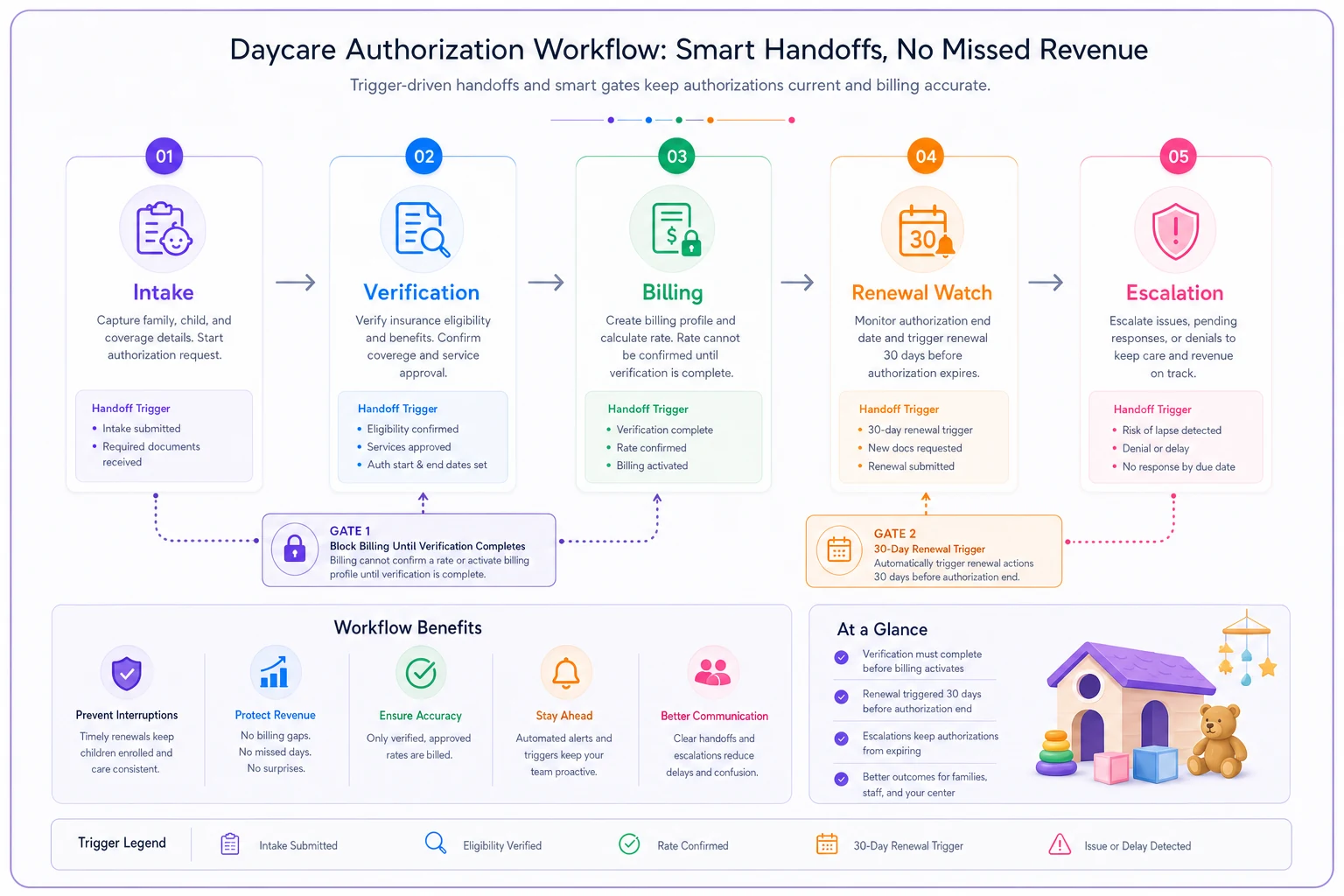
The diagram maps triggers to owners so it's clear who acts and when; use it to make your handoffs auditable and enforced.
The audit-ready folder structure
Auditors don't reward good care. They reward findable proof. A folder that's technically complete but disorganized still fails the sample review, because the reviewer can't locate what they need in the time they've allotted.
[Child Name] – [Program] – [Case #] ├── 01Authorization │ ├── currentauthletter.pdf │ └── priorauthletters/ ├── 02Eligibility │ ├── incomeverification[date].pdf │ └── workschoolattestation[date].pdf ├── 03Redetermination │ ├── redeterminationdue[date].txt │ └── renewalpacketsubmitted[date].pdf ├── 04AttendanceandBilling │ └── authhoursvsbilledhours.pdf └── 05Correspondence └── parentandagencycomms/
Two rules make this survive contact with reality: date-stamp every filename (auditors need to know which income verification was current at the billing date), and keep prior versions rather than overwriting. When an auditor asks "what was authorized during March," you need the March auth letter, not just the current one.
The biggest folder mistake isn't missing documents — it's overwriting. When a family's authorization renews, centers replace the old letter with the new one. Then an audit questions a billing period that fell under the old authorization, and there's no record of what the terms were. Keep the history.
A sample intake checklist you can actually use
Print this, tape it to the intake desk, and don't let a file leave "provisional" until every box is checked:
-
[ ] Authorization letter received and filed (with dates)
-
[ ] Case/authorization number recorded in system
-
[ ] Authorized hours per week entered (actual number, not "full-time")
-
[ ] Authorization start AND end dates entered
-
[ ] Redetermination due date calculated and scheduled
-
[ ] Income verification received, dated, filed
-
[ ] Work/school attestation signed and filed
-
[ ] Effective date of care confirmed against authorization date
-
[ ] Billing rate set to match authorized hours exactly
-
[ ] File status changed from "provisional" to "confirmed"
-
[ ] Handoff to billing logged with date and owner
If a child is attending and the file is still "provisional" after your 7-day internal deadline, that's your escalation trigger — not a note to revisit later.
Escalation triggers: what happens when the process breaks anyway
Even a clean process leaks when parents go silent or an agency is slow. Escalation triggers decide who acts and when, so a stalled file doesn't quietly accumulate undefendable charges.
-
Day 7, docs still missing front desk escalates to director. File flagged "at-risk" in billing.
-
Day 14, still missing director makes direct contact with family; billing holds any retroactive charges beyond the covered period.
-
30 days before auth end, no renewal started renewal owner initiates packet and notifies parent.
-
Authorization lapsed while child still attending immediate stop on confirmed-rate billing; document the care as pending resolution.
-
Reported income/schedule change re-verify authorized hours within 5 days before billing continues at the old rate.
The point isn't to withhold care from a family in a rough spot. It's to make sure you're not billing for something you can't prove, because that's what turns into a clawback. Care can continue while the file resolves — the billing is what needs the guardrail.
When to formalize this — and when it's overkill
This makes sense when: you have more than a handful of subsidy-funded children, multiple programs with different rules, or you've already had one recovery notice. At that point the manual approach is a liability, not a savings.
This is probably overkill when: you have two or three subsidy kids on a single program with a stable, long-tenured intake person who knows every rule cold. A lightweight checklist is enough; you don't need the full folder architecture and escalation ladder.
Who should not rely on a single person's memory: any center where the director is the only one who understands the subsidy rules. That's the single most common failure mode — the whole process lives in one head, that person takes leave or leaves the job, and the next audit exposes eighteen months of drift.
Where automation actually earns its place here
The tedious part of all this isn't collecting documents — it's tracking dozens of different deadlines across programs and catching the moment a file goes stale. That's exactly the kind of repetitive, deadline-driven work where an operational platform with built-in automation pays for itself: redetermination dates calculated at intake, reminders firing before authorizations lapse, and billing that can't flip to a confirmed rate until the file is actually complete.
You don't need software to run this process — a disciplined checklist and a shared calendar can carry a small center. But once you're juggling 40+ subsidy files across two or three programs, manually watching every deadline is where the leaks come back. Automating the deadline-tracking and the handoff gates removes the two failure points that cause almost all reimbursement loss: missed dates and premature billing. The same logic applies to the broader admin load — we broke down where those hours actually go in this look at time sinks in childcare admin.
Reimbursement loss in subsidy programs is rarely about bad care or even bad billing. It's about intake files that can't prove eligibility at the exact moment a payer checks. Fragmented rules make that easy to get wrong, and the losses don't surface for weeks or months — which is why centers keep repeating the same mistakes.
Fix the front of the pipeline — a tight minimum-data form, real documentation deadlines, explicit handoff gates, and a folder structure built for a reviewer's eyes — and the back of the pipeline mostly takes care of itself. You already earned the money by showing up and caring for the child. The intake process is just there to make sure you get to keep it.
Ready to transform your daycare operations?
Join hundreds of daycare centers using Carexly to save time, improve communication, and enhance child care quality.