



When Amazon bumped its minimum starting pay to $20/hour for core operations workers, it did something that matters far beyond its own warehouses. As CNBC reported, the raise came with Day 1 financial benefits and grocery discounts layered on top. For a daycare center sitting ten minutes from a fulfillment hub, that announcement isn't corporate news — it's a direct hit to your hiring pool.
The tricky part is that Amazon doesn't need to steal your lead teachers to hurt you. It only needs to raise the perceived floor for hourly work in your zip code. Once an assistant teacher earning $17 realizes a warehouse shift pays $20 with no lesson plans, no parent conferences, and no diaper duty, you've got a retention conversation you weren't planning to have this quarter.
This is a playbook for moving quickly — without blowing up your payroll or your ratios.
Why a warehouse wage hurts a classroom
Daycare labor math is brutal in a way most industries never deal with. You can't thin out coverage when things get tight, because ratios are legally fixed. Lose an infant-room teacher and you don't just lose productivity — you can lose the legal right to keep those infants in the building until you backfill.
That's the core difference between daycare staffing and almost every other hourly employer. Amazon can run a shift slightly short and ship fewer packages. You cannot run an infant room slightly short. The option doesn't exist.
-
Recruitment pressure — new candidates compare your posting to a $20 warehouse role and never apply.
-
Retention leakage — existing staff, especially entry-level assistants, start quietly browsing.
The leakage usually starts with your most trainable, lowest-paid people — the ones you've invested in but haven't promoted yet. They're close enough to the floor to feel the pull, and junior enough that leaving feels low-risk.
The real problem this exposes
A single competitor raising wages doesn't create a staffing problem. It exposes one that was already there.
Eliminate administrative bottlenecks.
Carexly helps you manage enrollments, attendance, and staff schedules effortlessly.
- Streamlined child enrollment
- Automated parent notifications
- Staff shift and activity scheduling
No credit card required
Most centers run on compressed pay bands that were set years ago and nudged up reactively. The gap between an assistant and a lead is often narrower than it should be, and the gap between a brand-new hire and a two-year veteran is sometimes almost nothing. When the external floor jumps, that compression becomes visible overnight. Your veterans do the math and realize a new hire down the street starts at nearly what they make after two years of loyalty.
That's the deeper issue: wage shocks reveal whether your compensation structure tells a story staff can believe in. If the only answer to "why should I stay?" is "we like you," you'll lose people to anyone offering a dollar more.
The centers that weather these moments aren't the ones that can match Amazon dollar-for-dollar. They can't, and shouldn't try. They're the ones whose pay progression and working conditions are clear enough that a $20 warehouse job isn't an obvious upgrade.
Move 1: Reforecast payroll before you touch wages
Before promising anyone a raise, figure out what you can actually absorb. Most owners skip this and either overcommit or freeze entirely.
A fast way to pressure-test it:
-
Pull your current fully-loaded labor cost as a percentage of tuition revenue. For most centers this lands somewhere around 45–55%.
-
Model a scenario where your lowest two pay bands rise by $1.00–$1.50/hour.
-
Recalculate labor-to-revenue at that new number.
-
Identify the tuition increase (or occupancy improvement) required to hold your margin flat.
-
Decide which of those levers you'll actually pull — and by when.
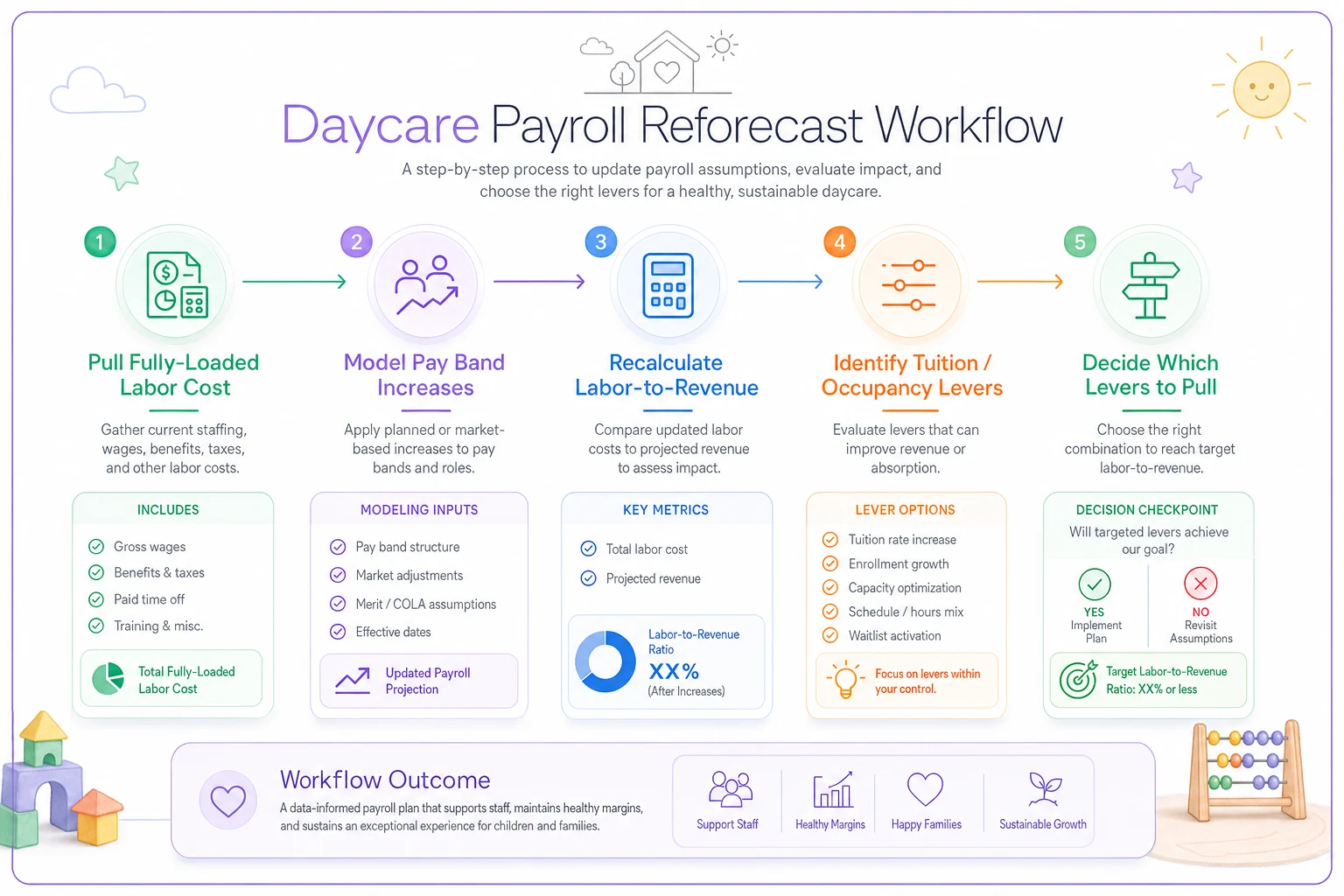
The point isn't precision. It's knowing whether a $1.25 bump pushes you from 52% to 56% labor cost (survivable) or 52% to 61% (not). That single number tells you how aggressive you can be in the next 60 days.
Move 2: Compete on the things Amazon can't offer
You will lose a straight wage war. So don't fight one. A warehouse can beat you on starting pay and day-one benefits, but there are categories where a small center structurally wins — if you make them explicit.
| Factor | Large hourly employer | Daycare center (if run well) |
|---|---|---|
| Starting wage | Higher | Lower, but closer than people assume |
| Schedule predictability | Rotating / mandatory overtime | Stable daytime hours, nights/weekends free |
| Commute | Often farther from residential areas | Frequently closer to home |
| Work meaning | Transactional | High — people genuinely like the kids |
| Advancement clarity | Opaque, slow | Can be fast and visible if structured |
| Physical demands | Heavy lifting, long standing shifts | Active but varied |
The mistake centers make is assuming staff already know these trade-offs. They don't. Nobody adds up the value of never working a Sunday or skipping a 40-minute highway commute unless you spell it out. Put a dollar figure on schedule stability and proximity in your recruiting conversations — "no nights, no weekends, and you're five minutes from home" is worth real money to a parent of young kids. Say that out loud. Don't leave it implied.
Move 3: Protect coverage without inflating hours
The dangerous trap in a wage scare is panic-hiring and panic-overtime. You lose one teacher, you burn three weekends of overtime covering the gap, and suddenly your labor cost spiked worse than if you'd just raised the band in the first place.
Containing hours while staying ratio-legal comes down to how you build schedules, not how many people you throw at the problem. A few things that actually help:
-
Stagger shift starts around your actual arrival curve so you're not fully staffed during the quiet first hour.
-
Cross-train floaters who can legally cover more than one age band, reducing single-point-of-failure rooms.
-
Treat overtime as a tracked exception, not a quiet default — one unmonitored OT habit can eat an entire planned raise.
Track overtime weekly so it appears in your labor model early, preventing it from quietly consuming planned raises.
Coverage planning and compensation planning are the same conversation. Raise wages but let overtime leak and you've funded the raise and the bleeding at once.
Move 4: Make retention a program, not a reaction
Counteroffers made in a panic are the most expensive raises you'll ever give, because they teach staff that the way to get paid more is to threaten to leave. Getting ahead of the drift requires structure your team can actually see.
This is where a deliberate approach to the full employee lifecycle pays off — the kind of role KPIs, documented SOPs, and fill-time tracking laid out in this hire-to-retain staffing lifecycle for daycare centers. When you already know your true cost-to-fill and your typical time-to-productivity for a new teacher, a retention bonus stops being a gut decision. You can say plainly: it costs roughly X to replace and retrain this person, so spending a fraction of that to keep them is obvious math.
A simple retention checklist to run this fall:
-
[ ] Identify your 3–5 highest flight-risk staff (usually trained assistants near the wage floor)
-
[ ] Confirm each has a visible next step and a timeline to reach it
-
[ ] Add a modest, scheduled raise or retention bonus for your most-at-risk band
-
[ ] Offer at least one non-cash lever people actually want (guaranteed schedule, extra paid prep time, flexible start)
-
[ ] Have a direct, non-defensive conversation with each flight risk before they start interviewing elsewhere
That last one matters most. The cheapest retention tool is a manager who notices drift early. By the time someone hands you a competing offer, you're already negotiating from behind.
A real scenario
A mid-size center — four classrooms, roughly 70 kids enrolled — sat about fifteen minutes from a large distribution facility. When the local hourly floor jumped, two assistant teachers making around $16.50 gave notice within three weeks, both citing pay.
Instead of matching warehouse wages across the board, the director did the math on replacement cost. Between advertising, interviews, onboarding, and the weeks of reduced effectiveness while a new hire found their footing, each departure was costing somewhere in the low thousands. Overtime to cover the gaps was quietly adding a few hundred a week on top of that.
The response was targeted, not blanket: a $1.25 bump for the two lowest bands, a small quarterly retention bonus tied to staying through the year, and a hard rule that overtime now required director sign-off. Labor cost rose a few points, offset partly by a modest tuition adjustment communicated to families as a staffing-stability investment. Over the following quarter, the center held its remaining team and refilled the two open roles without the rolling overtime bleed. Not a dramatic turnaround — just a center that stopped losing people faster than it could replace them.
When matching pay is the wrong move
Raising wages isn't always the answer, and reflexively matching a big employer can quietly wreck a center that was already thin on margin.
Don't match across the board if:
-
Your labor cost is already north of ~55% of revenue and occupancy is soft.
-
The departures are performance-related, not pay-related — paying more to keep the wrong people is a trap.
-
You haven't modeled the tuition or occupancy change needed to fund it. Hope is not a funding source.
Targeted raises make sense when:
-
The loss is concentrated in trainable, hard-to-replace roles.
-
Your pay bands are compressed and veterans are within a dollar of new hires.
-
You have room in occupancy or pricing to absorb the increase without going underwater.
The goal is surgical, not sweeping. A well-aimed $1 in the right band beats a demoralizing across-the-board raise you can't sustain into next year.
Where to actually start this week
Amazon's own announcement framed the raise around pay plus benefits — a reminder that total package, not just hourly rate, is what candidates actually compare. Your fastest wins this fall come from the same logic, aimed at your reality.
Run the payroll model first. Identify your flight risks second. Fix pay-band compression where it's dangerous. Lock down overtime so you don't fund a raise and a leak simultaneously. And make your non-cash advantages — schedule stability, proximity, the actual meaning of the work — explicit instead of assumed.
You're not trying to out-pay a company with a logistics budget. You're trying to make leaving your center feel like a downgrade for the specific people you most need to keep. Do that, and a competitor's wage headline becomes a prompt to tighten your operation rather than a crisis you scramble through.
Ready to transform your daycare operations?
Join hundreds of daycare centers using Carexly to save time, improve communication, and enhance child care quality.