


You lose a lead teacher in March. It takes 23 days to post the job, 19 days to get decent applicants, 12 days to interview, 8 days for background checks, and another 14 days of shadowing before they're classroom-ready. That's 76 days—almost three months where you're scrambling for coverage, burning out your remaining staff, and watching parents notice the revolving door of new faces.
Most daycare centers focus on the immediate problem: finding warm bodies to maintain ratios. But the real issue isn't finding people—it's that there's no real system between hiring someone and keeping them. That gap is where operations fall apart.
Why your best teachers leave after 8 months (and it's not about pay)
This pattern shows up constantly. A new assistant teacher starts Monday in the toddler room. Nobody explains the naptime routine, the allergy protocols, or which parents need careful handling at pickup. By Friday they're overwhelmed. After three weeks of confusion, they either quit or you let them go.
It happens because most centers treat hiring like a transaction. You check references, verify certifications, run the background check—then basically drop someone into a classroom and hope for the best.
Centers that keep staff for years do something different. They build what I'd call a daycare staffing lifecycle—a connected system that starts before the interview and runs through the full length of employment. Not a handbook gathering dust in a drawer, but actual operational workflows that guide every touchpoint along the way.
The four phases that determine if someone stays or goes
Phase 1: Pre-hire positioning (Days -30 to 0)
Eliminate administrative bottlenecks.
Carexly helps you manage enrollments, attendance, and staff schedules effortlessly.
- Streamlined child enrollment
- Automated parent notifications
- Staff shift and activity scheduling
No credit card required
Before you post the job, you need to be clear on what success actually looks like for that specific role. Not generic descriptions copied from Indeed, but real performance indicators tied to how your center operates.
-
Morning drop-off completion time
8:45am or earlier
-
Parent communication notes
100% completion by 3pm daily
-
Bottle tracking accuracy
Zero errors per week
-
Developmental observation logs
4 per child per month
These aren't arbitrary. They're the exact behaviors that predict whether someone will work in your environment. When you interview, you're scoring against those indicators—not gut feelings about personality.
Phase 2: The onboarding runway (Days 1-30)
Most centers hand over a policy packet and call it done. Real onboarding means structured handoffs. If a departing teacher is still around, they should be documenting:
-
Daily routine timestamps and where things tend to go sideways
-
Parent preferences and sensitivities by family
-
Child-specific soothing techniques that actually work
-
Unwritten dynamics around staff scheduling and break coverage
One center I worked with built what they called "role journals"—living documents where each position holder adds their discoveries over time. When their toddler teacher of three years left, the new hire inherited nearly 50 pages of operational knowledge no training manual would ever capture.
Phase 3: Development checkpoints (Days 31-365)
What kills retention after the early months is the plateau. Someone masters the basics around month three, then coasts. Without clear growth markers, good teachers get bored and quietly start looking elsewhere.
Month 1-3: Classroom mastery
-
Maintain ratios without reminders
-
Complete all documentation on time
-
Handle standard parent concerns independently
Month 4-6: Cross-training expansion
-
Shadow in adjacent age group for 8 hours
-
Lead one curriculum planning session
-
Train one new staff member
Month 7-12: Leadership preparation
-
Create one process improvement proposal
-
Handle schedule conflicts for their room
-
Conduct peer observations with written feedback
Each checkpoint should include a sit-down conversation—not a performance evaluation, but an actual discussion about what's working and what needs adjustment. That distinction matters more than it sounds. Evaluations feel like judgment. Check-ins feel like coaching.
Phase 4: Retention triggers and early warning systems
You usually know someone's about to quit weeks before they actually do. They stop volunteering for extra tasks. They're suddenly calling out every other Friday. They go quiet in staff meetings. Most centers don't track these signals in any structured way.
A few trigger metrics worth watching:
-
Attendance patterns (Monday/Friday callouts specifically)
-
Documentation delays (daily sheets coming in late)
-
Parent feedback shifts (complaints appearing after months of praise)
-
Behavioral changes in team dynamics
When two signals show up together, have a retention conversation. Not "are you thinking of leaving?" but something like "what would make this role work better for you?" Sometimes it's a scheduling issue. Sometimes it's room dynamics. A lot of the time it's something fixable—if you catch it early enough.
The small-center versus multi-site matrix nobody explains
Running one center with eight teachers is a completely different operational reality than running three centers with 24. Most operators use the same staffing approach regardless of scale, which is where things break down.
Single-center lifecycle management
In one location, you can personally oversee each phase. Onboarding might look like:
-
Week 1
Shadow different rooms each day
-
Week 2
Assist in target classroom with active guidance
-
Week 3
Lead portions of the day with observation
-
Week 4
Full autonomy with daily check-ins
You know every teacher's strengths. You can adjust room assignments based on chemistry. You catch problems early because you're physically there.
KPIs at this scale focus on depth:
-
Individual teacher retention rate
-
Internal promotion percentage
-
Cross-training completion levels
-
Parent satisfaction correlated by teacher
Multi-site lifecycle management
With multiple locations, everything has to be systemized. You can't personally onboard every new hire.
What tends to work is site-level lifecycle ownership:
-
Each director owns their center's 30-day onboarding process
-
Regional floaters deliver specialized training
-
Standardized checkpoints with room for local adaptation
-
Centralized tracking so you see patterns across locations
KPIs shift to systemic patterns:
-
Fill-time by location and role type
-
Retention variance between centers
-
Training completion rates across sites
-
Internal transfer success rates
The mistake multi-site operators make is trying to maintain single-center intimacy at scale. Build frameworks that let directors customize within guardrails—and let go of the idea that everything has to happen exactly the same way everywhere.
Converting lifecycle data into staffing decisions
Track these numbers consistently:
| Metric | Target |
|---|---|
| Days from resignation to posting | Under 2 |
| Days from posting to first interview | Under 7 |
| Days from final interview to start date | Under 10 |
| Total vacancy days | Under 21 |
| 90-day retention rate | Above 85% |
| Interview-to-hire ratio | 4:1 or better |
| Internal referral percentage | Above 30% |
| Failed background check rate | Below 5% |
Cost multipliers worth tracking:
-
Overtime hours during vacancy
-
Agency or temp staff costs
-
Director hours spent covering ratios
-
Parent credits issued for staffing disruptions
One center found they were spending around $3,400 per hire once they factored in overtime, temps, and director coverage during vacancies. By cutting fill-time from 31 days to 18, they saved roughly $1,700 per position—which added up to nearly $24,000 across their annual hires.
The interview scorecard that predicts year-one success
Stop asking "why do you want to work with children?" Start scoring observable behaviors that actually correlate with retention.
Behavioral indicators (rate 1-5):
Preparation signals:
-
Arrived 5+ minutes early
-
Brought required documents
-
Dressed appropriately for classroom environment
-
Asked role-specific questions
Communication patterns:
-
Maintained appropriate energy level throughout
-
Used specific examples versus vague generalities
-
Acknowledged uncertainty instead of bluffing through it
-
Demonstrated active listening
Experience markers:
-
Described difficult situations without shifting blame
-
Showed understanding of developmental stages
-
Mentioned child safety unprompted
-
Referenced ratios or regulations naturally in conversation
Practical demonstration:
-
Comfortably entered an active classroom
-
Engaged appropriately with children present
-
Noticed and responded to subtle cues
-
Maintained professional boundaries
Score threshold: 65+ points correlates with roughly 80% likelihood of one-year retention. Below 50 points, expect departure within 90 days about 70% of the time.
Building SOPs that actually get followed
SOPs fail when they read like legal documents. The ones people actually follow read more like recipes—specific, actionable, and usable under pressure.
Bad SOP example:
"Ensure appropriate supervision during outdoor play activities while maintaining required ratios and safety protocols."
Better SOP example:
-
Outdoor supervision (2-3 year olds)
-
1. Count children before leaving classroom
-
2. Assign lead teacher to front, assistant to back of line
-
3. Scan playground for hazards before releasing children
-
4. Position one teacher by climber, one roaming
-
5. Count every 5 minutes using the roster sheet
-
6. Whistle = immediate freeze and count
The difference is specificity—the kind someone can follow on their third day without stopping to ask questions.
Write SOPs for these critical handoff moments:
-
Shift changes (who tells whom, about what)
-
Room transitions (moving a child up age groups)
-
Incident reporting (who needs to know, within what timeframe)
-
Parent concerns (escalation triggers and routing)
-
Supply requests (approval levels and workarounds)
-
Schedule changes (notification timelines and coverage protocols)
SOPs that read like recipes get followed. SOPs that read like policy get ignored.
Technology's role in lifecycle management
Manual tracking starts breaking down somewhere around 15 employees. You can't keep in your head who needs which training, whose certifications expire when, or who's overdue for a check-in conversation. Past a certain size, this is where AI-powered operational software stops being optional.
Instead of directors managing spreadsheets and sticky notes, integrated platforms track every lifecycle touchpoint automatically. When someone hits day 29, the system triggers the 30-day review workflow. When a certification is about to expire, reminders go out weeks ahead. When attendance patterns start signaling retention risk, directors get an alert before it becomes a crisis.
The real value isn't replacing human judgment—it's freeing directors from administrative time sinks so they can focus on actual staff development. Centers using lifecycle automation generally report spending significantly less time on staffing administration while seeing meaningful improvements in retention.
Automate triggers for 30-day reviews and expiring certifications so directors get alerted before tasks slip.
Technology supports workflows, but it doesn't replace the coaching and human connection that actually keep teachers long-term.
Common lifecycle breaks that compound over time
The expertise drain spiral: Your most experienced teacher leaves. Their replacement needs extra support, pulling your assistant director away from other responsibilities. Quality drops in both rooms. Parents notice. Another teacher burns out from the chaos. The cycle accelerates.
The ratio coverage trap: Short-staffed Monday means pulling floaters. Tuesday's absent teacher can't be covered. You end up working the floor Wednesday. Thursday you're too far behind on admin to notice Friday's schedule gap. Overtime costs spike. Morale drops.
The onboarding bottleneck: Three new hires start the same week. Nobody gets proper attention. All three struggle. One quits immediately. The other two muddle through, making preventable mistakes that frustrate parents and teammates alike. Six months later, they're gone too.
The development desert: After initial training, there's no structured growth path. Ambitious teachers leave for programs that have career ladders. The comfortable ones stagnate. Either way, quality flatlines while competitors who invest in development quietly pull ahead.
These breaks compound because each one increases load elsewhere in the system. Fixes that only address symptoms rarely hold.
Making the lifecycle work at your center
Start with one room—probably the most problematic one. Work through four basic questions:
-
What does success look like for this specific position?
-
What information would actually help someone succeed in week one?
-
What separates good from great at the 90-day mark?
-
What typically makes people leave this particular role?
Build your lifecycle interventions around those answers. Run it through one full hire cycle and adjust based on what actually happened versus what you planned.
Centers that do this well don't implement everything at once. They pick the biggest staffing pain point—maybe onboarding, maybe retention—and build a real system there first. Once that's working, they expand.
For centers ready to move beyond manual tracking, operational platforms built for childcare can turn your lifecycle framework into automated workflows. Instead of hoping managers remember to schedule 30-day check-ins, the system does it. Instead of scrambling when someone resigns, predefined workflows kick in immediately. The lifecycle stops being a concept and becomes how the place actually runs.
Here's a quick visual of the hire-to-retain workflow.
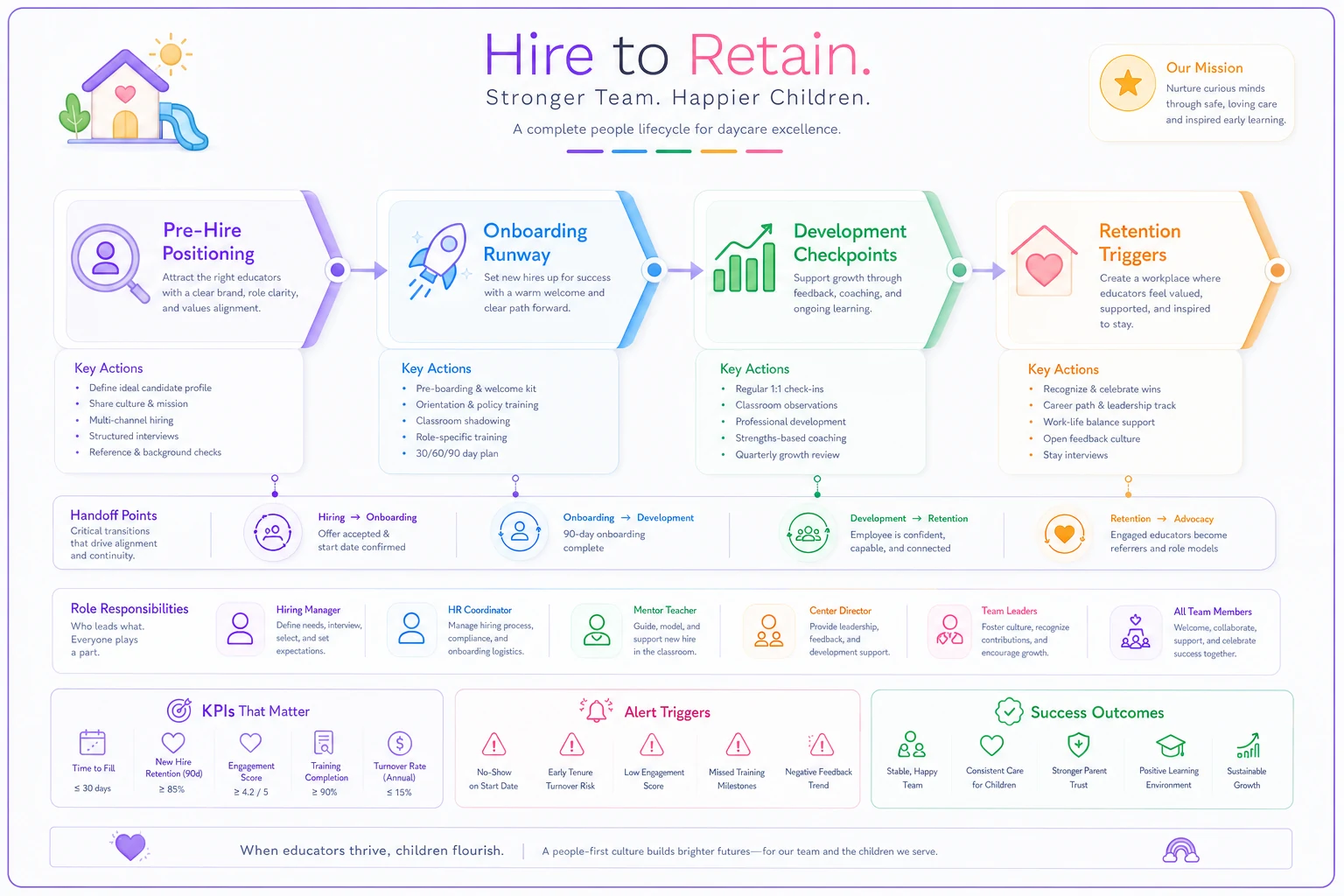
Whether you're working with spreadsheets or more sophisticated software, the underlying principle holds: treat staffing as a connected lifecycle, not a series of isolated transactions. Centers that make that shift see turnover drop, quality improve, and directors spending less time firefighting.
The lifecycle investment that pays for itself
Building a real staffing lifecycle takes upfront effort. Creating role-specific KPIs, documenting SOPs, and designing development checkpoints requires focused hours. But compare that to the alternative.
Every teacher who quits costs somewhere between $3,000 and $7,000 in real dollars—recruitment, training time, overtime coverage, temp staff, and eroded parent confidence. A center with 20 teachers losing 10 per year is bleeding $30,000 to $70,000 annually just from churn.
Cut turnover by even 30% with a basic lifecycle system and that's $10,000 to $20,000 back—not counting the harder-to-measure benefits: teachers who actually know each child, parents who recognize familiar faces, directors who can focus on running the program instead of constantly backfilling roles.
Once the framework is built, it largely sustains itself. New hires enter a proven system. Managers follow established checkpoints. KPIs signal when something needs attention before it becomes a crisis. The reactive scramble of constant recruiting gives way to something that actually feels manageable.
Your next hire either continues the turnover cycle or starts a different pattern. The staffing lifecycle you build—or don't build—is what determines which one you get.
Ready to transform your daycare operations?
Join hundreds of daycare centers using Carexly to save time, improve communication, and enhance child care quality.