



The Conference Board reported that its Consumer Confidence Index slipped to 89.4 in August 2026, and the more worrying detail buried in the Reuters coverage was that the Expectations component — the part measuring how households feel about the next six months — fell sharply. That's the number childcare operators should actually pay attention to, because it tends to move before families change their spending, not after.
For a daycare, the gap between "parents start feeling nervous" and "parents actually reduce days, switch providers, or apply for subsidy" is usually somewhere between four and ten weeks. Which means the softening you feel in October is being decided right now. This post is a prioritized checklist to get ahead of it — not a panic plan, just the seven moves that matter when household budgets tighten.
One thing worth saying upfront: most owners react to a confidence dip by cutting staff first. That's almost always the wrong move, and it's the one that breaks ratios and creates problems you can't easily undo. Staff adjustments are step six for a reason.
Why a confidence dip hits daycares differently
Childcare is a strange spending category. It's simultaneously non-negotiable (parents need to work) and highly elastic at the margins — families can drop from five days to three, pull an infant and use grandma, or shop around on price. So a confidence dip rarely shows up as a wave of withdrawals. It shows up as erosion:
-
A family quietly drops Friday
-
A two-week "we're traveling" pause that never comes back
-
A tuition payment that lands four days late, then eight
-
A subsidy application from a family who was paying full freight last quarter
None of these trigger an alarm individually. Collectively, they can pull 6–9% out of monthly revenue over a quarter while fixed staffing costs stay exactly where they are. That's the real danger — eroding revenue against sticky payroll.
Step 1: Rebuild your daycare enrollment forecast around *committed* revenue, not headcount
The mistake that comes up constantly: owners forecast on enrolled children — "we have 74 kids, we're fine." But 74 enrolled kids at varying schedules, some on subsidy, some 60 days behind, some hinting they might drop a day, is not 74 units of revenue.
Eliminate administrative bottlenecks.
Carexly helps you manage enrollments, attendance, and staff schedules effortlessly.
- Streamlined child enrollment
- Automated parent notifications
- Staff shift and activity scheduling
No credit card required
| Revenue tier | What it includes | How to treat it in the forecast |
|---|---|---|
| Committed | Full-time, paid current, no signals | Count at 100% |
| Probable | Paying but showing soft signals (late once, dropped a day, asked about pricing) | Count at ~75% |
| At-risk | 30+ days late, requested schedule reduction, or applying for subsidy | Count at ~40% |
| Pending | Waitlist conversions, tours booked, subsidy approvals in process | Count at expected close rate, not 100% |
When you do this honestly for the first time, the number usually drops more than owners expect — and that gap between "enrolled" and "committed" is exactly the revenue you need to defend over the next 90 days.
Step 2: Triage subsidy intake before the volume hits you
When budgets tighten, subsidy applications go up. That's not necessarily a bad thing — subsidy revenue is still revenue, and often more stable than a stressed private-pay family. The problem is that subsidy intake is documentation-heavy and time-sensitive, and a wave of applications during a busy stretch is exactly when reimbursements start slipping through the cracks.
-
Sort incoming families by conversion likelihood — a family already eligible with paperwork mostly ready is a fast yes; an unclear-eligibility family needs a longer runway.
-
Attach a "days to funding" estimate to each application so you know when the money actually lands, not just when you submitted.
-
Flag private-pay-to-subsidy conversions separately — these change your per-child revenue and your forecast, and they're easy to miss.
-
Build a single checklist per program so nobody is guessing which documents each agency needs.
The failure pattern here is predictable: a family gets verbally approved, everyone assumes the revenue is secure, and then a missing income verification stalls the file for six weeks. You've been providing care the whole time and haven't been paid for it.
Step 3: Reforecast schedules to protect ratios, not just headcount
This is where confidence dips quietly wreck margins. When families drop days, they rarely do it evenly. You end up with a room that's near-full Tuesday through Thursday and half-empty Monday and Friday — but you're staffing all five days to the same template because the enrolled roster looks unchanged.
Now you're paying full ratio coverage for a Friday running at 55% capacity.
The move is to reforecast staffing off actual daily attendance patterns, not enrollment. Look at your real Monday-vs-Friday spread over the last three weeks. If Friday infant attendance has quietly dropped from 8 to 5, that may let you consolidate rooms or adjust a shift while staying fully compliant. We've written before about how ratio-based shift templates fix coverage and utilization when your data sources don't agree — and this is exactly the moment that disagreement costs you money.
Never solve a soft-attendance day by dropping below required ratio. That's not a cost saving, it's a citation waiting to happen. The goal is utilization, not shaving compliance.
Step 4: Run a pricing and discount scenario before you touch price
The instinct during a downturn is to discount to hold families. Sometimes right, often expensive. Before you offer anything, model it.
A realistic scenario: a center with 68 kids is worried about losing a handful of price-sensitive families. The owner considers a 10% loyalty discount across the board to keep everyone happy. On paper it feels caring. In practice, a 10% discount on the 40-plus families who were never going to leave is a straight giveaway, and it barely moves the six or seven families actually at risk.
-
Offer a schedule-flex option (drop to 3 days at a slightly higher per-day rate) instead of a blanket price cut — retains the family, protects per-child economics
-
Reserve real discounts for at-risk families you've actually identified in Step 1
-
Avoid publishing any across-the-board cut; it's nearly impossible to walk back and it trains your paying base to expect it
When discounting makes sense: you have specific families flagged as at-risk and a discount is cheaper than an empty slot. When it's a bad idea: you're discounting out of anxiety, to families who weren't going anywhere.
Step 5: Get ahead of families with communication — before they decide
Families don't usually announce they're leaving. They decide quietly, and by the time they tell you, it's already done. The window to influence that decision is before that conversation, and most centers miss it entirely because their outreach is reactive.
-
A warm check-in that isn't about money ("wanted to see how [child] is settling into the new room")
-
A calm heads-up on any upcoming schedule or policy changes so nothing feels like a surprise
-
A quiet mention of flexibility if they need it — don't lead with discounts, lead with "we're here to work with you"
The tone matters a lot. The instant your communication smells like you're worried about your own revenue, parents get worried too. Confident, steady, kid-focused messaging holds families better than any promotion. This is also where keeping a single, consistent record of who's been contacted and what was said prevents outreach from doubling up or falling through the cracks entirely.
Step 6: *Now* look at staffing — and do it with a scalpel
Only after you've reforecast committed revenue, triaged subsidy, right-sized schedules, and stabilized at-risk families do you look at labor. And even then, the first lever isn't layoffs.
-
Trim overtime and premium hours first — least painful, often the largest hidden cost.
-
Consolidate under-attended rooms on soft days, keeping ratios intact.
-
Adjust open shifts and float coverage before touching core staff.
-
Slow or pause hiring on non-critical roles rather than cutting existing team members.
-
Reduce hours before eliminating positions where possible — a team you keep is a team you don't have to rehire and retrain when enrollment recovers.
The reason the order matters: staff are your single hardest thing to rebuild. Enrollment can recover in six weeks. A great lead teacher who left because you cut her hours in a panic is gone for good, and replacing her costs far more than the payroll you saved.
Step 7: Set a weekly review cadence instead of a monthly one
During stable periods, a monthly financial review is fine. During volatility, monthly is too slow — a soft week can compound into a soft month before you look up. Shift to a lightweight weekly review of just a few numbers:
-
Attendance vs. enrolled (utilization, per room)
-
New late payments (aging, week over week)
-
Subsidy applications received and days-to-funding
-
Withdrawals and schedule-reduction requests
-
Tours and waitlist conversions
You're not building a giant report. You're watching five signals and reacting fast. The centers that ride out a confidence dip well aren't the ones with the biggest cash cushion — they're the ones who noticed the erosion in week two instead of week seven.
Here's a simple workflow visualization of the weekly review process.
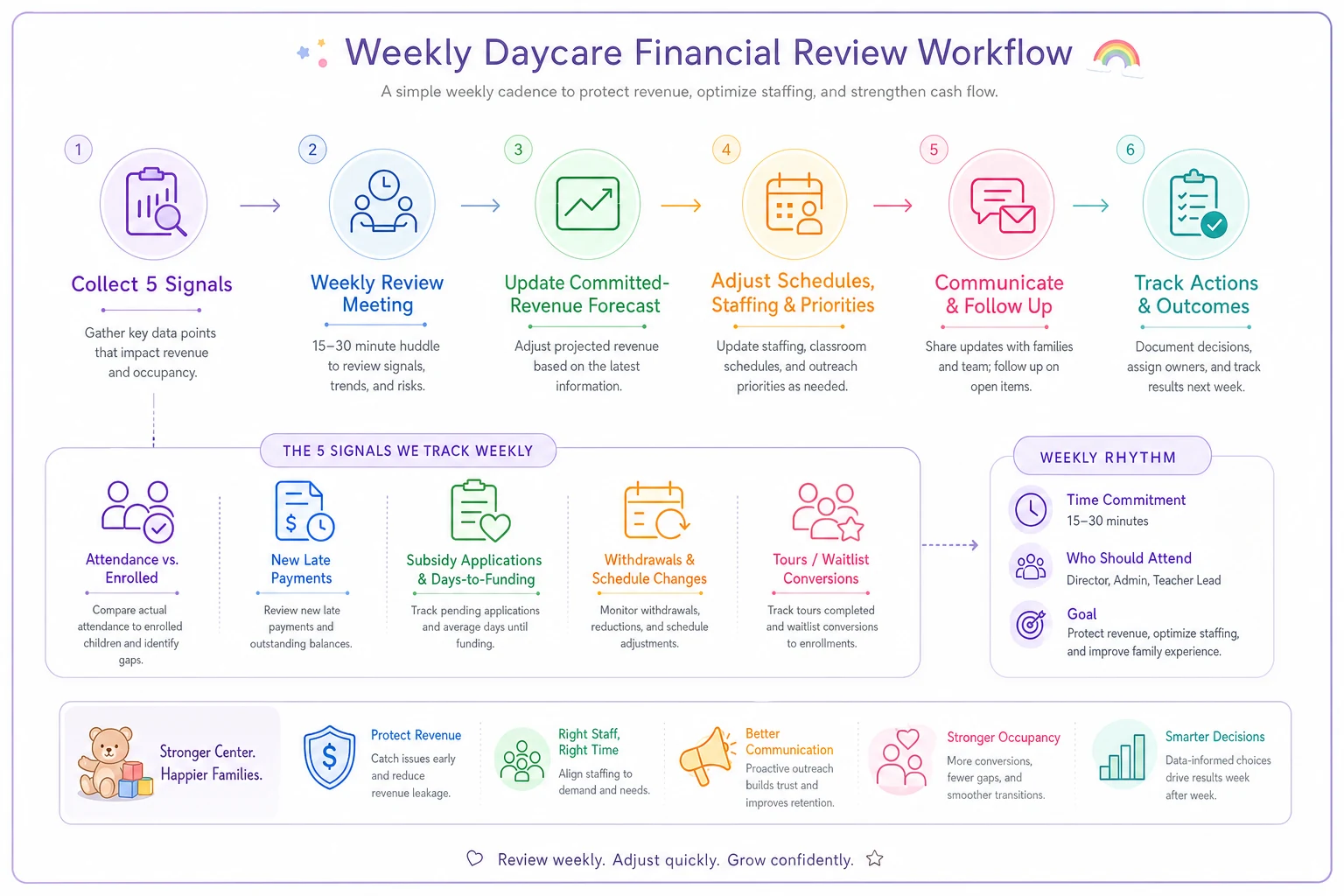
This maps the weekly review steps so teams can move from signal to action quickly.
A quick real scenario
A single-site center running around 70 kids noticed three families drop a day each over two weeks in early fall, plus two tuition payments slipping late. Nothing dramatic. On the old monthly-review habit, none of it would've registered until the month closed short by roughly $4k–$5k.
Instead, by running the committed-revenue tiering from Step 1, the owner saw the at-risk bucket climbing and moved early: consolidated a soft Friday infant room while staying fully in ratio, fast-tracked two subsidy applications that had been sitting half-complete, and made three quiet check-in calls. Two of the three families who dropped a day came back to full-time within a month once flexibility was offered. The Friday consolidation trimmed a shift's worth of premium coverage without a single layoff. Net effect over the quarter was a small dip instead of a real hole — and the whole team stayed intact.
The underlying problem this exposes
A confidence dip doesn't create new operational weaknesses. It exposes the ones already there — mostly the gap between enrolled and actually paying, and the gap between staffed and attended. Centers that forecast on headcount and review monthly are flying blind in exactly the moment precision matters most.
None of this requires a dramatic operational overhaul. It's tighter, faster visibility into a small set of numbers, and the discipline to act on soft signals before they harden into withdrawals. When household budgets tighten, the centers that come out ahead aren't the cheapest or the ones sitting on the deepest reserves — they're the ones who saw it coming a month earlier and made small, precise adjustments instead of big, panicked ones. Get your daycare enrollment forecast honest, watch the right five numbers every week, and touch staffing last. That sequence is the whole game.
None of this requires a dramatic operational overhaul. It's tighter, faster visibility into a small set of numbers, and the discipline to act on soft signals before they harden into withdrawals. When household budgets tighten, the centers that come out ahead aren't the cheapest or the ones sitting on the deepest reserves — they're the ones who saw it coming a month earlier and made small, precise adjustments instead of big, panicked ones. Get your daycare enrollment forecast honest, watch the right five numbers every week, and touch staffing last. That sequence is the whole game.
Ready to transform your daycare operations?
Join hundreds of daycare centers using Carexly to save time, improve communication, and enhance child care quality.