



The Fed left the federal funds rate untouched on October 28, holding it in the 3.75%–4.0% range. You can read the full FOMC statement from the Federal Reserve if you want the exact language, but the short version is: borrowing stays expensive, inflation hasn't fully gone away, and families aren't getting the relief they were hoping for.
For most daycare owners that's not abstract macroeconomics. It's the parent who asks to switch from five days to three. It's the line of credit you were going to tap for playground resurfacing that now costs more to carry. It's the slow creep of late tuition payments that shows up whenever household budgets tighten.
A pause sounds like "nothing happened." But operationally, a pause is the dangerous part — elevated rates that stay elevated are what grind on a center's margins over a few quarters. Below are seven moves worth making in the next two to three weeks, not next quarter.
1. Rebuild your cash runway on a 13-week view, not a monthly one
Monthly budgets hide the thing that actually kills centers: the week where payroll lands two days before a big tuition batch clears. When rates were low and credit was cheap, you could paper over those gaps with a quick draw on a line of credit. That's a worse idea now. Every short-term draw costs more to service, and if you're rolling a balance month to month, the interest is quietly eating a classroom's worth of supplies.
Switch to a rolling 13-week cash forecast. List every known inflow (tuition by program, subsidy reimbursements, registration fees) and every outflow (payroll runs, rent, insurance, food program, loan payments) by the actual week they hit. The goal isn't precision to the dollar — it's spotting the three or four weeks in the next quarter where you go tight.
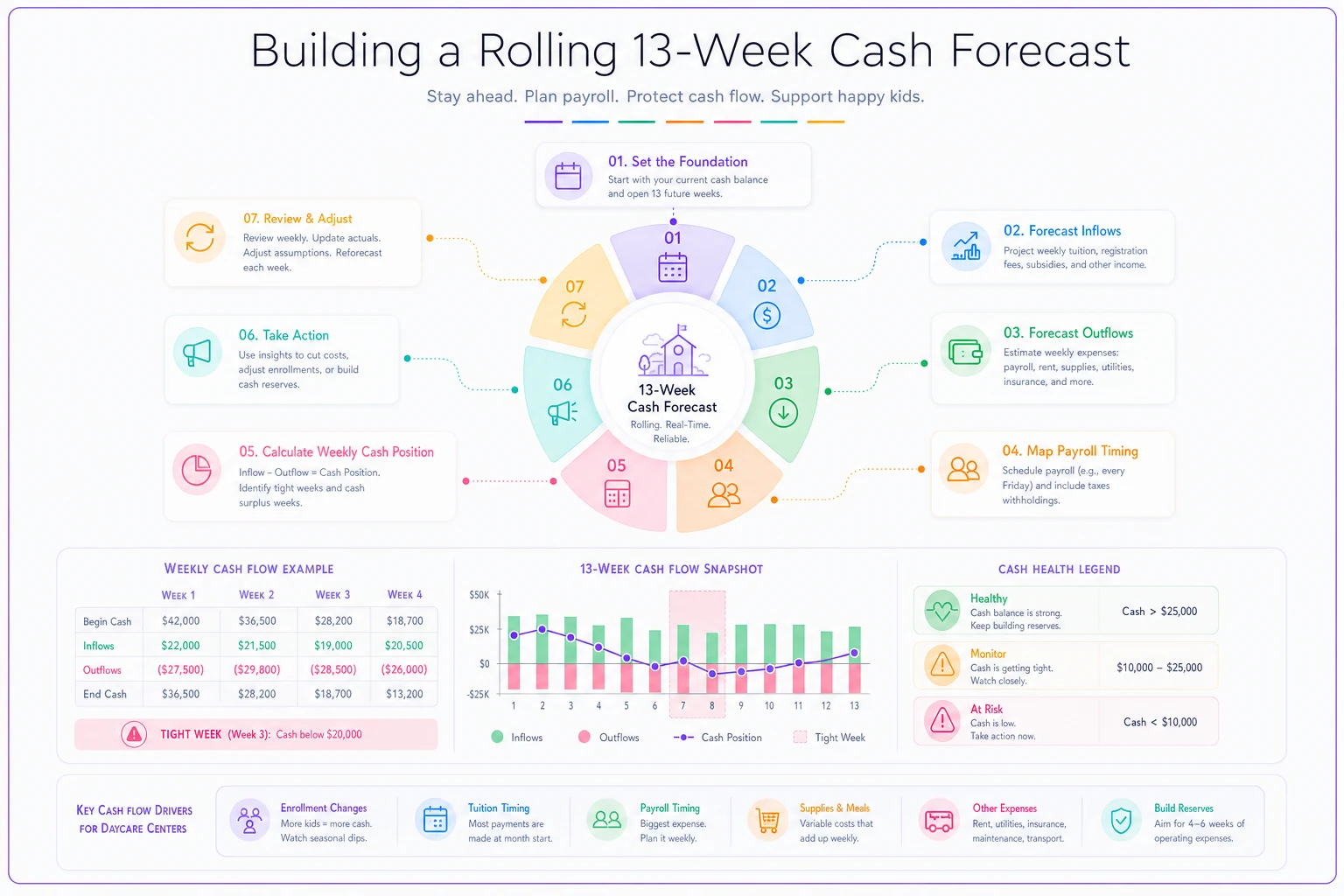
A simple visual makes it easier to show leaders which weeks will be tight and why.
One example worth sharing: a center running roughly $95k in monthly revenue looked healthy on paper, but a week-by-week view showed two weeks where the balance dipped under $4k because a quarterly insurance payment and a payroll run landed at the same time. That's the kind of thing you want to see six weeks out, not the Monday it happens.
If you've never built one of these, our childcare financial governance playbook for owners and directors walks through the structure in more detail. The rate environment just makes it urgent.
2. Stress-test tuition affordability before you touch prices
The instinct when inflation lingers is to raise tuition. Sometimes that's right. But the mistake is raising it across the board without knowing which families are actually price-sensitive and which programs have waitlist demand behind them. Segment your families into three buckets:
Eliminate administrative bottlenecks.
Carexly helps you manage enrollments, attendance, and staff schedules effortlessly.
- Streamlined child enrollment
- Automated parent notifications
- Staff shift and activity scheduling
No credit card required
-
Full-pay, low-flight-risk — dual income, long tenure, engaged. These absorb modest increases.
-
Subsidy or mixed-pay — reimbursement rates are the real ceiling here, not what you charge.
-
Stretch families — the ones who already asked about payment plans or dropped a day. These are your churn risk.
Raising rates 6% on the first bucket is very different from raising it on the third. When centers raise flat across all three, the stretch families leave first — and they tend to be in the hardest-to-refill age bands. Infants especially, where ratios make every empty spot expensive.
A smarter move: hold or barely nudge rates on the price-sensitive segment and recover margin through ancillary fees — late pickup, registration, optional enrichment — that full-pay families opt into willingly.
3. Tighten receivables before nonpayment becomes a pattern
Late payments are the first quiet symptom of household budget stress, and they tend to show up a month or two before anyone formally withdraws. By the time a family is 45 days behind, you're already in a bad position — you can't easily discharge a child, and the balance keeps growing. A simple receivables cadence that actually works:
-
Day 1 past due automated friendly reminder, no fee language.
-
Day 3 second reminder with the specific balance and a one-click pay link.
-
Day 7 short personal message from the director — human, not a system template.
-
Day 10 offer a written payment plan proactively.
-
Day 14+ escalation conversation with clear terms.
The difference between centers that keep bad debt under control and the ones that don't usually isn't the policy — it's whether the reminders actually go out on time, every time. That's exactly the kind of repetitive task that slips when your director is covering a classroom. Scheduling those reminders through your management platform so they fire automatically takes the forgetfulness out of it, which matters most during the weeks you're already stretched thin.
Schedule receivable reminders through your management platform so they fire automatically and don't rely on manual sends.
Scheduling those reminders through your management platform so they fire automatically takes the forgetfulness out of it, which matters most during the weeks you're already stretched thin.
4. Freeze or re-sequence capital projects you were planning to finance
Anything you planned to put on credit — a roof repair, a van, a classroom build-out — deserves a second look. CNBC's coverage of the October decision noted the Fed gave no clear signal of near-term cuts, so planning around "rates will drop soon" is wishful thinking. Sort your planned spending into three categories:
| Category | Examples | Decision now |
|---|---|---|
| Safety / compliance | Licensing-required repairs, security fixes | Do it — non-negotiable |
| Revenue-generating | Opening a new classroom with waitlist demand | Proceed only if payback is under ~18 months |
| Nice-to-have | Cosmetic upgrades, non-urgent equipment | Defer or pay cash |
The trap is treating a cosmetic upgrade as urgent because a vendor had availability. If it needs financing and it isn't tied to safety or clear new revenue, it can wait a quarter or two.
5. Map ratio-aware schedule adjustments to protect payroll
Payroll is your biggest line, and when enrollment softens even slightly, overstaffing creeps in fast. The problem is you can't just cut hours — ratios are legal requirements, and thin coverage creates compliance and safety risk.
What actually protects both payroll and ratios is matching staff hours to real attendance patterns, not enrollment on paper. Most centers staff to their roster, but midweek attendance — especially part-timers and the family that "sometimes" comes Fridays — runs lower than expected. That gap between staffed-for and actually-present is pure payroll leakage.
Pull two weeks of actual check-in data by hour and compare it to your scheduled coverage. You'll usually find a predictable soft window — late Friday afternoons are the classic one — where you can combine classrooms within ratio and release someone early. Done consistently, trimming even a handful of over-coverage hours per week adds up over a quarter without touching anyone's core schedule or breaking a single ratio.
6. Reforecast enrollment with a wider range than usual
When household confidence is shaky, your enrollment forecast shouldn't be a single number. Build three scenarios:
-
Flat current enrollment holds, normal seasonal churn.
-
Soft 5–8% of stretch families drop a day or withdraw over the next two quarters.
-
Tight subsidy delays plus accelerated withdrawals in your weakest age band.
The point isn't to predict which one happens. It's to know your trigger points in advance — the enrollment level at which you'd combine classrooms, pause a new hire, or lean harder on waitlist conversion. Centers that decide these triggers while things are calm make clean decisions. Centers that wait until the soft scenario is already playing out tend to panic-cut, which damages morale and often costs more to fix than whatever they saved.
7. Protect your best staff before the budget conversation starts
The mistake that compounds everything else: trimming payroll in a way that pushes out your strongest teachers. In a tight budget, losing one experienced lead and backfilling at a higher rate can wipe out whatever you saved — and you risk families leaving with the teacher they trust.
Before any cost conversation, identify the five or six people you cannot afford to lose and make sure your adjustments don't land on them. Protecting core staff might mean trimming elsewhere, adjusting a soft Friday, or holding an open position rather than filling it. The cheapest retention tool you have right now is clarity — staff get nervous when they hear "the Fed" and "budget" in the same sentence, and a short honest update does more to keep good people than most owners expect.
A quick real scenario
A single-site center with around 70 kids enrolled noticed receivables creeping up over two months — nothing dramatic, just more families landing in the 30-day bucket than usual. They ran a 13-week cash forecast and spotted two genuinely tight weeks ahead. Instead of drawing on their line of credit (now noticeably more expensive to carry), they did three things: moved reminder messaging to fire automatically on a set cadence, offered proactive payment plans to four stretch families instead of waiting, and combined two classrooms on Friday afternoons within ratio.
Nothing heroic. But bad debt stopped growing, both tight weeks cleared without touching credit, and they trimmed roughly $1,200–$1,500 a month in over-coverage payroll without a single layoff. The families on payment plans stayed enrolled, which mattered more than the few late fees they waived.
When to act aggressively — and when to hold
Act aggressively if: you carry a revolving line-of-credit balance, enrollment has already softened, or you have significant exposure to subsidy reimbursement timing. Elevated rates hit you hardest in that combination.
Hold steady if: you're debt-free, have a solid waitlist across all age bands, and your receivables are clean. Over-reacting here just creates anxiety for staff and families. The right move is to build the forecasts and set your triggers now so you're ready — not to start cutting preemptively.
Don't make flat across-the-board tuition hikes out of fear, and don't finance anything optional while carrying costs stay this high. Those two moves tend to cause more damage than the rate environment itself.
Bottom line
A rate pause isn't a non-event for daycare operators — it's confirmation that the squeeze on household budgets, borrowing costs, and your margins is sticking around for a while. The centers that come through this cleanly aren't necessarily the ones with the biggest reserves. They're the ones who tightened their cash visibility, protected their strongest people, and made small ratio-aware adjustments early, while they still had room to choose.
Start with the 13-week forecast. Everything else gets easier once you can actually see which weeks are going to be tight.
Ready to transform your daycare operations?
Join hundreds of daycare centers using Carexly to save time, improve communication, and enhance child care quality.