



Most centers don't fail because they can't run a classroom. They fail because nobody wrote down who gets to spend what, when to touch reserves, and what the numbers need to say before you hire, cut, or discount. The books look fine in September, and by February you're moving money between accounts and hoping enrollment holds.
Financial governance sounds like a corporate term, and that's part of the problem. Owners hear "governance" and picture a board meeting with a policy binder nobody reads. In a childcare center, governance is really just a set of pre-made decisions that keep a bad month from becoming a bad year. It's the difference between reacting and having already decided.
This is a systems piece. The individual tools — a reserve calculator, a delegated-spend matrix, approval thresholds — are useful on their own, but they only protect you when they're wired together into decision gates. A reserve number means nothing if there's no rule about what triggers you spending it. An approval threshold means nothing if it isn't tied to your cash runway. Here's how the pieces connect, and where they usually break.
Why the money problems in childcare are almost never about the money
The uncomfortable pattern across small centers is that financial trouble is a governance failure wearing a cash-flow costume. The director approved a curriculum upgrade in October because it was "only $2,400." The assistant director signed off on a substitute agency contract because the room was uncovered and someone had to. The owner covered a plumbing repair off the business card without recording it as a capex draw. None of these are irresponsible on their own. Added up, over a year, they quietly drain the buffer that was supposed to carry the center through the summer enrollment dip.
Childcare has a specific problem with this: your revenue is unusually predictable and unusually fragile at the same time. Predictable because enrollment doesn't swing wildly week to week. Fragile because a single infant room dropping from 8 to 5 children can erase your margin, and because so much of your income depends on things outside your control — subsidy reimbursement timing, a corporate parent getting relocated, a competitor opening two miles away.
That combination is exactly why loose spending controls hurt more here than in other small businesses. A restaurant with a bad month can cut hours and food cost fast. A center's costs are mostly locked-in payroll tied to ratios you're legally required to maintain. When revenue dips, you can't cut proportionally. So the reserve, the spending discipline, and the revenue rules have to do the work that flexible costs do in other industries.
The four pieces and how they lock together
Think of governance as four components feeding into decision gates:
Eliminate administrative bottlenecks.
Carexly helps you manage enrollments, attendance, and staff schedules effortlessly.
- Streamlined child enrollment
- Automated parent notifications
- Staff shift and activity scheduling
No credit card required
-
Reserve policy — how much cash you hold and what it's allowed to be used for
-
Delegated-spend matrix — who can approve what, without asking
-
Internal controls — the checks that keep spending honest and recorded
-
Multi-source revenue rules — how you treat tuition vs. subsidy vs. grants vs. registration income differently
A decision gate is the moment these come together. "Should we hire a floater for the toddler room?" isn't answered by the schedule alone. It's answered by: what's our current runway, does this spend fall inside someone's delegated authority, does it require dipping into reserves, and is the revenue backing it stable or seasonal?
When centers skip the gate and just answer operationally — "yes, the room needs coverage" — they make correct classroom decisions that are wrong financial decisions. That's the core failure mode.
Building the reserve number (and what most owners get wrong)
Generic advice says "keep three to six months of expenses." That range is nearly useless for childcare because your months aren't equal. July expenses and October expenses can differ significantly, and your revenue swings on a school-year calendar.
A better reserve calculation works off your worst plausible stretch, not an average month. Here's a simple version: Reserve calculator (structure):
| Input | How to get it | Example |
|---|---|---|
| Baseline monthly operating cost | 12-month average of all outflows | ~$78,000 |
| Peak-cost month multiplier | Highest month ÷ average | 1.15 |
| Fixed cost floor | Payroll + rent + insurance you can't cut in 30 days | ~$61,000 |
| Enrollment-shock factor | Revenue loss if occupancy drops one tier | ~$9,000/mo |
| Target runway (months) | Based on how fast you can re-fill seats | 4 |
Your reserve target is roughly: (fixed cost floor + enrollment-shock factor) × target runway. In this example that's about (61,000 + 9,000) × 4 = $280,000. That number will make a lot of owners flinch, and that's fine — the point isn't to have it tomorrow. The point is to know the gap so you can set a monthly reserve contribution and stop pretending the checking-account balance is your safety net.
The mistake that keeps showing up: owners set a reserve target once, hit it, and then treat the whole balance as spendable because "we have reserves now." A reserve without a use policy isn't a reserve. It's a slush fund with good intentions.
Tie your reserve directly to your forecasting. If you've already built out occupancy-driven financial forecasts with staffing triggers, your reserve target should update as projected occupancy changes. A center forecasting a soft fall should be raising its reserve floor, not spending down.
Tuition elasticity to cash runway: the workbook that connects pricing to survival
This is the piece almost nobody builds, and it's the most valuable one.
-
Price scenario (hold, +3%, +6%, +9%)
-
Projected enrollment response per age group (your estimate, refined each year with actual data)
-
Resulting monthly net + runway impact
A worked example. Say a mid-size center is considering a 6% increase across the board:
-
Infant/toddler rooms
expect near-zero attrition, adds ~$4,100/mo net
-
Preschool rooms
expect 1–2 families to leave, still nets ~$2,700/mo
-
School-age
expect noticeable pushback, maybe 3–4 families leave, nets close to break-even
The workbook shows that the 6% increase adds roughly $6,500–$7,000/month, which extends runway by close to a month over the year — but almost none of that gain came from school-age. That tells you something operational: raise selectively. The workbook turns a gut-feel pricing decision into a runway decision.
If you want the pricing mechanics in depth, they're in childcare tuition pricing that protects occupancy and revenue. The governance layer here is just wiring those pricing scenarios directly into your cash model so you can see the runway consequence before you send the letter.
One thing most owners miss: elasticity data is a retention signal, not just a pricing one. If a 6% bump loses you four school-age families, that age group was already loosely attached. The workbook surfaces weak retention before it becomes empty classrooms.
The delegated-spend matrix
This is where governance becomes daily reality. A delegated-spend matrix answers one question: who can approve what, without escalating? Get this wrong and you either bottleneck everything through the owner — slow and exhausting — or let spending happen with no visibility, which is worse.
| Spend type | Lead teacher | Director | Owner | Reserve draw? |
|---|---|---|---|---|
| Classroom supplies | Up to $150/mo | Up to $600/mo | Any | No |
| Substitute/agency coverage | — | Up to $1,200/incident | Any | No |
| Repairs & maintenance | — | Up to $800 | Any | Over $2,500 |
| New hire (budgeted role) | — | Approve | Approve | No |
| New hire (unbudgeted) | — | Recommend | Approve only | Depends on runway |
| Capital / equipment | — | Up to $1,000 | Any | Over $3,000 |
| Discounts / tuition waivers | — | Up to $75/mo/family | Any | No |
Two things make this work that owners routinely skip.
First, discounts belong on the spend matrix. A director quietly granting sibling discounts and "just this month" waivers is spending money — it just doesn't look like spending because no check gets written. Uncontrolled tuition adjustments are one of the biggest silent leaks in centers. Put them on the matrix.
Second, notice the reserve-draw column. Any spend that requires touching reserves jumps up a decision gate automatically, regardless of dollar amount. A $2,600 repair is inside the owner's normal authority, but if paying for it means dipping below your reserve floor, it becomes a governance decision, not a maintenance one.
Internal controls that fit a 15-person center
Corporate internal controls assume you have separate people for every function. You don't. The person who invoices parents might be the same person who records the payment. That's not automatically a fraud risk — it's just the reality of a small operation — but it does mean you need lightweight compensating controls.
-
Two eyes on anything over a threshold. Any spend above a set line (say $1,000) needs a second person to see the invoice, even if they don't formally approve it. Visibility alone deters most problems.
-
Monthly bank reconciliation the owner personally reviews. Not does — reviews. Ten minutes looking at the reconciliation catches the drift before it becomes a problem.
-
A recorded reason for every discount and waiver. Not for audit theater — because unexplained discounts are how a center loses $15k a year without noticing.
-
Subsidy income reconciled separately from tuition. Different timing, different risk, different collection process. Blending them hides late reimbursements.
-
Petty cash and the business card treated as spend, not convenience. Every card charge coded to a category, monthly.
Ten minutes personally reviewing the monthly bank reconciliation catches drift before it becomes a problem.
The pattern worth internalizing: internal controls in a small center aren't about catching a thief. They're about catching yourself before a mistake compounds. The owner who covers a repair on a personal card "to sort out later" is the most common control breakdown — not malicious, just messy, and it makes the numbers lie.
Multi-source revenue rules
Centers with tuition, subsidy, grants, registration fees, and maybe a food program reimbursement often treat all incoming money the same way. That's a mistake, because these sources have completely different reliability profiles.
-
Tuition (private-pay) treat as recurring but seasonally variable. This funds operating baseline.
-
Subsidy/voucher income treat as delayed and occasionally clawed back. Never let subsidy timing fund payroll obligations directly — the lag will burn you.
-
Grants treat as non-recurring. Fund one-time things (equipment, training, a facility upgrade), never ongoing staff positions. The classic trap is hiring a full-timer on grant money, then being unable to let them go when the grant ends.
-
Registration/annual fees treat as reserve contribution, not spendable operating income. This is the easiest way to build reserves without feeling it — those September fee inflows top up the buffer instead of getting absorbed into day-to-day operations.
The governance rule that ties it together: the more unreliable the source, the less it's allowed to fund fixed costs. Fixed costs — payroll, rent — get funded by your most reliable revenue only. Variable and unreliable income funds variable and one-time things.
Turning it into one dashboard: tuition scenarios → runway → staffing triggers
Everything above is theory until it lives on one screen you actually look at. The goal is a single dashboard that maps your enrollment and tuition scenario to your runway and tells you what staffing action it triggers.
| Occupancy scenario | Projected runway | Reserve status | Auto-trigger |
|---|---|---|---|
| At/above target (≥90%) | 5+ months | Above floor | Fund reserve, normal hiring |
| Mild dip (82–89%) | 4–5 months | At floor | Freeze unbudgeted hires, hold discounts |
| Moderate dip (75–81%) | 3–4 months | Below floor | No reserve draws w/o owner gate, review floater roles |
| Serious dip (<75%) | <3 months | Draining | Staffing restructure gate, pause all capex |
The value of the dashboard isn't the data — it's that the trigger is pre-decided. When occupancy slides into the "moderate dip" band, you don't hold a stressful meeting about whether to freeze hiring. You already decided. The gate fires. This is what removes emotion and delay from the decisions that matter most, and it's why keeping your forecast, reserve, and spend matrix in one connected view beats three spreadsheets that disagree with each other.
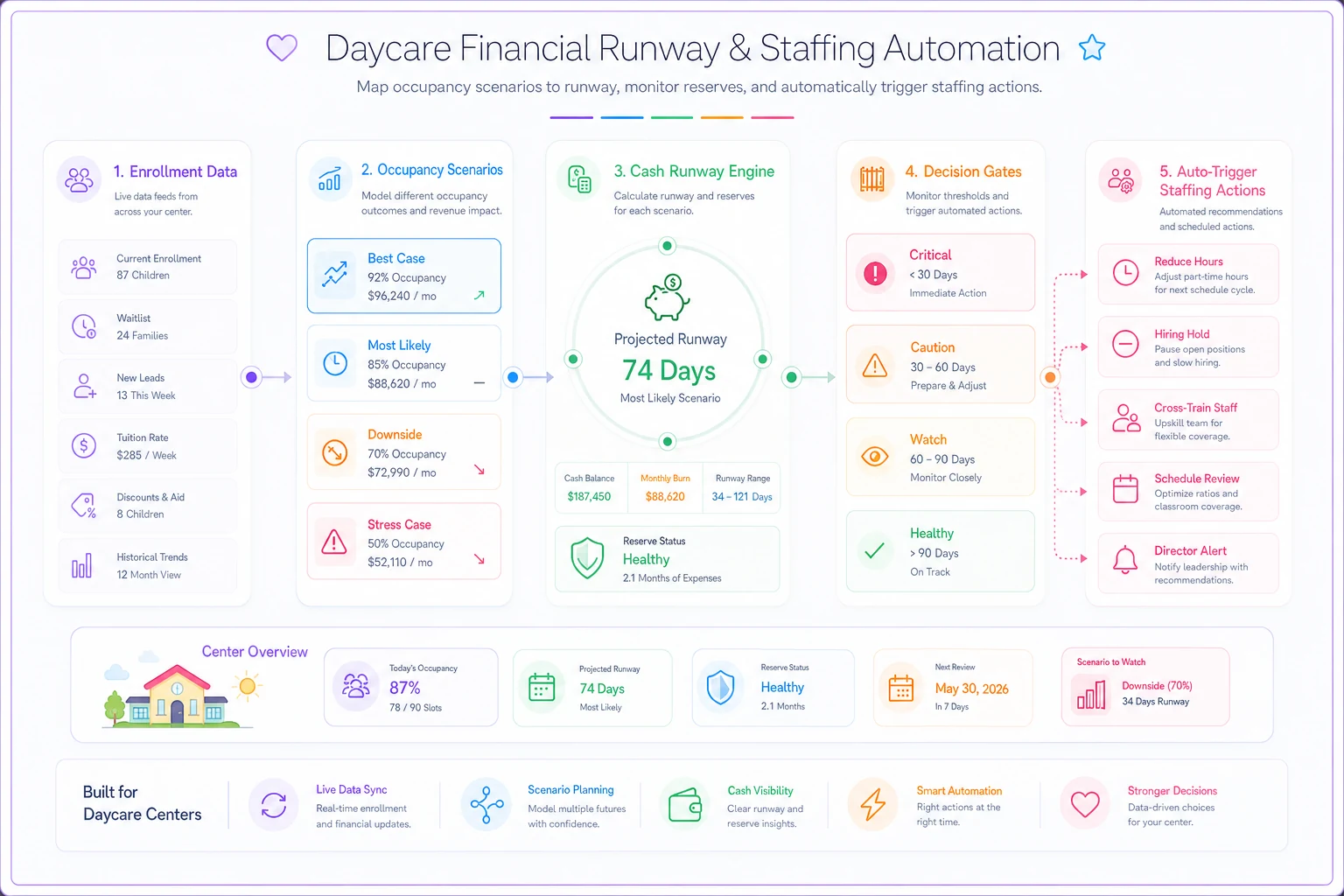
This is also where operational software earns its place — not as a magic fix, but because keeping enrollment, forecasting, reserve targets, and approval thresholds in sync by hand is exactly where the whole system quietly breaks down. When occupancy updates in your enrollment records, your runway projection and staffing triggers should update too, without someone remembering to rebuild a spreadsheet. AI-assisted forecasting can flag when a scenario crosses a trigger band before anyone on staff notices — which is precisely the kind of drift that governance is designed to catch early. The dashboard is only useful if it's current, and "current" is genuinely hard to maintain manually across a busy center.
Sample policy excerpts you can adapt
Keep these short. A governance policy nobody reads is worse than none, because it creates false confidence.
Reserve policy (excerpt): > The center maintains an operating reserve targeting four months of fixed operating cost plus one enrollment-shock tier. Registration and annual fees are directed to the reserve until the target is met. Reserve draws exceeding $2,500 require owner approval and a documented repayment plan restoring the floor within two quarters.
Delegated authority (excerpt): > The Director may approve operating expenditures up to $600 per instance and substitute coverage up to $1,200 per incident without escalation. Any expenditure requiring a reserve draw, and any unbudgeted new position, requires Owner approval regardless of amount.
Discount governance (excerpt): > All tuition adjustments, waivers, and discounts are recorded with a stated reason and reviewed monthly. Cumulative discretionary discounts may not exceed 3% of monthly gross tuition without Owner approval.
When this level of governance makes sense — and when it's overkill
When it makes sense: You're running one full center at or near capacity, or you're planning a second location. The moment you have staff spending money you don't personally see every day, you need the matrix and the controls. Multi-site without governance is how owners lose control fastest.
When it's overkill: A brand-new home-based or micro-center with the owner handling every dollar personally doesn't need a five-tier delegation matrix. Build the reserve discipline and the revenue rules first; add delegation when you add people who spend.
Who should not bolt this on all at once: A center already in a cash crunch shouldn't stop everything to build a full governance system — you'll fix the leak while the boat sinks. Stabilize cash first, then install the gates so it doesn't happen again.
One place this connects to physical operations worth flagging: capital planning. Governance falls apart when a surprise facility expense blows through your reserve because it was never forecast. Pairing this with a real 3-year capex plan and inspection cadence means big repairs become scheduled reserve draws, not emergencies that trigger your worst-case gates.
A real scenario
A center with roughly 95 licensed slots was running at about 88% occupancy and felt financially "fine" — checking account never went negative. But over an 18-month stretch, the owner noticed summers getting tighter every year. By the third August, they were transferring personal money in to cover payroll.
When they built the pieces out, the picture became clear fast. Discretionary discounts and waivers were running close to $1,800/month, none of it tracked. Subsidy reimbursements were averaging 40-plus days late, and payroll was effectively being floated on that gap. There was no real reserve — the "buffer" was just whatever hadn't been spent yet.
The fixes weren't dramatic. Putting discounts on the delegated-spend matrix with a monthly cap cut discretionary waivers by more than half within two months. Redirecting annual registration fees — about $22k across the year — straight into a real reserve account instead of letting them get absorbed into operations made an immediate difference. They stopped counting subsidy income as available until it actually landed. And they built the scenario dashboard so the August squeeze became a predictable trigger instead of a surprise.
A year later the owner didn't transfer any personal money over the summer for the first time. The center wasn't earning dramatically more — occupancy was basically flat. The money had been there the whole time. It was just leaking through decisions nobody was gating.
The takeaway
The centers that stay financially healthy aren't the ones with the highest tuition or the fullest classrooms. They're the ones where the important money decisions were made before the pressure hit — where the reserve has a use policy, the spending has an owner, the revenue is treated according to how reliable it actually is, and the whole thing feeds one view that tells you what to do when enrollment moves.
Governance isn't paperwork. It's the set of decisions you make once, calmly, so you don't have to make them badly under stress in February. Build the pieces so they connect, wire them into gates, and let the system carry the weight your gut has been carrying alone.
Ready to transform your daycare operations?
Join hundreds of daycare centers using Carexly to save time, improve communication, and enhance child care quality.