

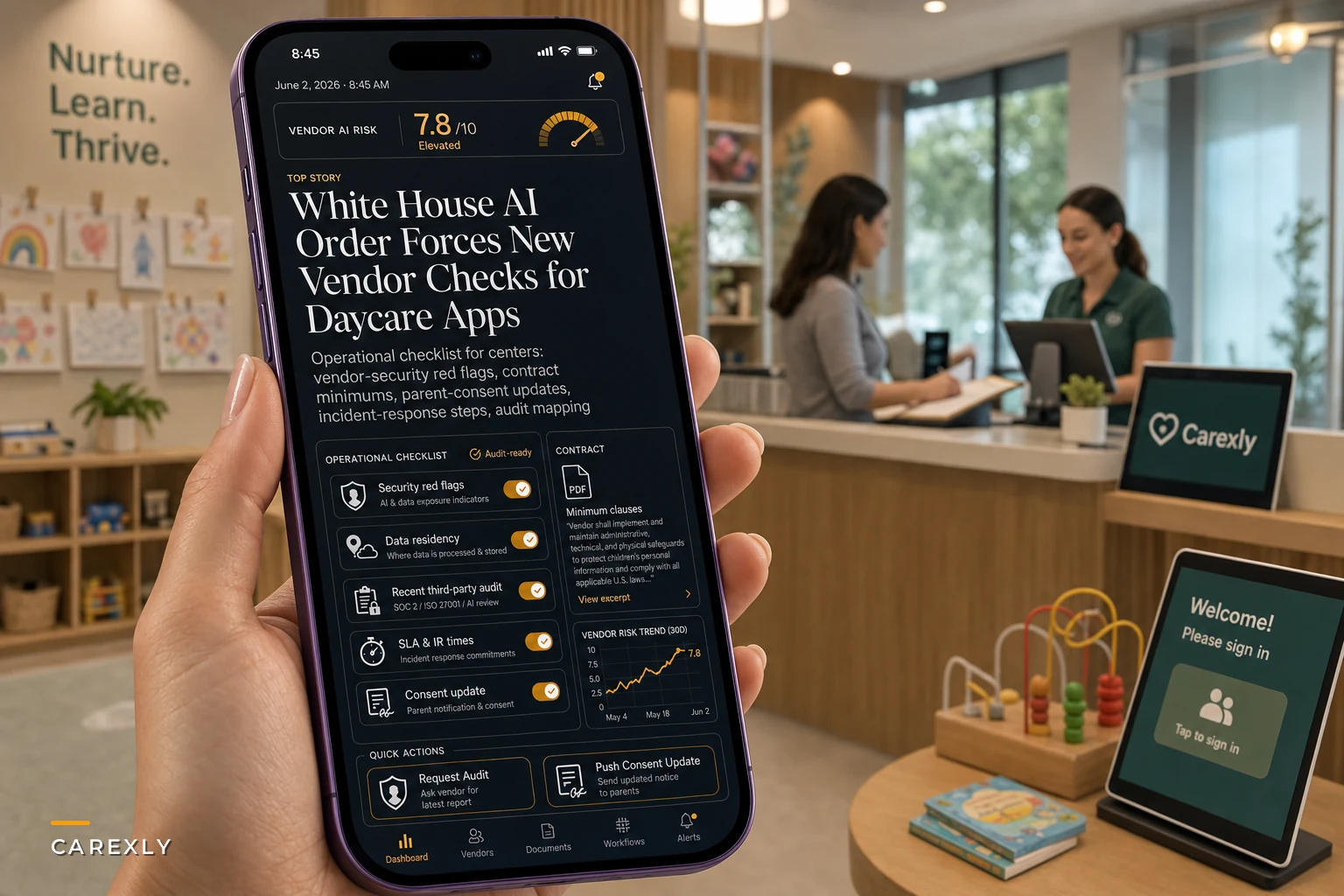

Monday morning. You're comparing two enrollment management platforms. Both promise streamlined waitlists, automated billing, parent portals. Same price range. Similar features. But starting this week, there's a massive difference between them that wasn't on your radar before.
The White House just issued an executive order directing federal agencies to accelerate AI security standards and push new guidance around AI-related cyber defenses and procurement. Sounds like Washington bureaucracy, right? Wrong. This changes everything about how you evaluate childcare software vendors — especially the ones using AI for enrollment predictions, staff scheduling, or parent communication.
What caught my attention: the order specifically calls for voluntary model submissions for government cybersecurity testing. Software companies are about to scramble to prove their AI systems are secure. The ones that can't? They'll lose government contracts, grants, and eventually, customers like you who need to pass state audits.
The vendor conversation you weren't having (but now must)
Last month, I watched a daycare director in Ohio get blindsided during a state audit. The auditor asked about their enrollment software's AI features — specifically, how parent data was being used to predict enrollment patterns. The director had no idea the system even used AI. Turns out, the vendor had added "intelligent forecasting" six months earlier without clear notification.
This is happening everywhere. Your attendance tracking system might be using AI to flag unusual patterns. Your parent communication platform could be using language models to draft messages. Your billing software might use machine learning for payment predictions. Most vendors don't clearly disclose this because most customers haven't been asking.
Now you need to ask. Not because you're anti-AI, but because state licensing bodies are about to start asking you.
The Reuters coverage of the order highlighted how this pushes new binding directives around AI procurement. Translation: if you receive any federal funding — Head Start, CCDF subsidies, military childcare contracts — your software choices are about to face new scrutiny.
What "AI vendor vetting childcare" actually means in practice
Picture this scenario. You're evaluating a new enrollment platform that promises to reduce your waitlist management time by 70%. Impressive, right? Under the old evaluation process, you'd check references, test the interface, negotiate pricing.
Eliminate administrative bottlenecks.
Carexly helps you manage enrollments, attendance, and staff schedules effortlessly.
- Streamlined child enrollment
- Automated parent notifications
- Staff shift and activity scheduling
No credit card required
Under the new reality, you need answers to questions like:
-
Does the system use AI to process or analyze parent data?
-
If yes, where is that data processed and stored?
-
Can the vendor provide documentation of their AI security measures?
-
How quickly can they respond to a data incident involving AI systems?
-
Will they notify you if they add AI features after you sign the contract?
A director in Phoenix recently discovered her scheduling software was using AI to predict staff callouts based on historical patterns. Not inherently bad — actually pretty useful. But the system was analyzing personal information like sick day patterns and even factoring in local weather data linked to employee zip codes. When a parent who worked in tech found out during a casual conversation, it sparked concerns about employee privacy that took weeks to address.
The feature was helping maintain ratios and reducing last-minute scrambles for coverage. But without proper disclosure and consent protocols, it became a liability.
The compliance audit connection nobody's talking about
Remember those surprise state licensing visits that already stress everyone out? They're about to get more complex. We've covered how to build role-mapped compliance workflows that keep documentation ready, but AI adds a new layer.
State auditors are receiving federal guidance to check how childcare centers handle AI-enhanced systems. Not because they want to make your life harder, but because parent data in AI systems creates new risks. If your attendance system uses facial recognition for check-in, that's AI processing biometric data of minors. If your communication platform uses AI to translate messages for non-English speaking families, that's AI processing potentially sensitive family information.
A center in California failed a routine audit last quarter — not because of ratio violations or safety issues, but because they couldn't explain how their management software's "smart scheduling" feature worked. The vendor's support team took three days to provide documentation, during which the center was flagged for follow-up review.
Building your vendor vetting checklist
Based on what different states are requiring, your vendor evaluation needs to include:
Immediate questions for current vendors:
-
List all AI or machine learning features currently active in our account
-
Describe the type of data each AI feature processes
-
Provide your AI security audit documentation from the last 12 months
-
Confirm your incident response time for AI-related security issues
-
Explain your data retention policies for AI training or processing
Red flags to watch for:
-
Vague answers about "proprietary algorithms"
-
No clear point of contact for AI security questions
-
Recent addition of AI features without customer notification
-
Data processing in countries without strong privacy laws
-
No option to opt-out of AI features while keeping core functionality
Documentation you need:
-
Written confirmation of what data is used for AI processing
-
Security audit reports (at least annually)
-
Incident response procedures specific to AI systems
-
Clear opt-out procedures for AI features
-
Notification policy for new AI feature additions
Visualize this vendor vetting workflow:
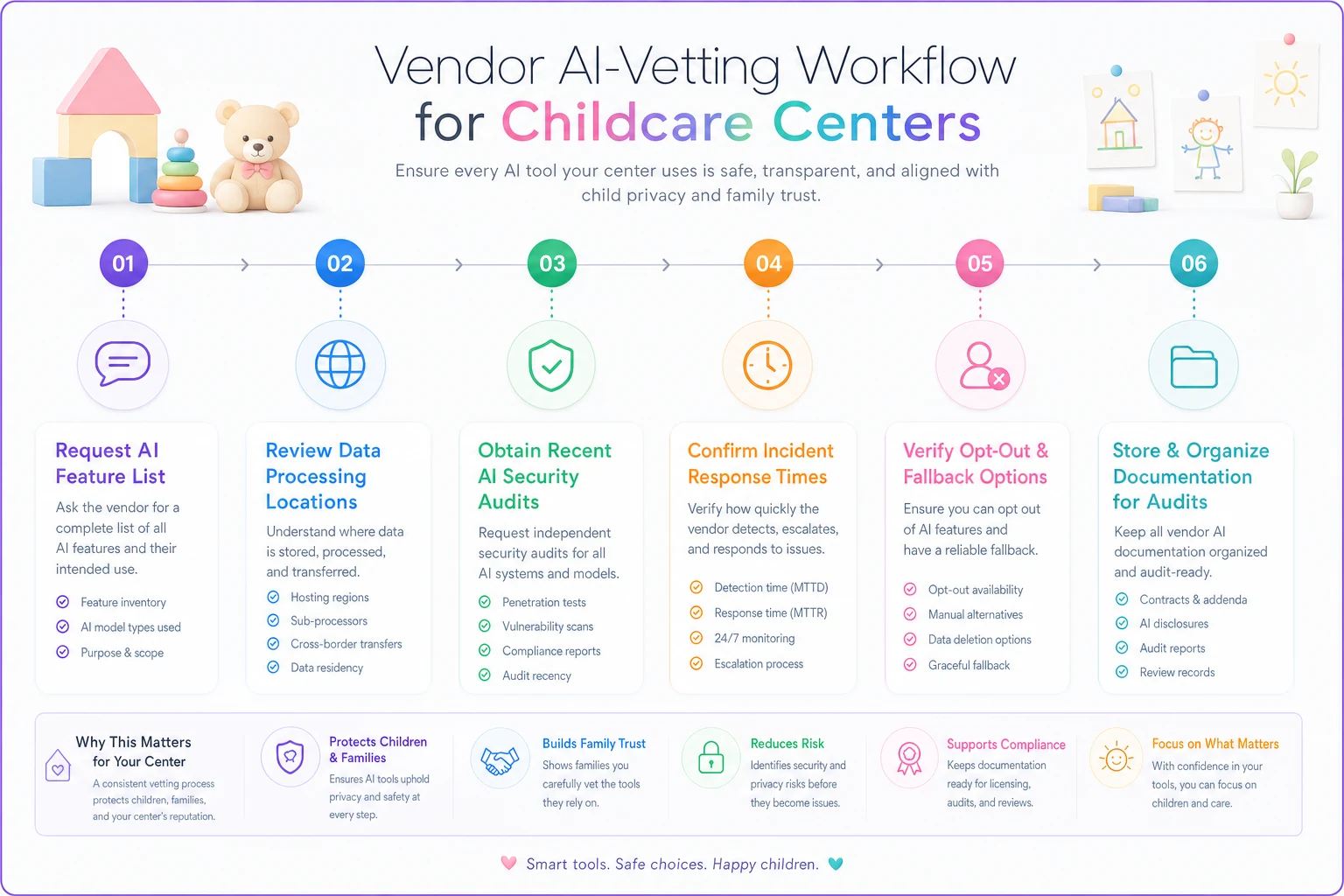
Keep a centralized, auditable folder of all vendor AI documentation to speed state audits.
Based on what different states are requiring, your vendor evaluation needs to include:
The enrollment platform evaluation that changed everything
Real example from a 120-child center in Maryland. They were choosing between two enrollment platforms last month. Platform A cost $200 less per month and had better reviews. Platform B cost more but provided detailed AI documentation upfront.
| Platform | Notes |
|---|---|
| Platform A | Platform A cost $200 less per month and had better reviews. Platform A's "smart waitlist" feature seemed great — it predicted which families would likely accept spots based on inquiry patterns. But when pressed, the vendor admitted the AI model was trained on data from all their clients nationwide. That means family behavioral patterns from California centers were influencing waitlist recommendations in Maryland. |
| Platform B | Platform B cost more but provided detailed AI documentation upfront. Platform B took a different approach. Their AI features were clearly labeled, with toggle switches to turn them off. They processed all data within the US, provided quarterly security audits, and had a 4-hour response time guarantee for AI-related incidents. Most importantly, they offered a "compliance package" with pre-written parent consent forms and staff training materials about AI features. |
The Maryland center chose Platform B. Two weeks later, they passed their state audit with zero issues. The director told me the auditor specifically praised their vendor documentation and parent consent protocols.
Parent communication about AI: the conversation you can't avoid
Parents are asking questions. Not all of them, but enough that you need a clear response. A dad who works in cybersecurity wants to know if facial recognition data from your check-in system is stored in the cloud. A mom who read about AI bias wonders if the scheduling system treats part-time families differently.
These aren't unreasonable concerns. Most centers don't have good answers because vendors haven't provided them. This is where AI vendor vetting becomes a parent relations issue, not just a compliance one.
Consider creating a simple one-page document:
"How We Use Technology to Protect and Serve Your Family"
List each system you use, whether it includes AI features, and what data it processes. Be specific but not technical. For example:
"Our enrollment system uses pattern recognition to predict peak enrollment periods, helping us maintain appropriate staffing. This system analyzes enrollment trends but never accesses individual family information for these predictions."
Parents appreciate transparency. Having this document ready shows state auditors you're proactively managing AI risks.
The operational advantage of proper vetting
Beyond compliance, proper AI vendor vetting creates unexpected operational benefits. When you understand exactly how your systems work, you can use them more effectively.
A center in Austin discovered during their vendor review that their communication platform's AI translation feature was consistently mistranslating allergy information in Spanish. They'd been using it for months without realizing the risk. After switching to a vendor with certified medical translation protocols, they not only improved safety but also saw enrollment increase by 15% in Spanish-speaking families who appreciated the accurate communication.
Another center found their scheduling software's AI was about 75% accurate at predicting when teachers would call out sick — three days in advance. Instead of being creepy about it, they used this insight to create a voluntary "on-call" pool of substitute teachers who got paid a small retainer to be available on high-probability days. Result? They haven't had a ratio violation in eight months.
When AI vendor vetting becomes a competitive advantage
The centers that get ahead of this aren't just avoiding problems — they're building trust. When parents tour your facility and you can confidently explain your technology safeguards, you stand out. When state auditors see comprehensive vendor documentation, you become the example they cite to other centers.
Understanding AI vendor capabilities helps you negotiate better contracts. If a vendor can't provide security documentation, that's leverage for a discount. If they offer robust AI features with proper safeguards, maybe that justifies a premium price.
A group of centers in Denver collectively negotiated with their management software vendor, demanding better AI documentation and security audits. The vendor initially resisted, then realized they'd lose 30 accounts. Now those centers get quarterly security reports, 24-hour incident response guarantees, and a 20% discount for being "AI accountability partners."
Moving forward with confidence
The White House executive order isn't meant to punish daycare centers — it's pushing the entire software industry toward better AI security practices. The burden of vetting falls on you, the buyer. And that's where it should be. You know your families, your compliance requirements, your risk tolerance better than any vendor.
Start with your current vendors. Send them the five immediate questions listed above. Their response — or lack thereof — tells you everything. The good vendors will appreciate the questions and have answers ready. The ones scrambling? Maybe it's time to explore alternatives.
For new vendor evaluations, make AI vetting part of your standard process. Not as an afterthought, but as a core evaluation criterion alongside price, features, and support. The vendors who can clearly explain their AI features, security measures, and data handling aren't just complying with federal expectations — they're showing they respect the trust you place in them with family data.
The centers that adapt quickly to these new requirements won't just avoid audit problems. They'll build more trustworthy operations, make better technology investments, and ultimately provide better care. When you truly understand the tools you're using, you can focus on what matters: the children and families you serve.
This shift in vendor vetting might feel like another compliance burden. It's really an opportunity to professionalize your technology stack, build parent trust, and stay ahead of regulatory changes. The centers doing this work now won't be scrambling when state licensing makes it mandatory. They'll already be there, documentation ready, parents informed, operations running smoothly.
The AI revolution in childcare software is here whether we planned for it or not. The question isn't whether to use AI-enhanced systems — most of us already are. The question is whether we'll be intentional, informed users who vet our vendors properly, or whether we'll get caught flat-footed when auditors start asking questions we can't answer.
Ready to transform your daycare operations?
Join hundreds of daycare centers using Carexly to save time, improve communication, and enhance child care quality.