



Starting July 1st, daycare centers across more than 20 jurisdictions face mandatory minimum wage increases ranging from $1.50 to $4.00 per hour. Cook County jumps to $14.05. Seattle climbs past $20. California localities push toward $18-19 floors. Your payroll run closing June 30th is the last one at current rates.
For a typical 35-child center running 8 staff near minimum wages, that's an extra $2,400 to $5,600 monthly hitting your July P&L — before overtime, before payroll taxes, before the compression problem where your $17/hour lead teachers suddenly make barely more than new hires off the street.
The real operational mess isn't the wage bump itself. Daycare centers run the tightest labor model in small business — you literally cannot cut headcount without violating state ratios. A restaurant facing the same pressure can pull a server shift. A retail store runs with one less cashier. You? Your 4:1 infant ratio is law. Your 10:1 preschool ratio is non-negotiable. Which leaves roughly 8 business days to restructure around higher labor costs you can't dodge by cutting staff.
Why Traditional Cost-Cutting Breaks Daycare Operations
Most businesses facing a 15-20% labor cost spike reach for the same playbook: reduce hours, combine roles, defer hiring. In childcare, every one of those moves triggers compliance violations.
Cut your floater's afternoon shift to save 4 hours daily? Now nobody covers teacher breaks, and you're technically out of ratio during every bathroom run and lunch. Combine assistant director duties with lead teaching to eliminate a salary? Your state licensing inspector will flag that immediately. Delay replacing the infant room teacher who quit last week? You'll cap enrollment in your highest-margin room.
Wage compression hits even harder than the base increase. Your experienced teachers at $16-17/hour suddenly earn $1-2 above new minimum wage. On paper, the gap between a 5-year veteran and a fresh hire disappears. Watch what happens when your best people realize they're making grocery-clerk wages for work that requires certifications, continuing education, and the ability to manage 8 toddlers at once.
The cascade is pretty predictable. July 5th, your lead toddler teacher mentions she noticed the Costco hiring sign at $18/hour. July 12th, two more teachers ask about raises. July 19th, someone quits. By August, you're burning $400/week on agency temps just to stay legal.
The Immediate Triage: What Needs Doing Before June 30th
Forget strategic planning for now. You have days, not months. The sequence matters more than perfect solutions.
Eliminate administrative bottlenecks.
Carexly helps you manage enrollments, attendance, and staff schedules effortlessly.
- Streamlined child enrollment
- Automated parent notifications
- Staff shift and activity scheduling
No credit card required
Below is an 8-day pre-July action timeline to follow closely.
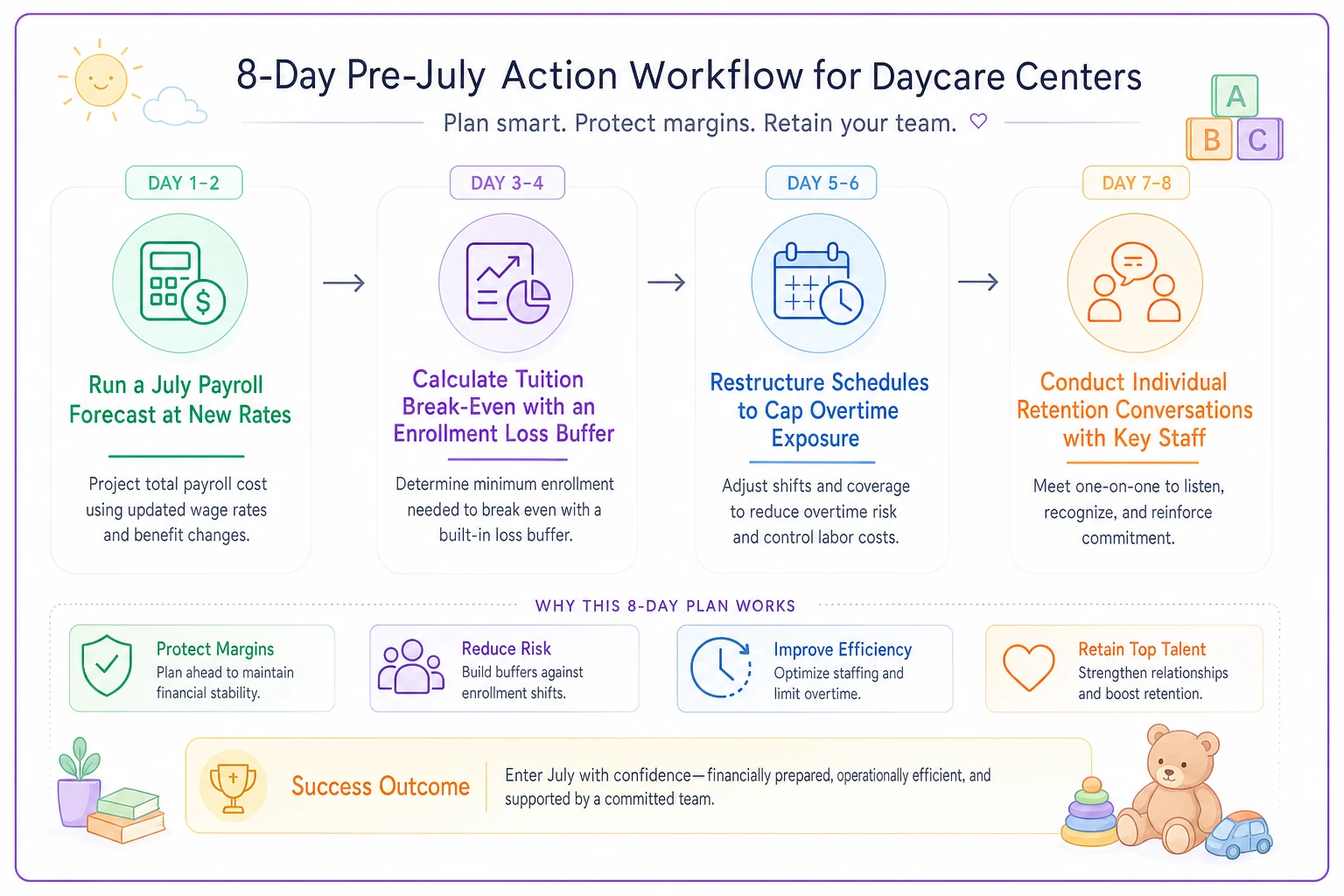
Day 1-2: Run your July forecast at new rates
Pull your actual June payroll register — not budgeted hours, actual clocked hours including overtime. Apply the new minimum wage to every employee below the new threshold. Add 7.65% for employer FICA on the increase. Add state unemployment insurance. Add workers comp premium increases if you're in a percentage-based state.
Don't skip the compression adjustments. Any employee currently within $2 of the new minimum needs a bump, or they're gone by August. A center with 6 employees at $13/hour and 4 at $15/hour facing a $15 minimum doesn't just bump the lower six — the four at $15 need to reach $17+ or they'll start looking.
Day 3-4: Identify your break-even tuition increase
Simple math first: total monthly labor cost increase divided by enrolled children equals minimum tuition bump needed. A $3,500 monthly increase across 35 kids means $100/child/month at minimum.
That's also fantasy math. Three families will leave immediately at any increase over $75/month. Two more will take until August to decide, leaving empty spots during peak payroll. Some competitors might absorb costs temporarily to poach your families. Realistic calculation: assume 10-15% enrollment loss from any tuition increase over $50/month. Price around that reality, not around perfect scenarios.
Day 5-6: Restructure schedules to minimize overtime exposure
Higher base wages make overtime genuinely catastrophic. Someone at $15/hour costs $22.50 in overtime. At the new $18 minimum, that's $27 for every minute past 40 hours.
Map every shift that currently risks overtime. Your opener who occasionally stays late when the 2pm teacher calls out? That's now a $70 mistake instead of $50. Build hard stops into schedules — nobody works past 38 hours except designated overtime-authorized roles. Use 3-4 part-timers to cover what one full-timer previously handled, keeping everyone under the overtime threshold.
Day 7-8: Lock in retention commitments
Recruiting in July is brutal. Every departure costs $1,800-2,500 in hiring, training, and temp coverage — now at higher rates than before.
Meet individually with your top 5 teachers. Not a group meeting where everyone vents. One-on-one conversations. Explain the compression fix coming in August even if you're still figuring out the details. Get verbal commits to stay through September. Offer non-monetary perks immediately — preferred schedules, classroom supply budgets, title changes that cost nothing but signal you see the difference between your veterans and a new hire.
The August Adjustment: Building Sustainable Operations at Higher Labor Costs
Once July payroll runs and the immediate crisis passes, you need systematic changes to stay profitable at these rates long-term.
The enrollment mix becomes critical. Infant care at 4:1 ratios generates roughly $400/month margin per child after labor. Preschool at 10:1 yields $180-220. Pre-K at 12:1 might hit $250. Your current mix might be 30% infant, 40% toddler, 30% preschool based on community demand — but at higher wage rates, that mix starts bleeding money.
| Room Type | Ratio | Est. Margin/Child/Month |
|---|---|---|
| Infant | 4:1 | ~$400 |
| Toddler | 6:1 | ~$250 |
| Preschool | 10:1 | ~$180-220 |
| Pre-K | 12:1 | ~$250 |
Centers making this work are converting toddler spaces to infant spaces, even though infant rooms need more equipment and specialized staff. The math holds: one infant room with 8 babies and 2 teachers at $18/hour generates more margin than a toddler room with 12 children and 2 teachers at the same rate. The facilities investment pays back in 4-6 months.
Some centers are testing radical schedule restructuring. Instead of 6:30am-6:30pm coverage requiring complex overlapping shifts, they're moving to 7:30am-5:30pm with premium-priced early/late care. Families who genuinely need 6:30am drop-off pay an extra $150/month. This concentrates demand and lets you run extended hours only when they're actually profitable.
There's also a hidden efficiency opportunity most centers ignore. One center tracked teachers spending 31 minutes daily on paper attendance, incident reports, and daily notes. At $18/hour, that's $35/day in pure paperwork labor. Multiply across 8 teachers for 260 days and you're burning roughly $70,000 annually on handwritten forms that could be automated.
This is also where building the right staffing lifecycle matters more than ever. You can't afford constant turnover at these wages. Every hire needs to stick for 18+ months just to break even on the investment.
Technology Leverage: Where Automation Actually Reduces Costs
The knee-jerk reaction is usually "we need software!" But most daycare management platforms just digitize your existing inefficiencies. You need specific automation that reduces labor hours without compromising care quality.
Attendance and ratio tracking
Manual headcounts eat 12-15 minutes per classroom daily. Teachers count, record, verify ratios, update whiteboards. At higher wages, that's roughly $500/month in labor just for counting children. Automated check-in systems with real-time ratio monitoring cut this entirely — parents scan QR codes or use door keypads, the system tracks ratios and generates compliance reports without anyone touching a clipboard.
Billing and payment processing
Most centers spend 3-4 hours weekly on payment processing: applying payments, chasing late accounts, updating billing records. At new minimum wages, that's around $280/week. Automated billing that syncs with attendance, applies payments, sends late notices, and updates records without manual input pays for itself in about six weeks.
Staff scheduling and timesheet management
Building compliant schedules that maintain ratios while avoiding overtime typically takes 4-6 hours weekly. Add another 2-3 hours for timesheet review. At $18/hour, you're spending $700-800/month on scheduling labor alone. Operational software with built-in scheduling logic — one that understands your ratio requirements, staff certifications, and overtime rules — can cut that down significantly.
Prioritize automations that eliminate daily teacher paperwork first — they compound fastest into annual savings.
What actually matters is whether these systems talk to each other. Separate attendance, billing, and scheduling platforms mean you're still manually moving data between them. The centers surviving this wage transition run integrated operational platforms where attendance drives billing, scheduling matches enrollment, and everything exports cleanly into payroll without double entry.
The Tuition Conversation: Scripts That Actually Work
You'll lose families regardless of how you position the increase. The question is whether you lose 3 or 12.
The worst approach is a generic letter about "rising costs" and "maintaining quality." Parents already know costs are rising — their grocery bills confirm it. They don't care about your operating expenses. They care about their own budget and their child's daily experience.
What actually minimizes departures is tying the increase to specific people and outcomes:
"Starting July 15th, tuition will increase by $75/month. This adjustment lets us maintain our experienced teaching staff through regional wage increases. Specifically, it means Ms. Sarah stays in the Butterfly room instead of taking the Target management position she was offered, and Ms. Jennifer remains with our infant program where she's cared for your children since 2019."
Name actual names. Parents will pay to keep teachers their kids love. They won't pay for abstract quality promises.
For families who push back, have a transition plan ready: "I understand this is tough. If you need to explore other options, I can give you references to a few quality centers with lower rates — though they typically have 2-3 month waitlists, and I'd need to know by July 5th to offer your spot to families on ours."
Urgency without ultimatums. Most families facing the actual hassle of switching centers over $75/month will stay put.
Timeline: Your Next 30 Days
Before June 30th:
-
Calculate exact payroll impact including taxes and compression adjustments
-
Identify break-even tuition with 10% enrollment loss buffer built in
-
Restructure all schedules to cap at 38 hours
-
Conduct individual retention conversations with top staff
July 1-7:
-
Announce tuition increase effective July 15th
-
Begin infant room conversion planning if the numbers support it
-
Audit manual processes for automation opportunities
-
Process any immediate resignation notices
July 8-15:
-
Finalize August schedules with overtime protections in place
-
Launch quick-win automations — digital attendance is usually the easiest first step
-
Handle family pushback conversations one-on-one
-
Post for any critical open positions at new wage rates
July 16-31:
-
Run first payroll at new rates and verify everything
-
Measure actual enrollment impact against your projection
-
Implement phase 2 operational changes
-
Begin September planning with real data instead of estimates
The centers that actually make it through this aren't necessarily the ones with the deepest pockets. Three months from now, the ones still running well will share a few specific traits worth noting.
The Centers That Thrive vs. Barely Survive
They moved fast on compensation but slow on operations. Matching minimum wage happened immediately, but schedule changes rolled out gradually with staff input. They didn't try to fix everything in July.
They picked their enrollment losses strategically. Instead of across-the-board increases and hoping everyone stays, they identified which families could absorb more and which would definitely leave. They priced around those realities and planned for specific departures rather than getting blindsided.
They automated one thing at a time. Not comprehensive digital transformation — targeted automation of whatever was burning the most labor hours. Usually attendance, billing, or scheduling. Pick one and actually nail it before moving to the next.
They took wage compression seriously. The centers losing their best teachers in August are the ones that ignored the psychological impact of veterans making barely above minimum. A title change, a schedule preference, or a $1.50/hour differential kept experienced people from walking into retail.
More than anything, they recognized this isn't a temporary crisis to outlast. These wage floors aren't rolling back. The operational model that worked at $12/hour is permanently broken. Centers building systematic efficiency now will be in a completely different position in two or three years while others scramble through the next version of this same problem.
Your July payroll deadline is fixed. Check your state's current minimum wage requirements if you haven't already confirmed your exact new rates. Whether this becomes a crisis or a turning point depends almost entirely on what you do in the next 10 days. Start with the payroll forecast — everything else follows from knowing your real number.
Whether this becomes a crisis or a turning point depends almost entirely on what you do in the next 10 days. Start with the payroll forecast — everything else follows from knowing your real number.
Ready to transform your daycare operations?
Join hundreds of daycare centers using Carexly to save time, improve communication, and enhance child care quality.