
Most centers that fail or stall on accreditation aren't running bad programs. They're running good programs with no paper trail. The teaching is solid. Family relationships are strong. Classrooms are warm and organized. But when the self-study window opens and someone has to produce evidence that a specific standard has been met across multiple classrooms, the whole thing collapses into a frantic scavenger hunt.
That gap — between doing the work and proving the work — is what this runbook is built to close. Not with a binder you throw together the month before your visit, but with a monthly capture rhythm that quietly builds your evidence file all year.
The scavenger-hunt problem, and why it keeps happening
The pattern repeats constantly. Accreditation feels far away, so evidence capture stays informal. A director makes a mental note that "Room 3 does great family conferences." A lead teacher has photos of a documentation wall somewhere on her phone. The health policy exists but nobody's checked whether signed acknowledgment forms are current for every family enrolled this year.
Then the self-study deadline lands. Now someone is texting three teachers asking if they still have that photo from October, reconstructing a lesson plan that got tossed in December, and chasing signatures on forms that should have been collected at enrollment.
This isn't laziness. The problem is that NAEYC and QRIS standards are written as outcomes — "the program supports children's social development," "teachers plan curriculum that responds to children's interests" — and outcomes don't tell you what artifact to save or when to save it. Somebody has to translate each standard into a concrete, recurring capture task with a name attached and a date it's due. Almost nobody does that translation until it's too late.
Translating standards into capture tasks
The core move in this whole system is turning a fuzzy standard into a specific, repeatable action. A standard says the program does something ongoing; your job is to decide what proves it and how often you need a fresh piece of that proof.
Eliminate administrative bottlenecks.
Carexly helps you manage enrollments, attendance, and staff schedules effortlessly.
- Streamlined child enrollment
- Automated parent notifications
- Staff shift and activity scheduling
No credit card required
| Standard area (paraphrased) | Evidence artifact | Capture frequency | Owner |
|---|---|---|---|
| Curriculum responds to children's interests | Dated lesson plans + reflection notes tied to observations | Monthly, one sample per classroom | Lead teacher |
| Family engagement & communication | Conference summaries, newsletter copies, sign-in logs | Per conference cycle + monthly comms sample | Assistant director |
| Health & safety practices | Daily health check logs, sanitation schedule photos | Monthly spot-capture | Room lead |
| Assessment of child progress | Portfolio snapshots (photos, work samples, notes) | 2–3 children per class per month | Lead teacher |
| Staff qualifications & ongoing training | Certificates, training hours logs | As earned + quarterly reconciliation | Director |
| Environment & materials | Classroom layout photos, materials inventory | Quarterly, plus after major changes | Room lead |
The key insight most centers miss: you don't need to document everything. You need a defensible sample captured consistently. An assessor isn't going to read through 40 lesson plans from one room. They want to see that a real, dated, repeating practice exists. Two solid samples a month per classroom beats a shoebox of undated photos every time.
The "capture frequency" column does the heavy lifting. Once a standard has a frequency, it becomes a calendar item instead of a someday intention.
Role ownership: the part that decides whether this survives
A capture task with no owner is a task that doesn't happen. This is the single biggest reason evidence systems fall apart — everyone assumes someone else has it covered.
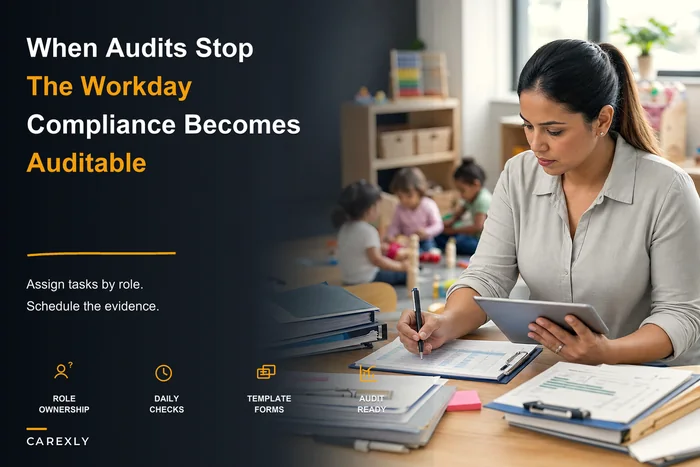
Assign ownership by proximity to the evidence, not by seniority. The person who creates the artifact should be the one who captures it. Lead teachers own classroom-level evidence because they're in the room when it's produced. The assistant director owns family-facing communication because that flows through the front office. The director owns anything program-wide — staff credentials, policies, compliance documents.
-
- Lead teachers — lesson plans, child portfolios, documentation walls, environment photos for their room
-
- Room leads / assistants — daily health logs, sanitation schedules, attendance-adjacent records
-
- Assistant director — family conferences, newsletters, communication samples, enrollment forms
-
- Director / owner — staff qualifications, training records, policies, licensing overlap, the master evidence index
Ownership should follow reliability, not job title.
One pattern worth borrowing: give each classroom a "capture champion" who isn't necessarily the lead teacher. Sometimes the most organized person in the room is the assistant. Ownership should follow reliability, not job title. A center that assigns capture to whoever actually remembers to do it ends up with a far cleaner file than one that assigns it strictly by rank.
The submission calendar
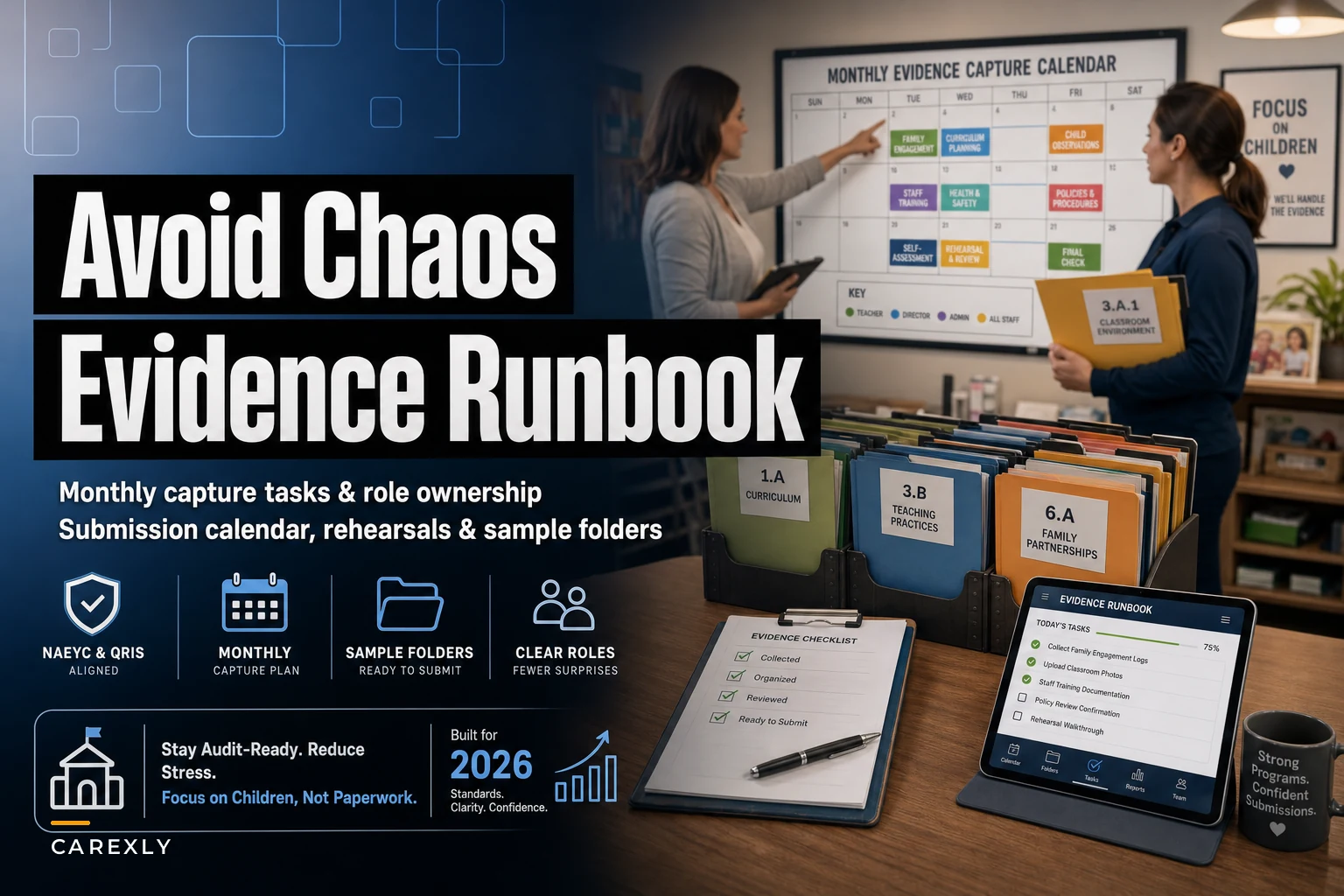
This is where a runbook beats a binder. Instead of one giant push, you spread capture across twelve predictable months. Each month has a small, bounded set of tasks tied to a submission date — a day when owners drop their artifacts into the shared system and someone confirms nothing's missing.
-
1. First week of the month — owners capture that month's required samples (lesson plan + reflection, portfolio snapshots, one comms sample per room).
-
2. Second week — room leads capture health/safety and environment items on their spot-check schedule.
-
3. Third week — assistant director reconciles family-facing evidence: conferences held, newsletters sent, forms signed.
-
4. Last business day — the submission date. Everything for the month gets filed. The director runs a five-minute completeness check against the month's list and flags gaps.
Quarterly, layer in the heavier reconciliations — staff credential audits, materials inventory, a review of which standards still feel thin on evidence. That quarterly check is your early-warning system. If a standard has three months of empty folders, you find out in month three, not the week before your visit.
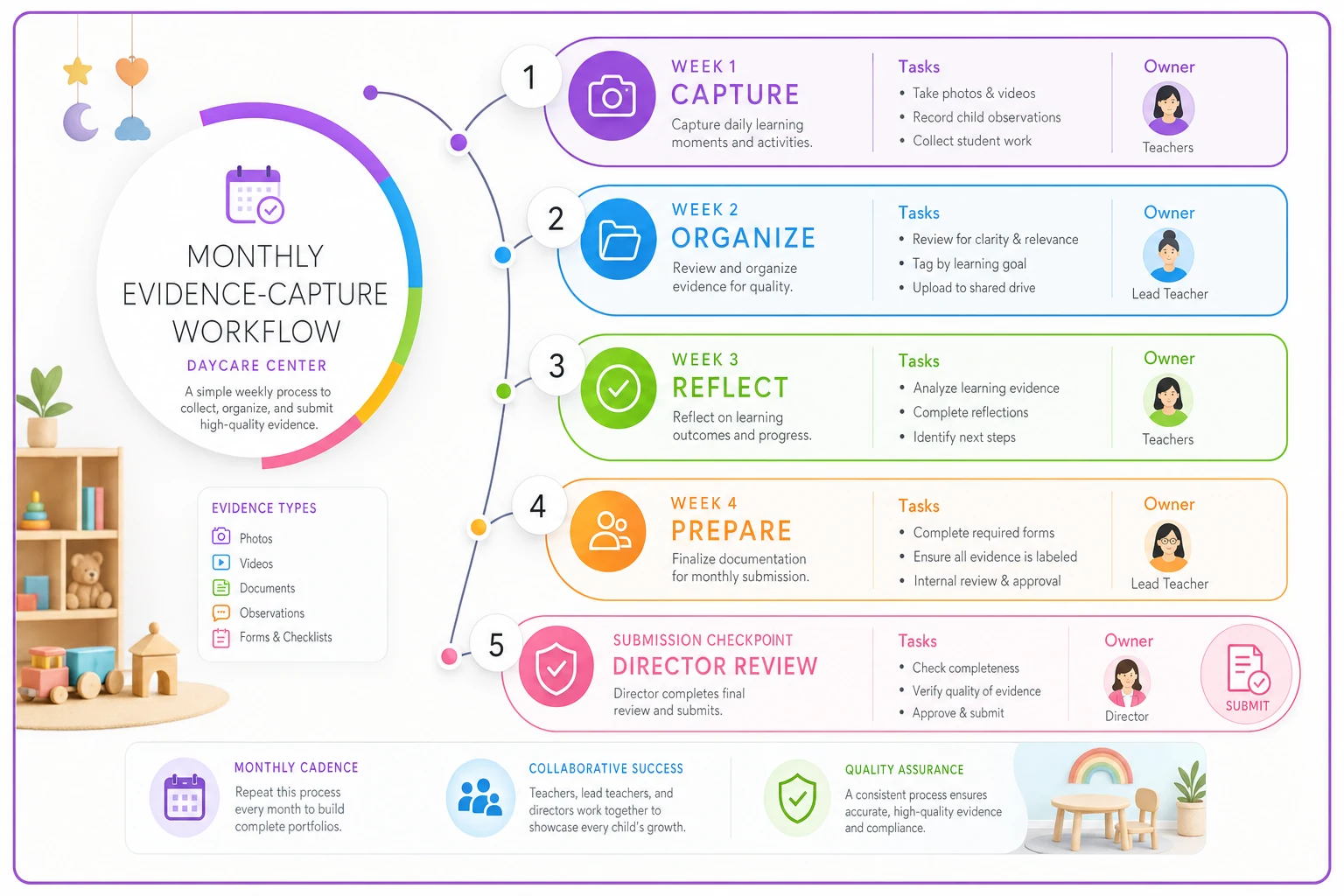
Here's a simple visual to imagine the monthly rhythm and handoffs.
Centers that make this stick treat the monthly submission date like payroll: non-negotiable, on the calendar, with someone responsible for confirming it happened. If the completeness check is nobody's job, the calendar becomes decoration.
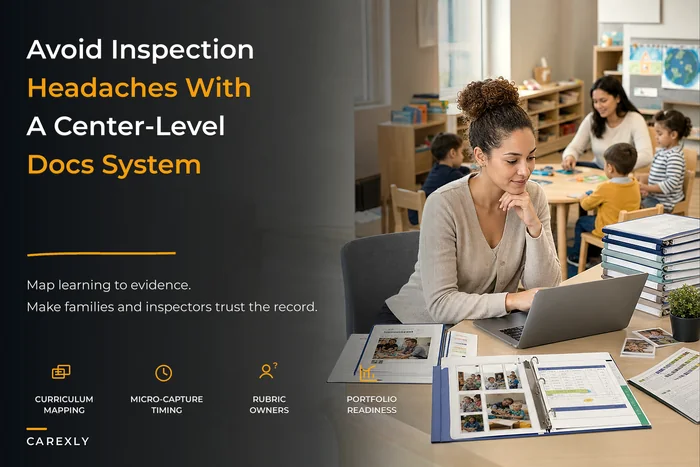
This connects directly to the broader documentation habits covered in a center-level learning and documentation system families and regulators trust — the evidence-capture calendar is essentially that system aimed specifically at accreditation standards.
Sample folders: structure your evidence like the assessor reads it
A shared drive full of photos named "IMG_4821" is not an evidence system. Your folder structure should mirror the standard areas so that when you're asked for evidence of a specific standard, you go straight to that folder.
/Accreditation Evidence /Curriculum /Room 1 /2025-01, 2025-02... /Room 2 ... /Family Engagement /Health & Safety /Assessment & Portfolios /Staff Qualifications /Environment
-
- Every file gets a date and a room in its name.
Room22025-03lessonplan.pdftells you everything at a glance. Undated evidence is nearly worthless to an assessor. -
- Keep one "sample folder" per standard area that holds your two or three strongest examples — the ones you'd actually show. During prep, you're curating from the full monthly captures into these highlight folders, not scrambling to create anything new.
A common mistake: centers save too much and drown their strong evidence in noise. The monthly capture builds the raw material; the sample folder is where you promote the best of it. Assessors respond to clarity, not volume.
Pre-inspection rehearsals
You wouldn't send a teacher into a new classroom with no walkthrough. Same logic applies to your evidence file. A rehearsal is a dry run where someone plays assessor and pulls evidence on demand.
Run it like this: a few weeks before your visit, hand a colleague a list of standards and ask them to request evidence at random — "show me evidence that curriculum responds to children's interests in Room 3." Time how long it takes to produce it. If it takes more than a minute or two, the folder structure or the labeling needs work.
-
- [ ] Can you produce dated evidence for every standard area within two minutes?
-
- [ ] Does every classroom have samples for the last three consecutive months?
-
- [ ] Are all staff credentials current and matched to a saved certificate?
-
- [ ] Are family acknowledgment forms complete for currently enrolled families, not last year's roster?
-
- [ ] Do sample folders contain your strongest 2–3 items, clearly labeled?
-
- [ ] Is there any standard where the evidence folder is thin or empty?
-
- [ ] Can someone other than the director find evidence without asking for help?
That last item matters more than people expect. If only one person knows where everything lives, a sick day during your visit becomes a real problem. Rehearsals expose single points of failure while you still have time to fix them.
A real scenario
A two-room center preparing for QRIS renewal had strong classroom practice but no capture routine. Their first rehearsal was rough — asked to show three months of curriculum evidence for the toddler room, the director found one dated lesson plan and a handful of undated phone photos. Pulling together a single standard's worth of evidence took most of an afternoon.
They set up the monthly rhythm: two lesson-plan samples per room, portfolio snapshots for two or three children, and one family-communication sample, all due the last business day of the month. Ownership went to the leads, with the director running the completeness check.
By month three, the submission date took about fifteen minutes to confirm. Their next rehearsal, the same "show me three months of curriculum evidence" request was answered in under a minute. Nothing about their teaching changed — they'd been doing good work the whole time. What changed was that the work was now provable on demand, without anyone staying late.
Where software quietly earns its keep
You can run this on a shared drive and a spreadsheet, and plenty of small centers do just fine with that setup. The friction shows up in two spots: remembering the monthly capture tasks, and confirming nothing's missing before the submission date.
That's the narrow place where an operational platform helps — assigning each capture task to an owner, sending the monthly reminder automatically, and flagging which classrooms haven't submitted before the deadline passes. AI-assisted workflows can also surface gaps when a standard area's evidence folder runs thin, so you find out in month two instead of during your rehearsal. It's not doing the teaching or the judgment for you; it's just making sure ownership and calendar discipline don't quietly erode over a busy year.
If your accreditation prep overlaps with licensing and inspection cycles, it's worth mapping the two together so the same artifacts serve double duty — the approach in a role-mapped, auditable compliance workflow for daycare centers pairs naturally with this evidence-capture rhythm.
When this level of structure makes sense — and when it's overkill
This full runbook is worth building if you're actively pursuing NAEYC accreditation or a higher QRIS tier, running more than one classroom, or if a past review stalled specifically on documentation. The coordination overhead pays off the moment you have to prove practice across multiple rooms.
It's probably overkill for a very small home-based program with a single caregiver who can produce everything from one well-organized drive in minutes. In that case, a simple monthly folder habit is plenty.
And standing this up three weeks before your visit is a bad idea. The whole value is the accumulated monthly record. Starting at the last minute gives you the calendar overhead without the built-up evidence. If a deadline is already close, focus on curating what exists and labeling it clearly, then build the ongoing rhythm for next cycle.
Accreditation chaos isn't caused by weak programs. It's caused by good programs treating evidence as a last-minute task instead of a monthly habit. Translate each standard into a specific capture task, hand it to the person closest to where that evidence is made, put a submission date on the calendar, and rehearse before it counts. Do that, and the visit stops being a scramble — it becomes a walkthrough of a file you've been quietly building all along.
Ready to transform your daycare operations?
Join hundreds of daycare centers using Carexly to save time, improve communication, and enhance child care quality.