

Most centers don't have a documentation problem. They have a documentation system problem.
A documentation problem looks like a folder missing a few observation notes. A documentation system problem looks like this: your most experienced pre-K teacher can describe a child's growth in beautiful detail during a parent conference, but when an inspector asks to see how that observation ties back to a curriculum goal, there's nothing on paper. The knowledge lives in her head. The moment she calls out sick — or leaves — it walks out with her.
That gap between what teachers know and what your center can show is where inspection headaches come from. It's also where family trust quietly erodes, because parents can sense the difference between "your kid had a great day" and "here's exactly how your kid is progressing toward specific developmental milestones."
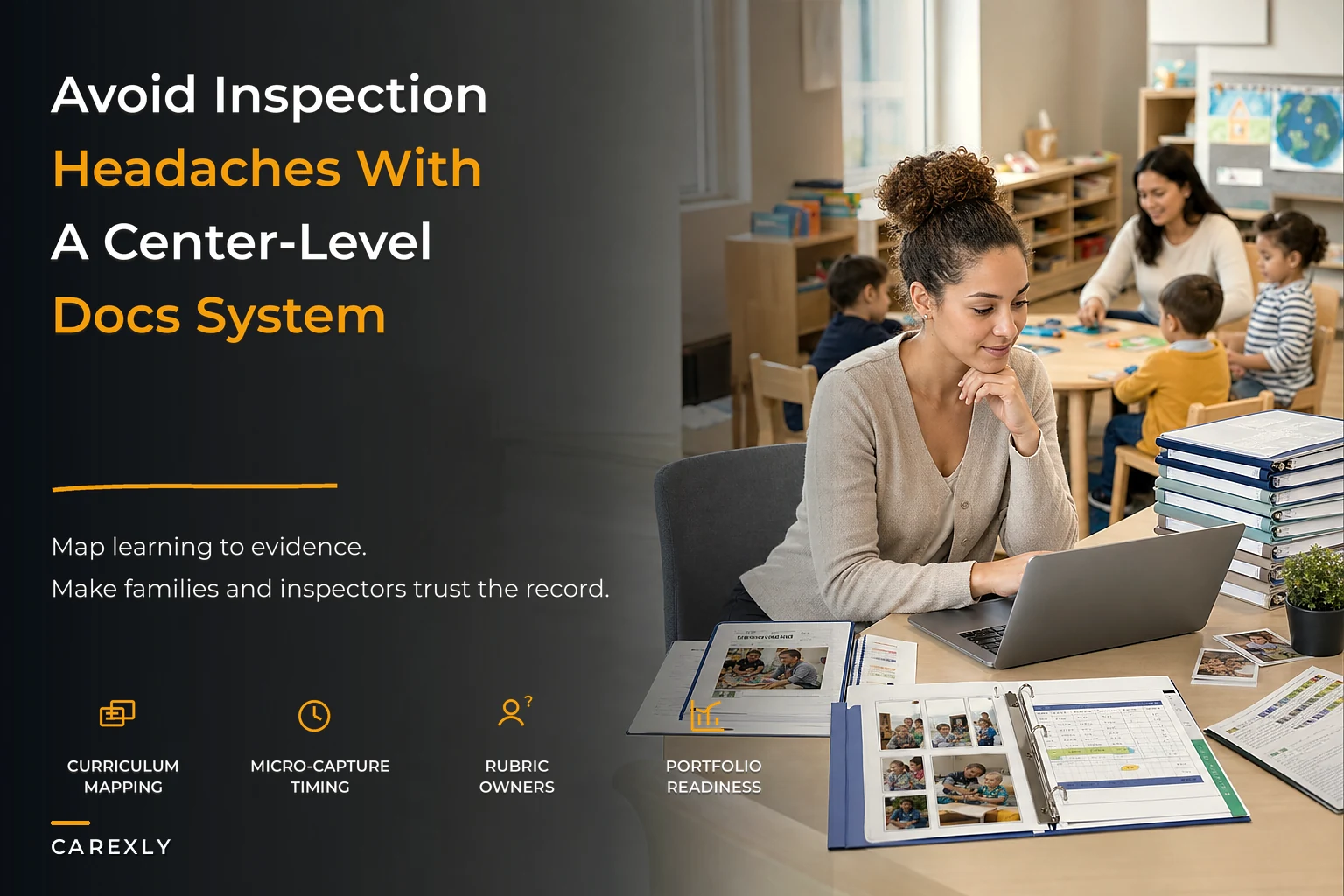
A real childcare learning documentation system connects four things most centers treat as separate chores: curriculum goals, daily teacher observations, portfolios, and family reports. When those four pieces don't talk to each other, teachers end up doing the same work three times and inspectors still find holes.
The four-layer chain most centers never fully connect
Think of documentation as a chain with four links. Each one feeds the next. If any link is weak, everything downstream falls apart.
-
Curriculum goals — the developmental outcomes you're actually trying to produce (language, motor skills, social-emotional, early math, etc.)
-
Micro-captures — small, in-the-moment observations teachers record during the day
-
Observation rubrics — the scoring layer that turns raw captures into evidence of progress
-
Portfolios + family reports — the assembled output that families read and inspectors review
The pattern that shows up constantly: centers invest heavily in the first link (they buy a nice curriculum) and the last link (they send cute monthly newsletters). The middle two — the micro-captures and the rubric — are where everything actually breaks.
Why? Because those middle links depend on teachers doing consistent, structured work during the most chaotic part of their day. "Consistent structured work during chaos" is exactly what falls apart first when a room is short-staffed or a teacher is new.
The core insight
Documentation quality isn't determined by your best day. It's determined by your worst-staffed Tuesday. If your system only works when a strong lead teacher is fully present and calm, it isn't a system — it's a dependency.
Why micro-captures beat "sit down and write observations later"
The most common failure mode is asking teachers to write observations at the end of the day or during nap time. It sounds reasonable. It almost never works.
Eliminate administrative bottlenecks.
Carexly helps you manage enrollments, attendance, and staff schedules effortlessly.
- Streamlined child enrollment
- Automated parent notifications
- Staff shift and activity scheduling
No credit card required
By 2:30pm, a teacher who spent the morning managing fifteen toddlers can't accurately reconstruct what happened at 9:15am. So what ends up in the record is a vague, generic summary: "Marcus played well with others and enjoyed the sensory table." That sentence is useless. It doesn't map to a goal, it doesn't show progress, and it reads identically to what she wrote about Marcus three weeks ago.
Micro-captures flip the timing. Instead of one big writing session, teachers grab tiny structured snapshots in the moment — a photo, a ten-second voice note, or a two-tap entry. The whole thing takes under fifteen seconds and happens while the memory is still fresh.
-
Child (tap to select)
-
Goal domain (language / motor / social-emotional / cognitive / self-help)
-
What happened (one line or a photo)
-
Level (emerging / developing / secure)
That's it. If a capture takes longer than fifteen seconds, teachers will skip it, and you're back to vague nap-time summaries.
A quick example of the difference
> Vague version: > "Aria had fun during circle time." > Micro-capture version: > Aria — Language — "Used three-word phrase 'I want more' unprompted during snack" — Developing
The second one takes almost the same effort but it's evidence. It maps to a goal, it shows a level, and six of these across a month tell an actual story of growth. An inspector reading it sees a functioning system. A parent reading it sees a teacher who genuinely knows their kid.
The rubric layer: where subjective becomes defensible
Captures are raw material. The rubric is what turns fifteen scattered observations into "here is where this child stands and here's the evidence."
The most common mistake is centers using rubrics that are either too vague ("meets expectations") or absurdly detailed — a 40-point developmental checklist no teacher will ever complete honestly. Both fail. The vague one gives inspectors nothing to verify. The overly detailed one gets filled in with copy-paste answers because no one has time to score 40 items per child per month.
The sweet spot is a handful of domains, each scored on a simple three-level scale, with required evidence attached. The evidence requirement is what makes a score defensible rather than just an opinion.
Here's a sample structure:
| Domain | Emerging | Developing | Secure | Evidence required |
|---|---|---|---|---|
| Language | Uses single words | Combines 2–3 words | Full sentences, follows 2-step directions | 2 captures/month |
| Fine motor | Grasps large objects | Uses pincer grip | Uses scissors/writing tools with control | 2 captures/month |
| Social-emotional | Plays alongside peers | Brief cooperative play | Sustained cooperative play, resolves minor conflict | 2 captures/month |
| Self-help | Needs full assistance | Attempts independently | Completes routines independently | 1 capture/month |
The "evidence required" column is the quiet enforcer. A teacher can't mark a child "secure" in language without at least two captures backing it up. When an inspector asks how you determined that score, the answer is right there attached to the rating. No scrambling.
The pattern nobody talks about
The rubric doesn't just serve inspections. It surfaces coverage gaps you'd otherwise never notice. If you run a report and see that self-help skills have almost no captures across the whole toddler room, that's not a documentation gap — that's telling you the curriculum isn't touching self-help, or teachers aren't noticing it. The documentation system becomes a mirror for what your program is actually doing versus what it claims to do.
Portfolio assembly: stop rebuilding everything by hand
If captures and rubrics are working, portfolios should mostly assemble themselves. That's the payoff.
In most centers, portfolio time is a nightmare. Once a quarter, teachers spend hours pulling photos off phones, printing them, writing captions, hunting for that one artwork sample, and stapling it into a binder. It's dreaded, it's rushed, and it always happens the week before conferences or inspections.
When your captures are already tagged by child and goal domain, the portfolio is just a filtered view. The assembly rule is simple:
-
Pull all captures for Child X between date A and date B
-
Group them by goal domain
-
Include the highest-level capture in each domain plus one photo artifact
-
Attach the current rubric scores
-
Flag any domain with fewer than the minimum required captures
That last rule matters most. A portfolio that flags its own gaps before an inspector finds them is worth more than a polished one that hides them. You want to know a child has thin motor-skill documentation in week two, not the morning of the visit.
Flag domains with low capture counts early so portfolios self-audit before conferences.
When manual portfolios still make sense
Not every center needs to automate this. If you run a small home-based program with eight kids and one primary caregiver who knows every child intimately, a well-organized paper binder can genuinely be enough. The overhead of a structured system probably doesn't pay off until you're past roughly 25–30 children or running more than two or three classrooms — that's the point where individual memory stops scaling and inconsistency between rooms becomes your real risk.
The monthly family-report workflow
Family reports are where all this work either pays off or gets wasted. And most centers get the cadence wrong before they get the content wrong.
Sporadic reporting — "we'll send updates when we have something good" — trains families to expect nothing, so a report appearing out of nowhere tends to signal a problem. That's backwards. A predictable monthly rhythm builds the trust that keeps families enrolled. This connects directly to the broader relationship work covered in mapping the inquiry-to-alumni family engagement lifecycle — documentation is one of the strongest retention levers you have, because it's proof of value families can actually see.
A workflow that runs cleanly at the end of each month:
-
Auto-compile each child's captures and current rubric scores for the month
-
Teacher review — 3–5 minutes per child to add one personal sentence and flag anything worth discussing
-
Lead/director spot-check — scan for domains with missing evidence, fix before sending
-
Generate the family version — plain language, photos, one "growth highlight," one "what's next"
-
Send + log — timestamp when each report went out and to whom
The teacher review step is deliberately capped at a few minutes per child. If it takes longer, teachers fall behind and reports go out late or not at all. The system does the heavy lifting; the human adds the warmth.
What a family-ready report actually says
> This month, Leo's language really took off. We noticed him starting to use full sentences to ask for things — like "Can I have the red truck?" during free play (see photo). He's also getting more comfortable joining group activities without needing an adult nearby. > > What's next: We'll be encouraging Leo to describe what he's building or drawing, to keep stretching those sentence skills. > > Growth this month: Language — Developing → Secure
It's warm and readable, but that last italic line is the same data an inspector sees. One record, two audiences. That's the whole design principle: write once, satisfy both families and regulators.
The dual-audience problem, solved by design
The reason documentation is so exhausting in most centers is that teachers effectively maintain two systems — one for parents (nice, photo-heavy, emotional) and one for compliance (dry, checkbox, defensible). They're documenting the same child twice in two different languages.
A properly built system produces both from a single set of captures. The compliance view shows goal mapping, evidence counts, and rubric progression. The family view shows the same underlying facts translated into plain, warm language. Nobody writes anything twice.
This is also what makes inspections calmer. Instead of a frantic assembly week, everything is already assembled and self-auditing. When compliance visits stop feeling like fire drills, the whole operation runs smoother — which connects to the broader idea of building a role-mapped, auditable compliance workflow so documentation isn't the thing that always trips you up.
When this is a bad idea
Don't try to roll out a full four-layer system all at once across every classroom. Centers that do this usually see teacher pushback and quiet abandonment within a month, because you've added workload before proving value. Start with one room and one age group. Get the micro-capture habit solid before touching rubrics. Get rubrics working before automating portfolios. Layer it in.
And if your teachers are already drowning — high turnover, chronic short-staffing — fix the staffing pressure first. A documentation system built on top of a broken staffing floor will collapse, because the middle links depend on teachers having fifteen seconds of breathing room. No amount of software fixes a room where the teacher never gets a moment to breathe.
A real scenario
A center running three classrooms — infants, toddlers, and pre-K, around 45 kids total — was preparing for a state re-licensing visit. Their documentation was the usual mix: some teachers kept great notes, one room had almost nothing, and portfolio assembly was a two-day scramble every quarter that ate into planning time.
The director estimated she spent close to a full day each month chasing teachers for missing observations and reconciling what was documented against curriculum goals. During the previous inspection, the toddler room got flagged for insufficient developmental documentation — not because the teaching was bad, but because there was no evidence trail connecting activities to goals.
They moved to structured micro-captures with a simple three-level rubric and a monthly report cadence. The change wasn't dramatic overnight. Over about three months, capture consistency across all three rooms went from wildly uneven to fairly reliable — the weak room went from a handful of observations a month to a few per child per week. The quarterly portfolio scramble basically disappeared, because portfolios became filtered exports instead of manual assembly jobs.
The real payoff showed up at the next inspection. The director pulled up each room's evidence report and rubric coverage in a few minutes. No flags. And a quieter win: parents at conferences started saying they finally understood what their kids were actually learning, not just that they'd had a good day. A couple of families who'd been on the fence about staying through the pre-K transition ended up re-enrolling.
The bottleneck to watch as you grow
At one classroom, documentation quality is basically about one teacher's habits. At three classrooms, it's about consistency between rooms. At five or more classrooms or multiple sites, it becomes about whether a director can see documentation health across the whole operation without physically walking into every room.
That's the real bottleneck growing centers hit — not the writing of observations, but visibility into whether observations are happening at all. A director can't personally verify captures across 80 kids. So the thing that has to scale isn't teacher effort — it's the ability to spot a room falling behind before it becomes an inspection finding. A dashboard showing "toddler room is at 40% of expected captures this month" turns a quarterly disaster into a Tuesday-afternoon nudge.
This is where an integrated childcare learning documentation system earns its place — not because it writes observations for you, but because it makes the invisible visible, keeps the capture-to-report chain intact, and lets a small team maintain consistent quality across many children without anyone doing the same work twice. The software isn't the point. The connected chain is the point. The software just keeps the chain from breaking under the weight of a busy Tuesday.
Pulling it together
Documentation stops being a headache when it stops being a separate task bolted onto teaching. The centers that sail through inspections and keep families loyal aren't the ones with the fanciest binders — they're the ones where a quick in-the-moment capture flows automatically into a rubric, into a portfolio, into a family report, all from a single entry.
Here's a simple visual of that chain.
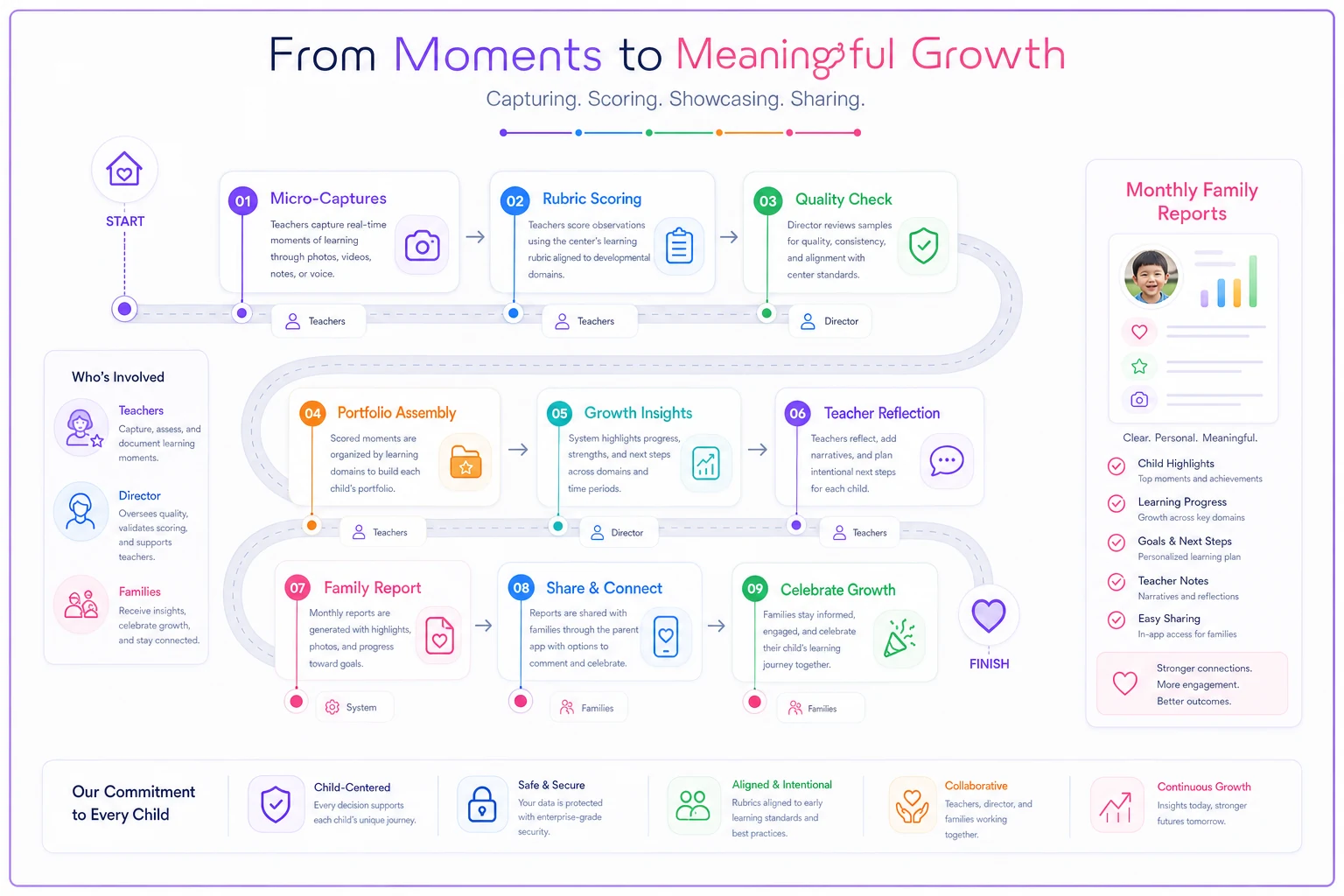
Build the chain link by link. Keep captures under fifteen seconds. Make rubrics defensible with required evidence. Let portfolios assemble themselves. Send families a predictable monthly story with the compliance data quietly baked in. Do that, and inspection week stops being something you dread — it becomes the week your system finally gets to show its work.
Build the chain link by link. Keep captures under fifteen seconds. Make rubrics defensible with required evidence. Let portfolios assemble themselves. Send families a predictable monthly story with the compliance data quietly baked in. Do that, and inspection week stops being something you dread — it becomes the week your system finally gets to show its work.
Ready to transform your daycare operations?
Join hundreds of daycare centers using Carexly to save time, improve communication, and enhance child care quality.