

The director at a 120-kid center near Denver showed me her family communication spreadsheet last month. Seven tabs, color-coded by classroom, with columns tracking who got which newsletter when. She spent three hours every Friday updating it, copying parent emails between sheets, marking who responded to event invites.
"We're losing families to the Montessori school down the street," she said. "They have worse ratios and higher prices, but parents rave about how connected they feel."
Her problem wasn't the spreadsheet. It was thinking family engagement meant sending the same weekly newsletter to everyone.
The daycare family engagement lifecycle nobody maps properly
Most centers handle parent communication like a light switch — either you're enrolled or you're not. But family engagement flows through distinct phases, each needing different touchpoints, different team members, and completely different success metrics.
Centers with waiting lists still lose 40% of families within eighteen months. Not because of quality issues. They never built systems that recognize families moving through predictable stages from first inquiry through becoming advocates.
The lifecycle breaks down like this:
Inquiry phase (0-30 days)
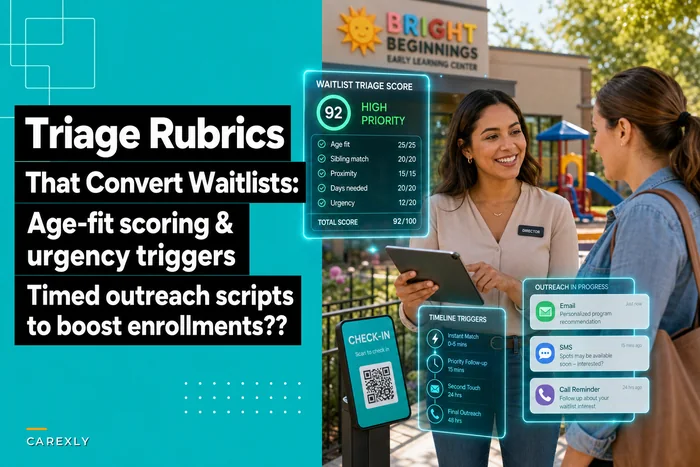
A parent calls asking about openings. Your front desk takes basic info, maybe schedules a tour. Most centers stop there. The ones with 85%+ conversion rates have inquiry scorecards tracking response time, tour booking rate, and handoff clarity.
Enrollment phase (30-60 days)
Tour happens, paperwork starts, deposits get collected. Most centers focus all their energy here — enrollment packets, immunization records, emergency contacts. But the emotional journey matters more than paperwork. Parents aren't comparing tuition rates. They're imagining their kid's daily experience.
Onboarding phase (first 90 days)
Kid starts, separation anxiety kicks in, routines form. Centers typically assign this to classroom teachers, but teachers juggling twelve toddlers don't have bandwidth for detailed parent updates. Centers crushing retention assign a specific admin role to shepherd new families through month one.
Active family phase (3 months - 2+ years)
The long middle where most relationships die slowly. Parents get busy, communication becomes transactional pickup/dropoff chitchat, engagement drops to nothing. Without intentional touchpoints, families drift toward "just another vendor" mindset.
Alumni/referral phase (post-graduation)
Families leave for kindergarten and disappear forever. Except at centers running proper alumni programs — those places get 30-40% of new enrollments from sibling referrals and alumni recommendations.
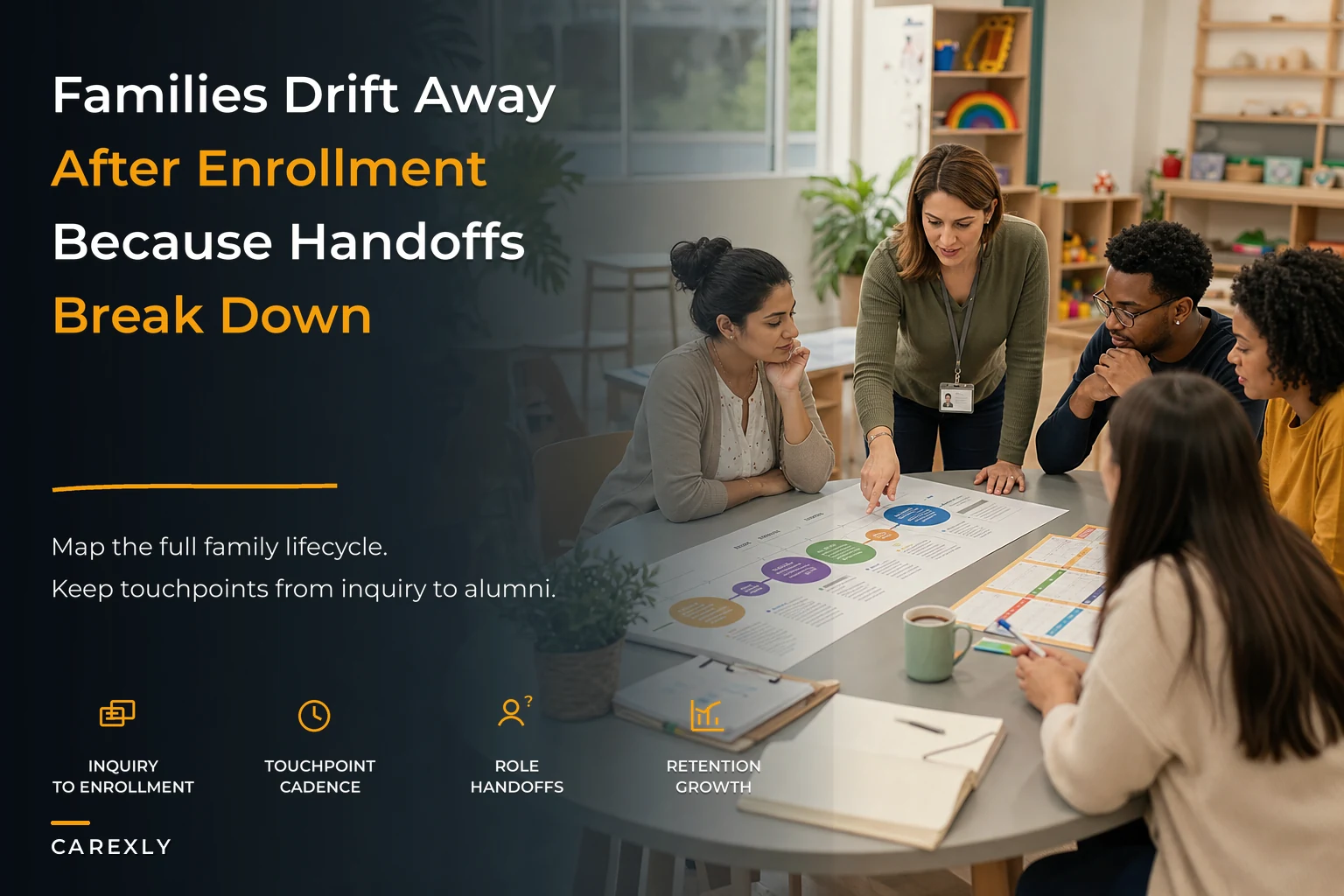
The breakdown happens because nobody owns the full journey. Front desk owns inquiry, admin owns enrollment, teachers own daily care, director owns everything else. That's not a system.
Why traditional parent communication breaks at scale
A 40-kid home daycare can maintain relationships through daily conversations at pickup. The owner knows every parent's name, their jobs, their concerns. At 80 kids, then 150, communication fragments.
Eliminate administrative bottlenecks.
Carexly helps you manage enrollments, attendance, and staff schedules effortlessly.
- Streamlined child enrollment
- Automated parent notifications
- Staff shift and activity scheduling
No credit card required
Communication scatters across classroom apps (different teachers, different update frequencies), email lists (some parents on multiple, some on none), physical notes (lost in backpacks), verbal handoffs (forgotten by tired parents at 5:45pm), and social media (only reaching the already-engaged).
The killer: role confusion about who should communicate what, when.
Assistant manager sends payment reminders. Lead teacher sends developmental updates. Float staff mention behavior concerns. Director sends policy changes. Parents get mixed messages from four different people about the same incident. Or worse — get nothing because everyone assumed someone else handled it.
One center in Phoenix lost three families in a month because parents heard about a lice outbreak through parking lot gossip instead of official communication. Not because they had lice — because the communication vacuum created panic.
Building your inquiry-to-alumni engagement machine
Stop thinking about parent communication as random touchpoints. Build it as an operational system with clear handoffs, templated content, and measurable conversion goals at each stage.
Stage 1: Inquiry Management Protocol
Response speed tracking
Set a two-hour response window during business hours. Measure it weekly. A parent comparing four centers will emotionally commit to whoever responds first with helpful information. Centers improve tour booking rates by 35% just by cutting response time from next-day to same-day.
Information capture beyond basics
Don't just get name and phone number. Capture:
-
Desired start date (urgency indicator)
-
Age of child (classroom availability match)
-
Specific concerns mentioned (allergies, development, schedule)
-
How they heard about you (referral source tracking)
-
Other centers they're considering (competitive intelligence)
Handoff documentation
When front desk schedules a tour with the assistant director, what information transfers? Most places: "Sarah's coming Thursday at 2." Better approach: "Sarah, mom of 18-month-old, needs full-time starting January, concerned about nap schedules, also touring Bright Horizons, referred by current family (Johnsons in Toddler 2)."
Track response times weekly and review quick wins with staff to keep response speed improving.
Stage 2: Enrollment Conversion System
The tour-to-enrollment window is where most centers hemorrhage opportunities. They give great tours then wait for parents to decide. The enrollment funnels that leave specific age groups empty often trace back to weak follow-up during this critical phase.
Build a five-touch enrollment sequence:
-
Same-day tour follow-up (text or email thanking them, attaching requested info)
-
48-hour check-in (answering questions that arose after they left)
-
Day 5 personal note (sharing something specific about their child discussed during tour)
-
Day 10 deadline reminder (if applicable) or availability update
-
Day 14 final touch (direct ask about decision timeline)
Assign this sequence to one person. Not the tour-giver, not the teacher, not randomly distributed. One person owns moving tours to enrollments.
Stage 3: Onboarding Experience Design
First impressions compound. A smooth first month creates parents who stay for years and refer friends. A rocky start creates parents already browsing other options.
Map your 90-day onboarding journey:
Week 1: Daily touchpoints
-
Morning
"Drop-off went great, [specific detail]"
-
Afternoon
Photo of child engaged in activity
-
Evening
One highlight from their day
Week 2-4: Rhythm building
-
Monday/Wednesday/Friday updates
-
Weekly development observation
-
Proactive problem-solving check-ins
Month 2-3: Relationship deepening
-
Monthly parent-teacher conferences (even 10 minutes)
-
Classroom involvement opportunities
-
Connection to other families (engineered, not random)
The mistake centers make: assuming teachers can handle this while managing ratios, diapers, and meltdowns. They can't. Assign a family success coordinator who owns weeks 1-12 for every new family.
The templated touchpoint calendar that actually works
Generic newsletters don't drive engagement. Lifecycle-specific content does. Build your content calendar around where families are in their journey, not around holidays and center events.
Inquiry-stage content (sent individually, not broadcast)
-
Virtual tour video links
-
Parent testimonial specific to their child's age
-
Typical day schedule for their target classroom
-
Tuition and fee transparency sheet
New family content (first 90 days)
-
Week 1
"What to expect" guide for their specific age group
-
Week 2
Developmental milestones checklist
-
Week 3
How to handle separation anxiety (tips from teachers)
-
Month 2
Community resources guide (pediatricians, activities, etc.)
-
Month 3
First progress report and celebration
Active family content (ongoing, segmented by classroom)
-
Monthly
Age-specific development tips
-
Quarterly
Progress reports with photo documentation
-
Bi-annual
Parent survey and feedback session
-
Annual
Family appreciation event (not a fundraiser)
Alumni content (post-graduation)
-
Kindergarten readiness resources
-
Sibling enrollment priority reminders
-
Referral incentive programs
-
Annual alumni event invitations
-
Success story sharing opportunities
Automate the scheduling, personalize the delivery. Set up your sequences once, then let them run with mail merge customization.
Conversion and retention targets by lifecycle stage
Without targets, you can't improve. Here's what decent looks like versus what excellent operations achieve:
| Lifecycle Stage | Metric | Average Performance | Top 10% Performance | Your Action Trigger |
|---|---|---|---|---|
| Inquiry → Tour | Tour booking rate | 45% | 70%+ | Below 50%: audit response time |
| Tour → Enrollment | Conversion rate | 30% | 55%+ | Below 40%: strengthen follow-up sequence |
| Enrollment → Month 3 | Early retention | 85% | 95%+ | Below 90%: review onboarding process |
| Month 3 → Year 1 | First-year retention | 75% | 90%+ | Below 80%: audit family engagement touchpoints |
| Year 1 → Graduation | Multi-year retention | 65% | 85%+ | Below 70%: implement retention interventions |
| Alumni → Referral | Referral rate | 15% | 35%+ | Below 20%: launch alumni program |
Track these monthly. When you miss targets, you know exactly which lifecycle stage needs attention.
The handoff matrix nobody creates (but everyone needs)
Role confusion kills family relationships. Parents get bounced between staff members, messages get lost, nobody owns outcomes. Build clear handoff protocols for each lifecycle transition.
The key transitions include inquiry to tour handoff where front desk captures inquiry, enters in system within 2 hours, assigns to tour coordinator, tour coordinator acknowledges receipt, and follows up within 4 hours.
Tour to enrollment specialist handoff means tour coordinator completes tour, documents parent concerns and questions, triggers enrollment sequence, enrollment specialist takes ownership, and sends first follow-up within 24 hours.
Tour to enrollment specialist -> enrollment specialist takes ownership and sends first follow-up within 24 hours.
Here's a simple visual to map those handoffs.
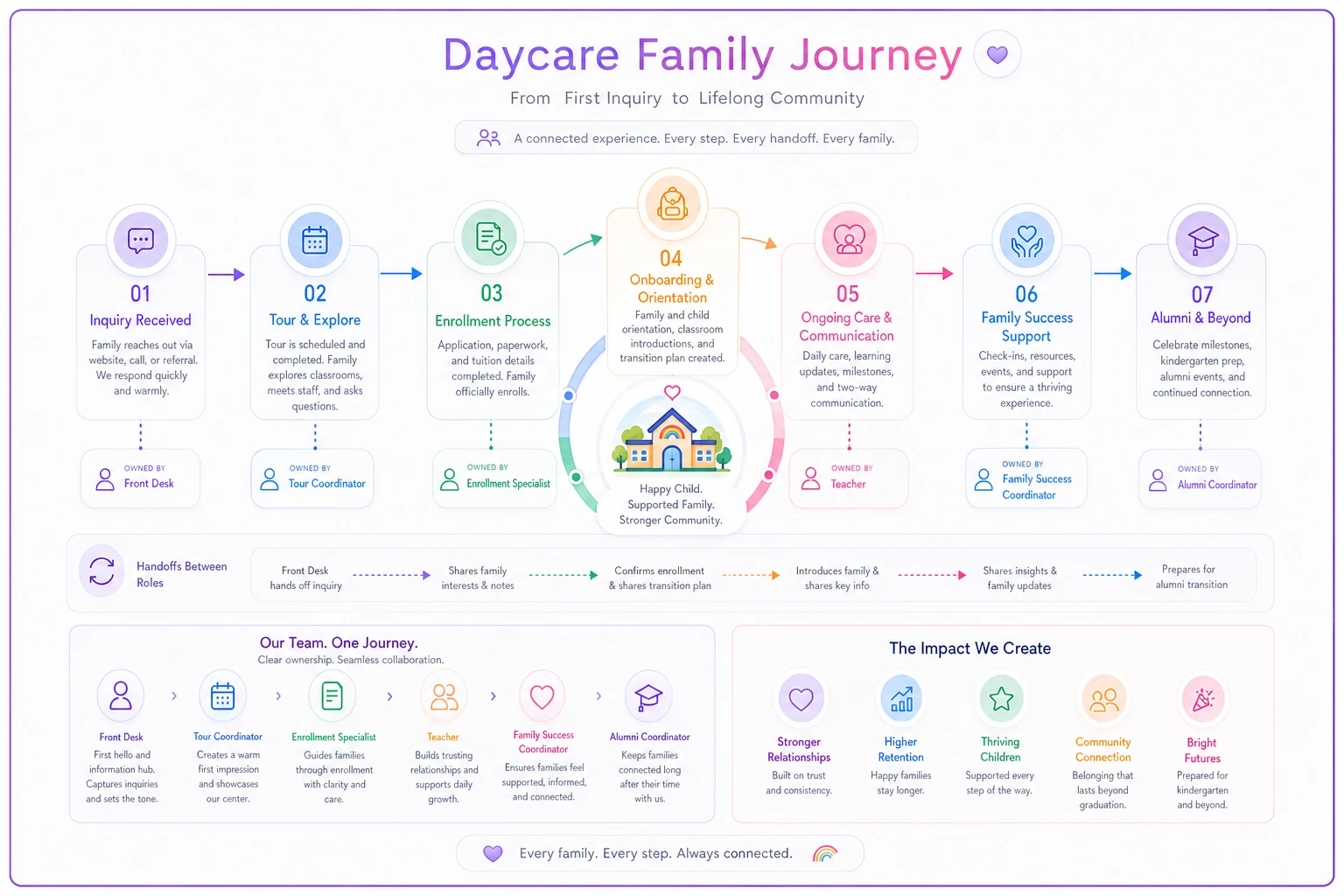
Enrollment to classroom teacher handoff requires enrollment specialist to complete paperwork, create family profile with key notes, schedule transition meeting, teacher reviews before first day, and confirms receipt and understanding.
Teacher to family success coordinator handoff happens when teacher flags any concerns by day 3, coordinator takes week 1 communication lead, weekly sync for first month, gradual transition to teacher-led by month 3, and clear escalation path maintained.
Active to alumni handoff tracks graduation date 6 months out, introduces alumni coordinator 3 months before, creates transition plan with family, explains alumni benefits, and officially transfers relationship post-graduation.
Without these handoffs documented and assigned, every family transition becomes a potential relationship failure point.
The evergreen content engine that feeds itself
Most centers treat content creation like a monthly scramble. "What should this month's newsletter say?" Wrong question. Build an evergreen library that automatically serves families based on their lifecycle stage and child's age.
Core content library gets created once and used forever. This includes 12 months of age-specific development guides (infant through pre-K), seasonal health and safety reminders (flu, sun safety, etc.), holiday celebration policies and alternatives, nutrition guidelines and meal planning resources, school readiness checklists by age, and behavior management strategies for common challenges.
The dynamic content system pulls child's enrollment date to trigger appropriate sequence, checks child's age monthly to send relevant development content, tracks family engagement score to increase or decrease frequency, and monitors response rates to test different content types.
Content recycling calendar works like this: January for re-enrollment campaigns and referral drives, March for summer program early bird push, May for graduation prep and kindergarten transition resources, August for back-to-school routines and new family orientations, October for holiday schedule planning and year-end appreciation, December for tax documentation and FSA reminders.
Create it once when you have time, deploy it automatically when families need it.
Where AI-powered operational software transforms the lifecycle
Managing this lifecycle manually means juggling spreadsheets, calendar reminders, and hoping nothing falls through cracks. It doesn't scale. By 60 kids, you're drowning. By 100, relationships suffer.
Operational software enhanced with AI automation changes this. Instead of manually tracking where each family sits in the lifecycle, the system monitors engagement automatically. Parent hasn't opened three emails? Flag for personal outreach. Child transitioning classrooms next month? Trigger preparation sequence. Family approaching one-year mark? Launch retention protocol.
The AI automation handles repetitive tracking and triggering, letting your team focus on actual relationship building. It analyzes response patterns to optimize send times. It identifies at-risk families before they leave. It ensures every family gets the right message at the right time from the right person.
For centers running 100+ enrollments, this isn't just convenient — it's the difference between 65% and 85% retention. The math is simple: keeping families longer means less marketing spend, more referrals, and dramatically better margins.
When lifecycle management isn't worth the complexity
Some centers shouldn't build elaborate lifecycle systems. If you're running a home daycare with 12 kids, you don't need automated sequences and handoff protocols. You need a notebook and genuine daily conversations.
Skip the full lifecycle approach if you have under 30 enrollments (relationships stay personal naturally), your waitlist exceeds capacity by 200%+ (retention matters less), you're planning to sell within 12 months (won't see ROI), or your staff turnover exceeds 50% annually (fix that first).
But for centers between 40-200 kids, trying to compete with larger chains while maintaining that personal touch? This lifecycle framework is how you systematize relationships without losing authenticity.
The compound effect of systematic engagement
A center in Austin implemented this lifecycle approach eighteen months ago. Started at 67% annual retention. Nothing special about their facilities, standard tuition for the area, decent but not exceptional ratios.
They mapped lifecycle stages, assigned clear owners, built their touchpoint calendar, and started measuring stage-by-stage conversion. First six months showed minimal improvement — systems take time to compound. Month seven, retention hit 71%. Month twelve, 78%. Month eighteen, 84%.
More interesting than the retention number: their cost per enrollment dropped by roughly half. Referrals went from 8-10 annually to 35-40. They raised tuition 8% with zero pushback because families felt the value through consistent engagement.
The director told me last week: "We stopped chasing new families and started nurturing the ones we had. Turns out that's way more profitable."
Your next seven days
Fixing your entire family engagement lifecycle takes months. But you can start improving it this week:
-
Map your current reality — Draw out how families actually move through your center today. Note every handoff, every gap.
-
Pick your worst transition — Usually it's tour-to-enrollment or month-three retention. Focus there first.
-
Assign one owner — Someone needs to own that transition completely. Not committee, not "everyone," one person.
-
Create three templates — Write three emails/texts for that transition stage. Nothing fancy, just consistent messaging.
-
Set up basic tracking — Even a simple spreadsheet tracking conversion rate at your problem transition.
-
Run for 30 days — Don't change anything else. Just improve that one transition.
-
Measure and adjust — Check your numbers. Did the conversion rate improve? If yes, move to next transition. If no, adjust the templates and try again.
The lifecycle approach isn't about perfecting every touchpoint immediately. It's about recognizing that families journey through predictable stages, and building systems that serve them appropriately at each stage. Start with your biggest gap, prove it works, then expand.
Most centers treat families like enrollment numbers. The ones with waiting lists and 85%+ retention treat them like relationships moving through a journey. The difference isn't effort — it's system.
Ready to transform your daycare operations?
Join hundreds of daycare centers using Carexly to save time, improve communication, and enhance child care quality.