


Most centers treat re-enrollment like a form. Send a packet in July, maybe a reminder in August, then wait to see who shows up in September. By the time you realize three families quietly moved to the center across town, you've already lost the lead time to backfill those spots from your waitlist.
The gap isn't that owners don't care about re-enrollment. It's that re-enrollment usually lives in someone's head instead of on a calendar. No cadence, no segmentation, no deposit deadline that actually means anything. The families who are already committed re-enroll fast, the ambivalent ones drift, and the spots you lose are the ones that were saveable.
This is a build plan for a 12-week campaign running roughly from mid-June through early September. It's structured by segment, anchored by deposit mechanics, and tied to your occupancy forecast so you know which classrooms are at risk before the risk becomes a vacancy.
Why the usual re-enrollment approach leaks occupancy
The single biggest mistake is treating every current family the same. A toddler family whose child ages up into your preschool room in September has a completely different decision than an infant family whose spot is secure — which is different again from a pre-K family staring down kindergarten.
When you send one generic "please confirm your spot for fall" email to all of them, the results are predictable:
-
The secure families confirm. You didn't need to worry about them anyway.
-
The transition families — aging into a new room, new teacher, new tuition tier — hesitate, because the email didn't address the one thing they're actually anxious about.
-
The departing families heading to kindergarten don't respond, and you don't formally reclaim those spots until it's too late to market them.
The other failure is the soft deadline. "Let us know by August 1" with no deposit attached isn't a deadline — it's a suggestion. Families don't act on suggestions during the busiest stretch of summer. Without a deposit holding the spot, you have no reliable signal about who's actually staying, which means your fall occupancy forecast is built on guesses.
Forecasting off guesses is where the real money leaks. If you think your preschool room is full and it's actually at 78%, you've under-marketed, over-staffed, or both.
The structure: three segments, one calendar
Before you touch the calendar, split your current roster into three segments. Everything else hangs off this.
Eliminate administrative bottlenecks.
Carexly helps you manage enrollments, attendance, and staff schedules effortlessly.
- Streamlined child enrollment
- Automated parent notifications
- Staff shift and activity scheduling
No credit card required
| Segment | Who's in it | Primary concern | Campaign goal |
|---|---|---|---|
| Secure | Children staying in the same room, same tuition tier | Low friction, mild inertia | Fast confirmation + deposit, minimal hand-holding |
| Transition | Children aging up into a new room/tier, or shifting schedules | Anxiety about change, cost, teacher | Reassurance + early commitment before they shop around |
| Departing / At-risk | Kindergarten-bound, relocating, or showing churn signals | May be leaving entirely | Confirm departure early to free the spot; save the saveable |
Your Transition families are where you both win and lose the most. They're the ones most likely to quietly look at another center when they realize tuition is jumping or their favorite teacher isn't moving up with them. Your messaging to them needs to arrive earlier and address those specifics directly.
For context on the broader lifecycle these families live inside — the way they move from inquiry through enrollment and eventually to alumni — this breakdown of the inquiry-to-alumni family engagement lifecycle is worth reading. Re-enrollment is just one high-stakes checkpoint inside that longer arc.
The 12-week calendar
Here's the month-by-month skeleton. Adjust the start date to land week 12 about two weeks before your fall term begins. The dates below assume a post-Labor-Day start.
Weeks 1–2 (mid-to-late June) — Segment and set the forecast baseline
Pull your current roster and sort it into the three segments before you do anything else. Once that's done:
-
Pull current occupancy by room and project September occupancy assuming everyone stays. This is your optimistic ceiling.
-
Build the same projection assuming all Departing and roughly half of Transition families leave. This is your pessimistic floor.
-
The gap between those two numbers is your campaign's job.
Weeks 3–4 (early July) — Open re-enrollment, Secure first
-
Send Secure families a short, warm "reserve your spot for fall" message with a deposit link. Make it a two-minute action.
-
Open deposits. Set the deposit as a tuition credit, not an extra fee — more on this below.
-
Goal
lock 60–70% of Secure deposits within these two weeks. They're your easy yes.
Weeks 5–6 (mid-to-late July) — Transition outreach with specifics
This is the heart of the campaign. Send Transition families a message that names the room they're moving into, the teacher if known, the new tuition rate, and what's genuinely great about the next stage. Offer an early-commitment incentive — a locked-in rate or waived registration fee for deposits made before a hard date.
Follow up individually. Transition families often want a 10-minute conversation, not another email.
Weeks 7–8 (early August) — Departing confirmation + waitlist activation
Formally confirm departures with Departing families. A simple "we see [child] is kindergarten-bound this fall — can you confirm so we can plan?" works fine. Some will surprise you and stay.
Every confirmed departure immediately converts that spot to "available" and triggers waitlist outreach for that specific room and age band. This is the step most centers skip, and it's the one that saves September.
Weeks 9–10 (mid-to-late August) — Deadline enforcement + second-pass follow-up
-
The deposit deadline hits. Spots without deposits are no longer guaranteed. Send this clearly and without apology.
-
Second-pass follow-up to any Secure or Transition family who hasn't deposited. Phone, not just email.
-
Backfill open spots from the waitlist with signed deposits.
Weeks 11–12 (early September) — Final reconciliation + forecast lock
-
Reconcile every room
deposited, confirmed-leaving, waitlist-filled, still-open.
-
Lock your staffing plan against actual deposits, not hopes.
-
Note which rooms came in under target — that's your enrollment marketing priority for the next cycle.
The whole point of the calendar structure is that each phase feeds the next. Segment early, confirm departures before mid-August, and your waitlist activation actually works. Skip the sequencing and you end up scrambling in week ten.
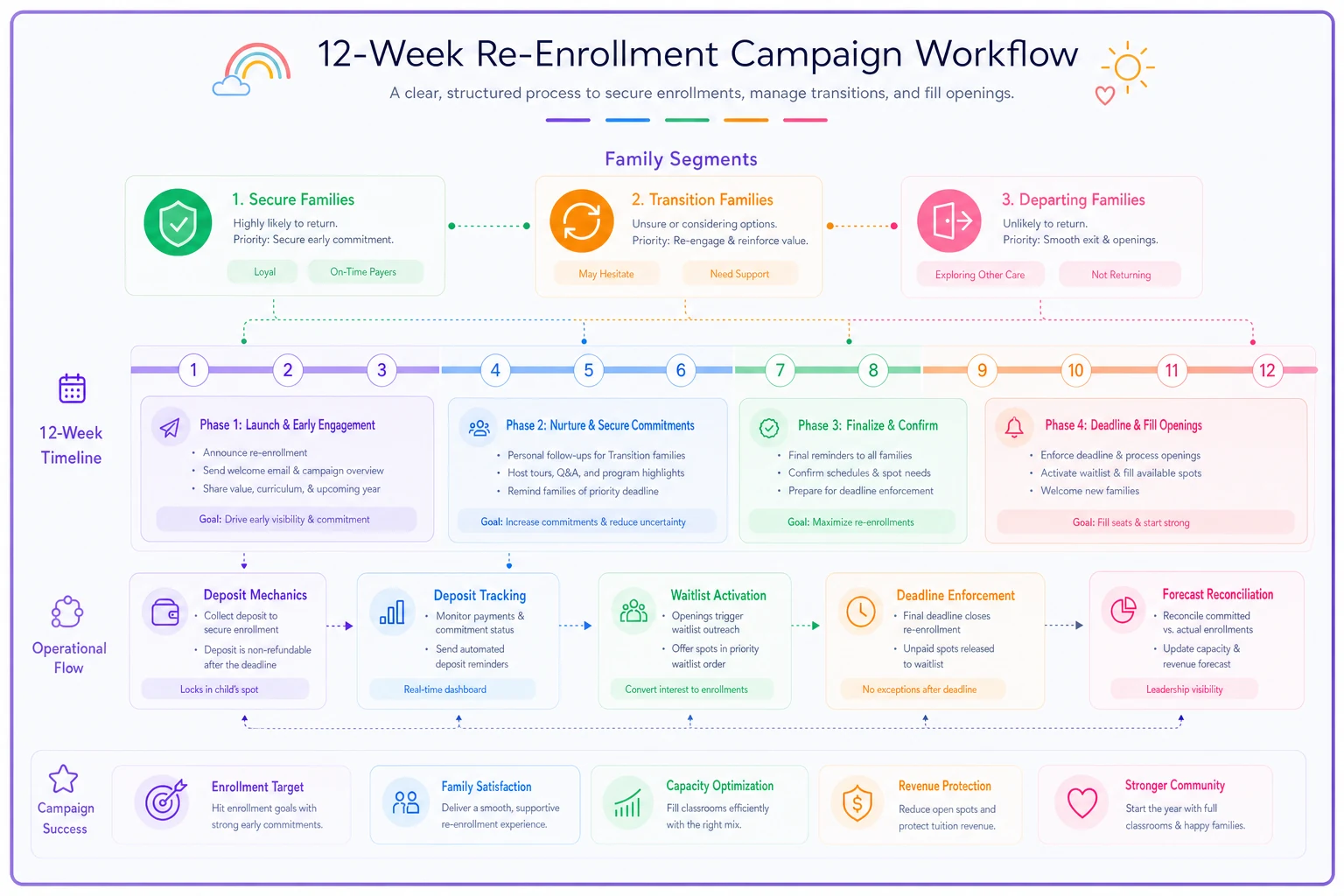
This timeline illustrates how segments, deposits, and waitlist activation flow together across the 12 weeks.
Deposit mechanics that actually drive action
A deposit does two jobs: it gives families skin in the game, and it gives you a clean data signal for forecasting. Both break if the mechanics are wrong.
-
Make the deposit a credit, not a cost. If families feel like they're paying extra, resistance spikes. If the deposit applies to September tuition or the first week's fees, it reads as "paying early" instead of "paying more."
-
Keep it meaningful but not painful. Somewhere around one week of tuition is usually enough to signal real commitment without creating a barrier. Too small and families don't treat the deadline seriously; too large and you create friction for families you want to keep.
-
Tie the deposit to a specific spot and date. "This deposit holds [child]'s place in the Butterfly room starting September 3" is far more motivating than "registration deposit."
-
Set one hard deadline, honored consistently. The moment you grant quiet exceptions, word spreads and the deadline stops working the following year. Have a stated policy for genuine hardship cases so "firm" doesn't mean "cold."
-
Refund policy in writing. Families hesitate when they're unsure what happens if plans change. A clear, fair refund window removes that hesitation and actually increases early deposits.
The forecasting benefit here is underrated. A deposited spot is a near-certain enrollment. A verbal yes is worth maybe 60–70% in your projection model. When your September forecast is built on deposits rather than intentions, your staffing and ratio planning stops being a gamble.
Waitlist prioritization: fill the right spot, not just any spot
The waitlist is where re-enrollment campaigns either close strong or fall flat. The mistake is treating it as one single list. It isn't — it's a set of lists organized by age band and room, because a waitlisted infant can't fill a vacated preschool seat.
When a Departing family confirms in weeks 7–8, you should be able to immediately see which room and age band just opened, who on the waitlist fits that exact band, and which of those families signaled urgency or a target start date near September.
-
Age-fit first. Non-negotiable. The child has to fit the room's age range and your ratio math.
-
Start-date fit second. A family that wants September beats one that wants January for a September vacancy.
-
Urgency signals third. Families who've toured twice, asked about availability recently, or are on a subsidy clock tend to convert faster.
-
Sibling priority if you offer it. Existing families filling a sibling spot are usually your highest-retention backfill.
Call waitlisted families the same week a spot opens — conversion rates are much higher.
Move fast once a spot opens. A waitlisted family who gets a same-week call with a specific offer converts dramatically better than one who hears back three weeks later — by then they've often committed elsewhere.
The KPIs that connect the campaign to occupancy
You can't manage this campaign without numbers to check against. A handful of metrics tell you mid-campaign whether you're on track or about to miss your fall numbers. The whole point of tracking them weekly is to course-correct in August instead of discovering the shortfall in September.
-
Re-enrollment deposit rate by segment — what percentage of Secure, Transition, and Departing families have deposited. Watch Transition most closely; a lagging number here is your earliest warning.
-
Transition retention rate — of families aging into a new room, how many stayed vs. left. This is the number that separates a healthy center from one slowly bleeding into competitors.
-
Spot recovery time — days between a confirmed departure and a filled replacement. Shorter is better; long gaps mean lost tuition.
-
Projected vs. deposited occupancy by room — the gap you're closing, updated weekly.
-
Deposit-to-start conversion — of deposited families, how many actually started. If this slips, your deposit amount or refund policy may need adjusting.
For a broader frame on which numbers genuinely drive owner decisions, this rundown of owner-facing KPIs that actually move the needle pairs well with the campaign-specific metrics above.
A real scenario
A mid-sized center — four classrooms, licensed for around 90 kids, running near 85% occupancy — kept losing preschool spots every fall. The pattern was consistent: toddlers aging up into preschool represented roughly 18–20 kids a year, and about a third of those families didn't re-enroll. Nobody noticed until September, when the preschool room opened under-filled and the toddler room had a waitlist it couldn't use yet.
The fix wasn't dramatic. They segmented the roster, moved Transition outreach up to early July, named the new teacher and tuition in the message, and attached a one-week-tuition deposit with a firm early-August deadline. Departures were confirmed in week 7, which freed spots early enough to pull from the toddler-graduate waitlist.
That first fall running the calendar, the preschool room started September at roughly 90% instead of the usual high-70s. Spot recovery time dropped from "weeks, sometimes never" to under a week for most openings. The quieter shift was probably more valuable: because deposits came in through July and August, the director built the fall staffing plan against real commitments instead of optimistic headcounts. No surprise under-enrollment, no scramble to cut hours in week two.
Sample limited-offer templates
Keep these short. Long re-enrollment emails get skimmed. Fill the brackets with your specifics.
Secure family (weeks 3–4):
> Hi [Name] — fall registration is open and [Child]'s spot in the [Room] is ready to reserve. Lock it in with a quick deposit here: [link]. The deposit applies straight to September tuition. Takes about two minutes. So glad [Child] is staying with us.
Transition family (weeks 5–6):
> Hi [Name] — big step coming up: [Child] is ready to move into our [New Room] this fall with [Teacher]. Tuition for that room is [amount], and we'd love to hold the spot for you. Reserve before [date] and we'll [waive the registration fee / lock this year's rate]: [link]. Happy to grab 10 minutes if you'd like to talk through the transition.
Deadline reminder (weeks 9–10):
> Hi [Name] — quick heads up: deposits for fall spots are due [date]. After that we can't guarantee [Child]'s place in the [Room], and we do have families waiting. Reserve here in two minutes: [link]. Let us know if anything's holding you back.
Waitlist offer (weeks 7–10):
> Hi [Name] — good news: a spot just opened in our [Room] for [age band], starting [date]. Based on your waitlist info it looks like a strong fit for [Child]. We can hold it with a deposit through [short deadline]: [link]. Spots like this go fast, so reach out today if you're interested.
Where this breaks down — and when to adjust
This calendar assumes you have a reasonably accurate current roster and a waitlist organized by age. If your waitlist is a mixed pile of names with no age or start-date info, fix that first — otherwise weeks 7–10 fall apart because you can't match openings to the right families.
It also assumes you can send segmented messages and track deposits without drowning in spreadsheets. Running three segments across 12 weeks by hand is doable for a single small center, but it gets brittle fast. Keeping your roster, waitlist, deposits, and occupancy forecast in one place is what prevents the whole thing from quietly unraveling during your busiest weeks — segmentation becomes a filter instead of a manual sort, deposit status updates your forecast automatically, and a confirmed departure can flag matching waitlist families without you cross-referencing by hand. AI-powered operational software handles exactly this kind of coordination well: the data is centralized, the signals are automatic, and your team isn't manually reconciling spreadsheets the week before fall starts. The tooling isn't the strategy, but it's what keeps the strategy from collapsing under its own moving parts.
When this is overkill: a center running consistently at or above capacity with a long waitlist and almost no voluntary churn probably doesn't need the full 12 weeks. A lighter version — deposits plus a clean departure-confirmation step — may be enough.
When it's essential: any center that loses saveable spots at transition points, runs below 90% in any room, or discovers enrollment gaps too late to market around them. That's most centers.
Closing thought
Re-enrollment isn't a July form drop. It's a timed sequence where the families most worth keeping — the ones aging into a new room, feeling the first pull toward a competitor — need to hear from you earliest and most specifically. Attach a real deposit, confirm departures before they strand a vacancy, and keep your waitlist sorted so every opening fills the right seat fast.
Do that consistently, and your fall occupancy forecast stops being a hope and starts being a number you can actually staff against. Not a prettier packet — just a September where the rooms are full because you did the work in June, July, and August, on a calendar instead of in your head.
Do that consistently, and your fall occupancy forecast stops being a hope and starts being a number you can actually staff against. Not a prettier packet — just a September where the rooms are full because you did the work in June, July, and August, on a calendar instead of in your head.
Ready to transform your daycare operations?
Join hundreds of daycare centers using Carexly to save time, improve communication, and enhance child care quality.