


Most tuition sheets I've seen were built once, three or four years ago, and then patched over time. A rate bump here. A special discount for the family who threatened to leave there. A "temporary" sibling deal that somehow became permanent. By the time you actually add it all up, the effective tuition your center collects per child is nowhere near the number printed on your enrollment packet.
That gap — between your published rate and your realized rate — is where a lot of centers quietly lose money without ever seeing a bad month on paper. Occupancy looks fine. The rooms look full. And yet the margin keeps shrinking, and nobody can point to exactly why.
This is a systems problem, not a pricing-sheet problem. Your childcare tuition pricing strategy touches enrollment, staffing ratios, subsidy timing, discount approvals, and how fast you react when a room starts emptying out. If those pieces aren't connected, you end up making pricing decisions blind — reacting to individual families instead of the room-level economics that actually pay your bills.
So let's build the whole thing out: explicit tuition models tied to occupancy, a couple of simple elasticity tests you can run in a spreadsheet, and discount rules structured tightly enough that they can be enforced automatically instead of negotiated case by case.
Why published rates and realized rates drift apart
Here's the pattern. A center prices each classroom based on a full room. Infant room at, say, $1,650/month with 8 slots. On paper that's about $13,200 in monthly revenue. Simple.
But the room is never cleanly full. One family is on a two-day schedule. Another got a 10% sibling discount. A third came in through a subsidy that reimburses below your private rate and pays 45 days late. A fourth is a staff child at half price. Suddenly your "full" infant room that should throw off $13k is realistically collecting somewhere around $10,500–$11,000 — and your director still thinks of it as a full, healthy room.
-
Discounts have no expiration. A concession made during a slow enrollment quarter outlives the reason it existed.
-
Part-time schedules are priced like they're linear. A 3-day slot rarely costs you 60% of a 5-day slot to deliver, because you still hold the ratio spot.
-
Subsidy rates get treated as equal to private rates in the head count, even though the actual cash and timing are very different.
-
Nobody owns the effective rate per room. Enrollment tracks bodies. Billing tracks invoices. Nobody tracks yield.
If you've already worked through which daycare KPIs actually move the needle, think of realized-rate-per-room as the number that sits underneath most of the others. It's what quietly determines whether full rooms actually mean healthy rooms.
Start with an explicit tuition model, not a price list
The fix isn't a fancier price sheet. It's writing down the logic behind your rates so every price can be traced back to a reason. When pricing is explicit, you can audit it, adjust it, and change it without renegotiating with every family individually.
Eliminate administrative bottlenecks.
Carexly helps you manage enrollments, attendance, and staff schedules effortlessly.
- Streamlined child enrollment
- Automated parent notifications
- Staff shift and activity scheduling
No credit card required
-
What's the base cost to hold this ratio slot? (Teacher cost + overhead allocated per seat.)
-
What margin do we need on top of that?
-
What's the schedule multiplier? (Full-time, 3-day, 2-day, drop-in — priced so part-time doesn't secretly subsidize itself off your full-timers.)
-
What's the occupancy trigger that changes the rate?
That fourth one is where most centers have nothing. They set a price and leave it until crisis. A better model bakes occupancy directly into your pricing posture.
Here's a simple version of occupancy-triggered pricing logic for a single classroom:
| Room occupancy | Pricing posture | Discount authority | Waitlist action |
|---|---|---|---|
| Below 60% | Aggressive fill | Up to 15% off, director-approved | Convert waitlist immediately, waive registration fee |
| 60–79% | Standard | Standard sibling/multi-day discounts only | Active outreach, timed follow-ups |
| 80–94% | Firm | New discounts frozen | Build waitlist depth |
| 95%+ | Premium / raise | No discounts; consider rate increase next cohort | Charge waitlist deposit |
A simple visual of this workflow helps staff apply the occupancy rules consistently.
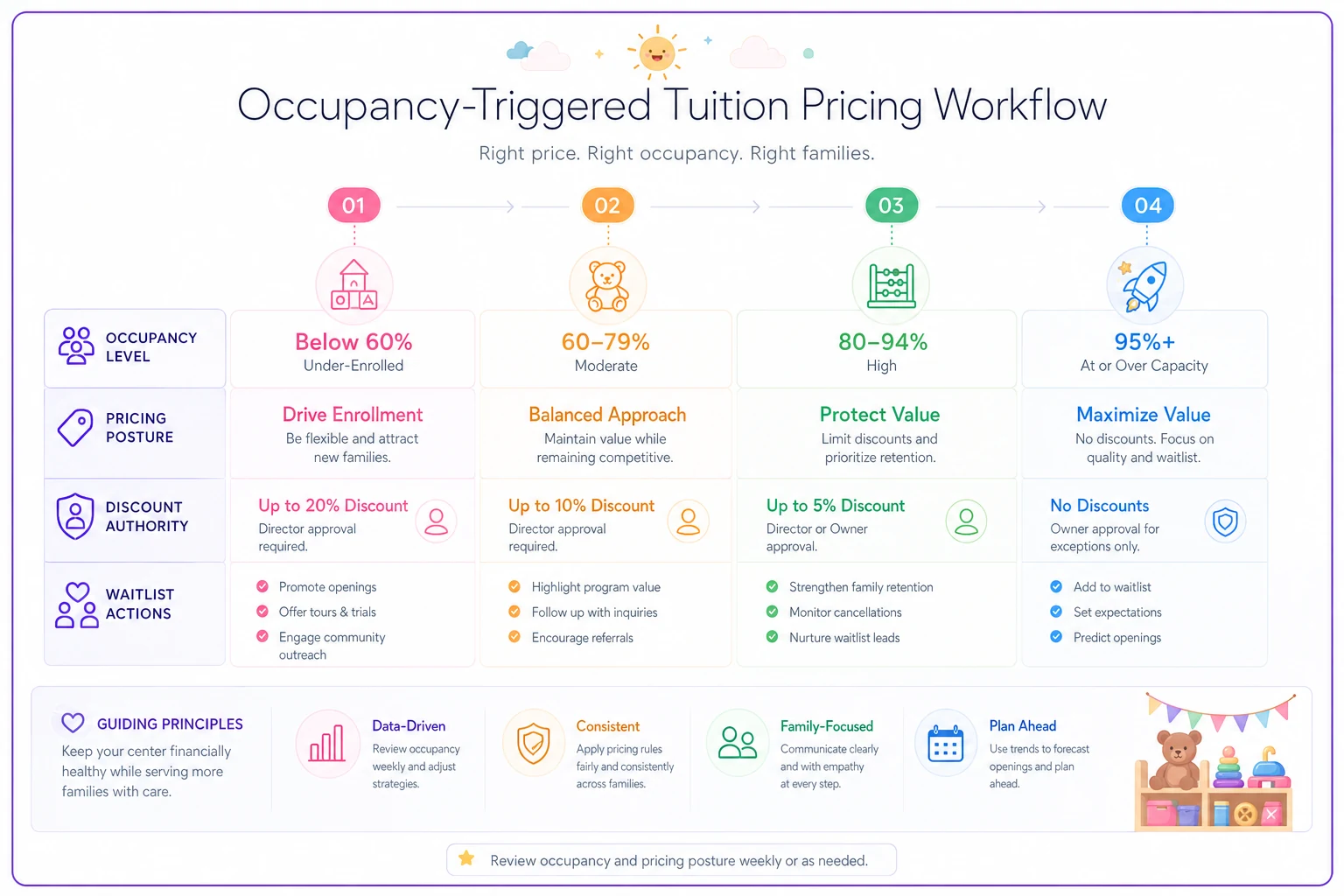
The point isn't the exact percentages — yours will differ by market and by room. The point is that your discount generosity and your willingness to raise rates should move with occupancy, and that logic should be written down where anyone in the office can apply it consistently. This connects directly to enrollment health. When one age group is chronically stuck below 60%, that's not always a pricing problem. Sometimes it's a funnel problem, which is worth addressing through enrollment funnels that leave specific age groups empty before you start cutting price. Discounting into an empty toddler room when the real issue is that inquiries never got a callback just trains families to expect discounts.
Simple elasticity tests you can actually run
"Elasticity" sounds like an economics-class word, but in a center it just means one thing: if I raise this rate, how many families do I lose, and is the trade worth it?
You don't need a model. You need a spreadsheet with four columns and the discipline to run the test on one room at a time.
Here's the worked version. Say your toddler room is at $1,400/month with 12 kids — $16,800 in monthly revenue.
-
New rate per child
$1,484
-
Revenue needed to match current $16,800
$16,800 ÷ $1,484 ≈ 11.3 children
-
So you can drop to about 11 children and still be roughly even.
That means if raising rates 6% costs you one family, you're basically flat on revenue but running the room with slightly less pressure. Lose zero families and you've added around $1,000/month — close to $12k a year from one room. Lose two families and you're behind. But now you also know the room was priced past what that market would bear.
Run the same table across a few scenarios so the decision is visible:
| Rate increase | New monthly rate | Breakeven headcount | If you lose 1 family | If you lose 2 |
|---|---|---|---|---|
| 3% | $1,442 | ~11.6 | +$1,062/mo | -$380/mo |
| 6% | $1,484 | ~11.3 | +$524/mo | -$960/mo |
| 10% | $1,540 | ~10.9 | -$140/mo | -$1,680/mo |
Two things jump out of a table like this that owners consistently miss:
-
Small increases are extremely forgiving. A 3% bump survives losing a family and still comes out ahead. Yet centers freeze at the idea of any increase because they picture families walking en masse.
-
The aggressive increase (10%) is fragile. It only wins if literally nobody leaves — and that's rarely how families behave, especially in infant and toddler rooms where switching is painful but not impossible.
The real elasticity test, though, isn't the math. It's the follow-up. After any rate change, watch withdrawal reasons for the next 60–90 days. If nobody cites price, you left money on the table and should test higher on the next cohort. If two or three explicitly name it, you found your ceiling. Log it. That log becomes your pricing memory so you're not re-guessing every year.
Discount governance: rules that survive a busy Tuesday
Discounts are where good pricing models go to die. Not because discounts are bad — they're a legitimate tool for filling soft rooms and rewarding loyalty — but because they get handed out in the moment, by whoever's at the front desk, with no rule and no expiration.
The failure looks like this: a family pushes back on tuition at pickup, the director wants to keep them, and a 12% discount gets promised verbally. It never gets logged with an end date. Eighteen months later that family is still paying 12% under rate, three other families have heard about it and asked for the same, and your realized rate per room has quietly eroded.
Discount governance means writing rules specific enough that they can be applied consistently — and eventually enforced by your billing system rather than by memory and goodwill. A workable structure has four parts:
-
1. A closed list of allowed discount types. Sibling, multi-child, staff, subsidy-gap, and a bounded "retention" discount. If it's not on the list, it needs owner sign-off. No inventing new discounts at the desk.
-
2. Caps and stacking rules. For example
sibling discount caps at 10%, and no two discretionary discounts stack. A family can't get sibling plus retention plus a promo. This one rule alone protects your rooms from the slow stacking creep that hollows out yield.
-
3. Expiration and review dates. Every discretionary discount gets an end date. Retention discounts expire in, say, 6 months and require an explicit renewal decision. This is the single most important governance rule, because it's the one that stops "temporary" from becoming forever.
-
4. Approval tiers by occupancy. Tie discount authority back to the occupancy table above. When a room is at 90%, the front desk simply can't approve a new discount without escalation.
When these rules are explicit enough to be coded into your billing setup, they stop depending on who's working that day. That's the whole idea behind treating tuition and concessions as policy rather than conversation — the same logic covered in policy-first tuition and discount rules designed for automation. The governance framework here is the pricing brain; that billing setup is the enforcement arm.
Here's a quick self-audit to see how leaky your current discounts are:
-
Can you pull, right now, a list of every active discount with its start date, end date, and reason?
-
Does every discretionary discount have an expiration?
-
Is there a hard cap on total discount percentage per family?
-
Do part-time schedules carry a schedule premium, or are they priced strictly linearly?
-
Does anyone review discount totals per room monthly?
-
When occupancy hits 90%+, does discount authority actually tighten — or does the desk keep giving the same deals?
If you answered "no" to three or more, your published rate and realized rate have almost certainly drifted, and it's worth an afternoon to reconcile them.
A real scenario: the toddler room that looked full
A mid-size center — two locations, around 140 kids total — had a toddler room they described as "always full, never a problem." Twelve slots, published rate $1,375. When we actually reconciled it, the picture was different. Two families on legacy retention discounts (one from a slow patch two years earlier), one multi-day family priced linearly at 60% for a 3-day schedule that still held a full ratio spot, and one subsidy child reimbursing about $180/month under private rate. The room's realized revenue was roughly $14,100 against a "full" expectation closer to $16,500 — about a $2,400/month gap, near $28k a year, on a room everyone considered healthy.
Nothing dramatic happened next. They did three unglamorous things:
-
Put an expiration on both retention discounts and let the older one lapse (that family stayed at full rate — the discount had long outlived its reason).
-
Added a modest part-time premium so the 3-day slot priced at 68% instead of 60%, reflecting the ratio seat it actually held.
-
Ran a 4% increase on the next enrollment cohort only, leaving current families untouched.
Over the following two quarters, the realized rate on that room climbed back to around $15,800 — not all the way to published, but the gap shrank by more than half. They lost zero families. The lesson wasn't "raise prices." It was that they'd been managing bodies while ignoring yield, and once they could see the gap, closing most of it required almost no confrontation.
When to raise rates — and when it's a bad idea
Raising makes sense when:
-
A room is consistently at 95%+ with a real waitlist behind it.
-
Your withdrawal logs show few or no price-related departures after past increases.
-
Your costs — wages especially — have moved and your margin per seat is compressing.
-
You can grandfather current families and apply the new rate to incoming cohorts, which drastically softens the reaction.
It's a bad idea when:
-
The room is soft (below 80%) and you haven't fixed the enrollment funnel first. Raising price into an empty room accelerates the emptiness.
-
You've had recent quality or staffing turnover that families are already nervous about. Price sensitivity spikes when trust is shaky.
-
You're doing it reactively across all rooms at once because one line item spooked you. Blanket increases generate exactly the mass-departure fear that keeps owners from ever raising rates again.
Who should probably not touch pricing yet: any center that can't produce a clean realized-rate-per-room number. If you don't know what each room actually collects versus what it should, you're not ready to change rates — you're ready to reconcile. Do that first. Pricing decisions made on published-rate assumptions are just guesses dressed up as strategy.
Bringing it together as one system
The reason tuition pricing quietly breaks isn't that owners pick bad numbers. It's that pricing lives in three disconnected places — the enrollment conversation, the billing system, and the occupancy report — and no single view reconciles them. Discounts get made in the first place, invoiced in the second, and their damage only becomes visible, months late, in the third.
An explicit model fixes the connection. When each rate traces back to a cost and a margin, when occupancy triggers govern how firm you hold, when elasticity gets tested one room at a time instead of feared in the abstract, and when discounts carry caps and expiration dates that can actually be enforced — pricing stops being a source of slow leakage and becomes something you can steer.
You don't need a complicated system to start. You need a realized-rate number per room, a written discount rule set with expirations, and the willingness to run a four-column elasticity test before your next enrollment cycle instead of after. Get those three in place and the rest of your operation — staffing to ratio, converting waitlists, forecasting revenue — finally has honest numbers to work from instead of the optimistic fiction printed on the enrollment packet.
Ready to transform your daycare operations?
Join hundreds of daycare centers using Carexly to save time, improve communication, and enhance child care quality.