

Most centers already have something they call a continuity plan. Usually it's a binder. Sometimes it's a laminated evacuation map by the front door and a phone tree that hasn't been updated since two teachers left. The problem isn't that owners don't care — it's that the plan exists as separate scraps: a backup idea for data, a loose sense of who covers if a lead is out, a vague notion that "we'd call the center down the road" if things got bad.
None of those pieces talk to each other. And disruptions don't arrive one at a time. A power outage knocks out your door access and your billing system on the same morning two staff call out sick and a parent shows up asking why nobody answered the phone. That's the real shape of an emergency — a few small failures stacking faster than one director can think through them.
A real childcare continuity plan isn't a document. It's a wired-together system where your recovery targets tell your staffing ladder what to do, your staffing ladder tells your mutual-aid network when to activate, and your supplier agreements have trigger points that fire before you're already stuck. This article is about building that wiring — and rehearsing it so it holds when you're stressed and short-handed.
Start from what "recovered" actually means for each system
Before you can plan fallbacks, you have to decide how fast each part of your operation needs to come back and how much information you can afford to lose. Those two numbers — recovery time and recovery point — anchor everything else.
If you've already set data backup targets, good. If not, the companion piece on disaster recovery for childcare centers walks through RTO and RPO for your records specifically. What most owners miss is that these targets shouldn't only apply to data. Every critical function has its own tolerance.
Think about it in tiers:
| Function | How long you can be down (RTO) | What "recovered" looks like |
|---|---|---|
| Child supervision / ratios | 0 minutes | Every classroom staffed to legal ratio at all times |
| Building access & security | Under 30 min | Doors controlled, sign-in/out working (even on paper) |
| Parent communication | Under 1 hour | You can reach every family and they can reach you |
| Attendance / who's-in-the-building record | Under 1 hour | Accurate roster of children present, on any medium |
| Billing & tuition processing | 24–72 hours | Charges can resume, no lost transactions |
| Enrollment / intake | 2–5 days | New family processing can wait, not forever |
The thing that reorders this whole plan: your tightest RTO isn't a data problem, it's a ratio problem. Supervision has a recovery target of zero. You cannot be "down" on child safety for even a minute. That single fact changes everything — staffing continuity outranks everything else, and your data recovery, while important, actually has more breathing room than most owners assume.
Once you've written out the tolerance for each function, you know which failures need instant fallbacks and which can wait a day. Now you can build ladders.
The staffing fallback ladder: what happens at each level of shortage
A phone tree isn't a plan. "Call people until someone says yes" collapses exactly when you need it, because the person doing the calling is also trying to hold a classroom together.
Eliminate administrative bottlenecks.
Carexly helps you manage enrollments, attendance, and staff schedules effortlessly.
- Streamlined child enrollment
- Automated parent notifications
- Staff shift and activity scheduling
No credit card required
A fallback ladder is different. It defines, in advance, who covers at each level of shortage — and the trigger that moves you from one rung to the next. The whole point is to remove decision-making from the moment of panic. When you're down two staff at 6:50 a.m., you shouldn't be deciding anything. You should be executing a rung.
-
Rung 1 — Internal shuffle. One person out. Float staff or a part-timer absorbs it. Prep and planning time gets suspended for the day. No outside calls needed.
-
Rung 2 — Cross-role coverage. Two out, or one out in your most ratio-sensitive room (infants). Admin staff with current credentials step onto the floor. The director stops office work and takes a classroom.
-
Rung 3 — On-call bench. Your shortage exceeds what internal people can absorb without breaking ratio. Activate your pre-approved substitute list — people already background-checked and oriented, not strangers you found that morning.
-
Rung 4 — Mutual aid. You still can't make ratio even with subs. Activate agreements with partner centers (covered below) to borrow qualified staff or, in worst cases, temporarily place children.
-
Rung 5 — Controlled reduction. You can't safely operate at capacity. Enact a pre-planned partial closure: combine ages where legal, cap attendance, or delay opening — with a family notification script ready to send.
The mistake almost everyone makes is having no Rung 3 built before they need it. Keeping a bench of oriented, credential-verified substitutes is unglamorous work that pays off maybe once or twice a year — but that once is the day that saves your license. The scheduling discipline behind maintaining floaters and coverage buffers is the same ratio math covered in the piece on schedule gaps that break ratios and inflate payroll; resilience is really just that same thinking extended into the bad days.
Set a recurring monthly check to verify substitutes' CPR and background clearance so your Rung 2 and Rung 3 options are actually deployable.
One more thing that gets skipped: each rung needs a credential check baked in. An admin stepping onto the floor at Rung 2 only helps if their CPR and background clearance are actually current. If your compliance tracking is loose, half your ladder is fiction.
create an image depicting the staffing fallback ladder workflow for a childcare center showing rungs from internal shuffle to controlled reduction, triggers for each rung, and actions to execute at each step
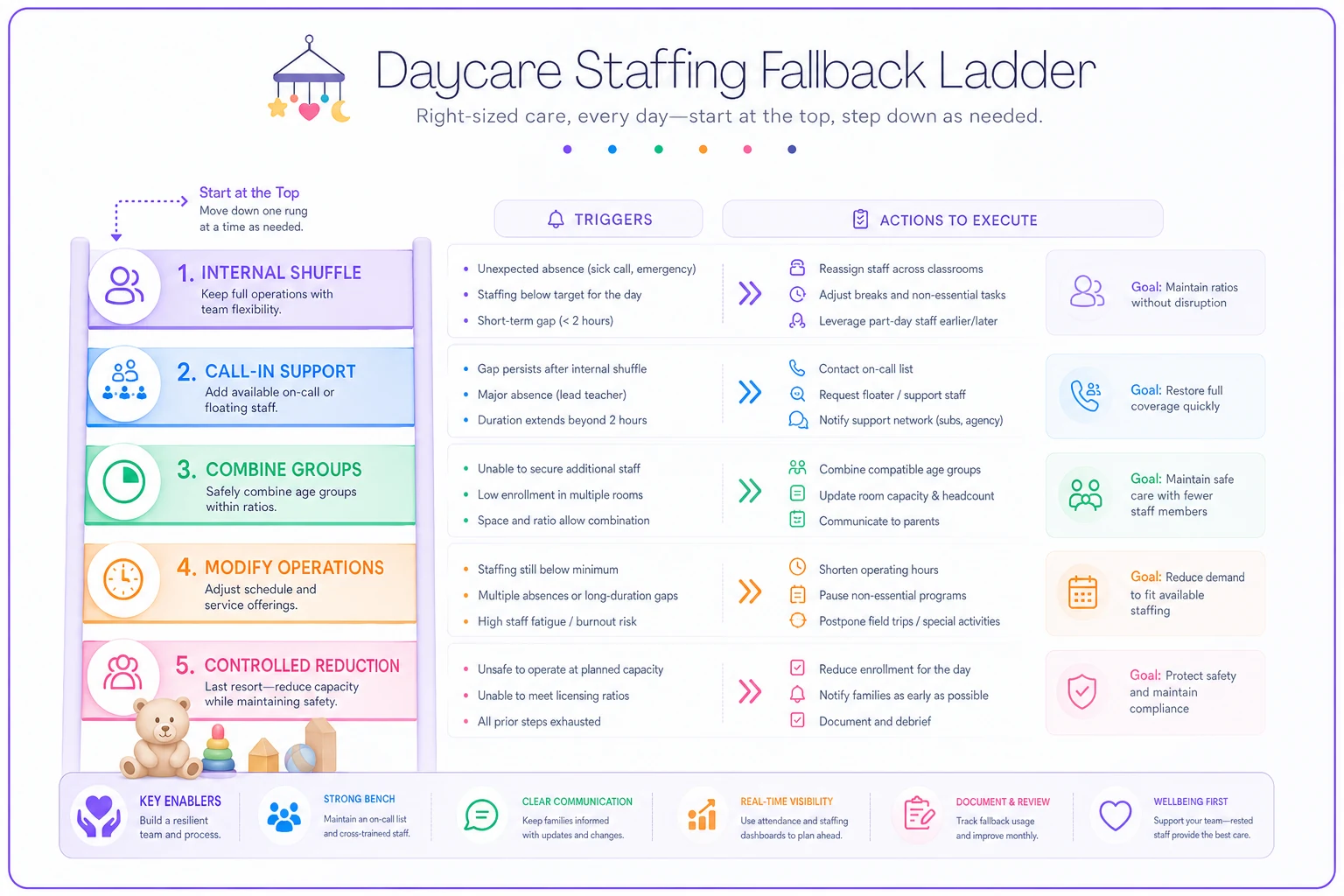
A visual like this helps teams run through the sequence in a tabletop and keeps the execution steps clear during a morning scramble.
Mutual-aid agreements: borrowing capacity from other centers
This is the piece almost no independent center has in place, and it's often the difference between staying open and sending families home. A mutual-aid agreement is a standing, written understanding with one or two nearby centers that you'll help each other during short-term disruptions.
It sounds like something only a chain could pull off. In practice, small independents are often better positioned for it — you're not competing for the same enrollment across town, and owners in the same area usually already know each other from licensing workshops or vendor visits.
What a workable mutual-aid agreement should cover:
-
What triggers it. "When either center drops below ratio and cannot recover through internal staff or subs within [X hours]."
-
What can be shared. Qualified staff for a shift, temporary child placement, physical space if one building is unusable, or supplies in a pinch.
-
Ratio and licensing responsibility. Whose license governs when children are temporarily placed. This has to be crystal clear and checked against your state's rules — it's the part that trips people up legally.
-
Reciprocity expectations. It goes both ways. You'll get the call too.
-
Cost handling. Whether borrowed staff are paid by the lending or borrowing center, and at what rate.
-
Time limits. Mutual aid is for short disruptions — days, not weeks. Spell out when it converts to something else.
-
Family notification. How each center communicates a temporary arrangement to parents.
> "[Center A] and [Center B] agree to provide mutual assistance during operational disruptions affecting either party's ability to maintain licensed care. Assistance may include qualified staffing, temporary child placement, or facility use, subject to the licensing and ratio conditions below. This agreement activates when the requesting center notifies the assisting center that it cannot maintain required ratios through its own staff and substitute pool within [X] hours…"
Honestly though, the agreement matters less than the relationship behind it. Sign the paper, then visit each other's centers, swap direct cell numbers, and bring it up in your tabletop rehearsals. A mutual-aid agreement you've never actually talked through is about as useful as a fire extinguisher nobody knows the location of.
Supplier failover triggers: catch the SLA breach before it becomes a crisis
Your center depends on a handful of outside services — internet and phone, food service, your childcare management software, cleaning and sanitation supplies, utilities. Each one has a service level you assume and rarely define in writing. Failover triggers turn those assumptions into actual decisions.
The pattern to avoid: waiting until a supplier has fully failed before you react. By then you're improvising. Instead, define the trigger point — the moment a supplier's degradation crosses into "activate backup" territory — and know in advance what the backup is.
A few worth setting up:
-
Internet / phone down. Trigger
outage exceeding 30 minutes during operating hours. Failover: staff mobile hotspot for critical lookups, printed daily roster and emergency contacts already on hand, main line forwarded to a cell.
-
Food service disruption. Trigger
supplier confirms they can't deliver, or delivery is more than [X] hours late. Failover: pre-stocked shelf-stable emergency menu covering [Y] days that meets your nutrition requirements; backup vendor number on the fridge.
-
Software / management platform outage. Trigger
system unreachable for more than [X] minutes. Failover: paper sign-in/out sheets, printed current roster with allergies and authorized pickups, manual attendance that gets entered later.
-
Utility (power/water). Trigger
outage with no restoration estimate under [X] hours. Failover: this flows straight into your facility scenario and likely the staffing ladder and mutual aid.
The most dangerous supplier failure is the one that also takes out your records access. When your software goes down, you don't just lose billing — you lose the roster that tells you which children have allergies and who's authorized to pick them up. That's why the failover for a platform outage isn't "wait for it to come back," it's "print the critical records nightly so a system outage never becomes a safety event." A same-day printed roster with allergies and pickup authorizations is the cheapest insurance in this whole plan.
Worked scenario: power outage plus staff shortage on the same morning
Plans read fine on paper. They break when two things happen at once. So here's a stacked scenario worked all the way through, because that's how emergencies actually arrive.
The setup: It's 6:45 a.m. at a center licensed for 84 children. An overnight storm knocked out power to the block — no lights, no internet, the keypad door lock is dead, and your management software is unreachable. At the same time, one infant-room lead and one preschool teacher both call out. You open at 7:00.
What happens without a wired plan: The director is simultaneously trying to reach the utility company, figure out the door situation, cover two rooms, and answer parents pulling into the lot. Nothing gets done well. By 7:20 there are children arriving with no accurate roster, an infant room understaffed, and a line of confused parents at the entrance.
What happens with the runbook:
-
Pre-open — Facility trigger fires. No restoration estimate under two hours crosses your utility RTO. Manual door procedure activates: a staff member is stationed at the entrance to admit and verify pickups by hand against the printed roster from last night.
-
Software failover activates simultaneously. Paper sign-in sheets come out. The printed roster — allergies, authorized pickups, emergency contacts — is already on the clipboard. You're not blind.
-
Staffing ladder — Rung 2 to 3. Two out, one in the ratio-critical infant room. Director and a credentialed admin step onto the floor (Rung 2). That still leaves you short for opening at capacity, so you call the on-call bench (Rung 3) and one sub confirms for 8:30.
-
Communication RTO — under one hour. With the landline down, the pre-written "power outage — we are open, arrive as normal, entry is by the front door with staff assistance" text goes out through parent messaging from a staff phone on cellular data. Every family gets it before drop-off panic sets in.
-
Sub arrives, ratios stable. You never dropped below ratio because Rungs 2 and 3 covered the gap while the door and roster procedures held safety together.
-
Recovery. Power returns a few hours later. Attendance gets entered from paper. Nothing lost, because your data RPO tolerated a few hours of manual capture.
The difference between the two versions isn't heroics. It's that every trigger and rung was decided in advance, so the morning was a sequence of executions instead of a scramble. That's the whole point of the runbook.
Rehearsed tabletop cadence: the part everyone skips
A plan you've never practiced is a guess. Tabletop exercises are the cheapest, most skipped part of continuity — no equipment, no cost, just 45 minutes and a scenario read aloud while your team talks through who does what.
A workable cadence for a small center: two tabletops a year, roughly 45–60 minutes each, plus one full walk-through whenever key staff change. Rotate the scenario each time so you're not just rehearsing the fire drill everyone already knows.
Rotate through scenarios like:
-
Power outage + staff shortage (the stacked one above)
-
Software/data outage during morning drop-off
-
Sudden loss of two staff in your most ratio-sensitive room
-
Building unusable (burst pipe) — mutual-aid space activation
-
A parent communication crisis layered on top of any of the above
A tabletop script owners can actually run:
> "It's Monday, 7:10 a.m. Power just went out with no estimate. Maria, your infant lead, just texted she's sick. We open in 20 minutes. Go around the room: what's your first action? What's mine? Who makes the call to activate the sub bench? At what point do we call [partner center]? Who sends the parent message, and what does it say?"
Then you let people answer, and you write down where the plan has holes. Every tabletop surfaces at least one — a phone number nobody has, a printed roster that's a week stale, a substitute who let their CPR lapse, an assumption two people held differently. Finding those in a 45-minute conversation is a gift. Finding them at 7:10 on a real Monday is a different thing entirely.
Centers that rehearse twice a year respond to real disruptions noticeably differently — staff have already said the words out loud once, and that matters more than a binder anyone can reference.
Where software helps — and where it doesn't
Continuity is mostly discipline, not tools. But a few things genuinely get easier when your operations run on a connected platform rather than scattered systems.
The honest version: software's biggest contribution to continuity is that your critical records — rosters, allergies, authorized pickups, emergency contacts, staff credentials — live in one place and can be exported or auto-printed on a schedule. When those live in one governed system, your nightly printed-roster failover becomes a two-click routine instead of a chore nobody gets around to. Credential expiry alerts keep your staffing ladder honest, so the admin you're counting on at Rung 2 actually has current clearances. A parent messaging tool that works from any staff phone means your communication RTO survives a dead landline.
What software won't do: sign your mutual-aid agreement, build the relationship behind it, or make your team calm under pressure. Those come from rehearsal. A platform that keeps your records clean and your alerts firing removes the dumb failures so your people can handle the real ones — but the plan is still yours to build and practice.
When a lightweight version is enough — and when it isn't
Not every center needs the full ladder. A home-based program with four staff won't build a five-rung fallback or two mutual-aid partners. For a very small operation, "here's our one sub, here's the neighbor center's number, here's the printed roster" is a reasonable place to start.
The threshold where the full system becomes necessary: once you're past roughly 50 children, once you have infant or toddler rooms with tight ratios, or the moment you run more than one site. At that scale, disruptions stop being something one owner can personally absorb, and the wiring — triggers, rungs, agreements, rehearsals — is what keeps a bad day from becoming a licensing event.
Who should not over-engineer this: a brand-new center still finding its enrollment footing. Build the two non-negotiables first — supervision continuity (your sub bench and ladder) and the printed critical roster. Add mutual aid and formal tabletops once you're stable. A perfect 20-page runbook nobody has rehearsed is worth less than a one-page ladder your whole team has practiced twice.
Bringing it together
The reason continuity plans fail isn't lack of effort — it's that the pieces are never connected. Recovery targets sit in one folder, staffing ideas live in someone's head, supplier assumptions exist nowhere at all, and the whole thing has never been said out loud as a group. A working childcare continuity plan ties those together: your recovery tolerances decide what needs an instant fallback, your staffing ladder defines who covers at each level of shortage, your mutual-aid agreements extend your capacity past your own walls, your supplier triggers fire before a degradation becomes a crisis, and your tabletop cadence keeps the whole thing rehearsed and current.
Start smaller than you think. Print tonight's roster with allergies and pickups. Write your five-rung ladder on one page. Call one nearby center this week about mutual aid. Run one 45-minute tabletop next month. That's most of the value, and it's achievable before the next storm rolls through on the morning two teachers happen to call out.
Start smaller than you think. Print tonight's roster with allergies and pickups. Write your five-rung ladder on one page. Call one nearby center this week about mutual aid. Run one 45-minute tabletop next month. That's most of the value, and it's achievable before the next storm rolls through on the morning two teachers happen to call out.
Ready to transform your daycare operations?
Join hundreds of daycare centers using Carexly to save time, improve communication, and enhance child care quality.