

Walk into most centers on a Thursday afternoon and you'll find a lead teacher hunched over a laminator, cutting out shapes for tomorrow's letter-of-the-week station. She built almost the exact same activity three months ago. And four months before that. Every teacher in the building is doing some version of this — in isolation — reinventing work that already exists somewhere in the building, usually in a binder nobody else can find.
That's the actual cost hiding inside "lesson planning." Not the planning itself. The rebuilding. And it's why prep time is one of the biggest invisible payroll drains in childcare.
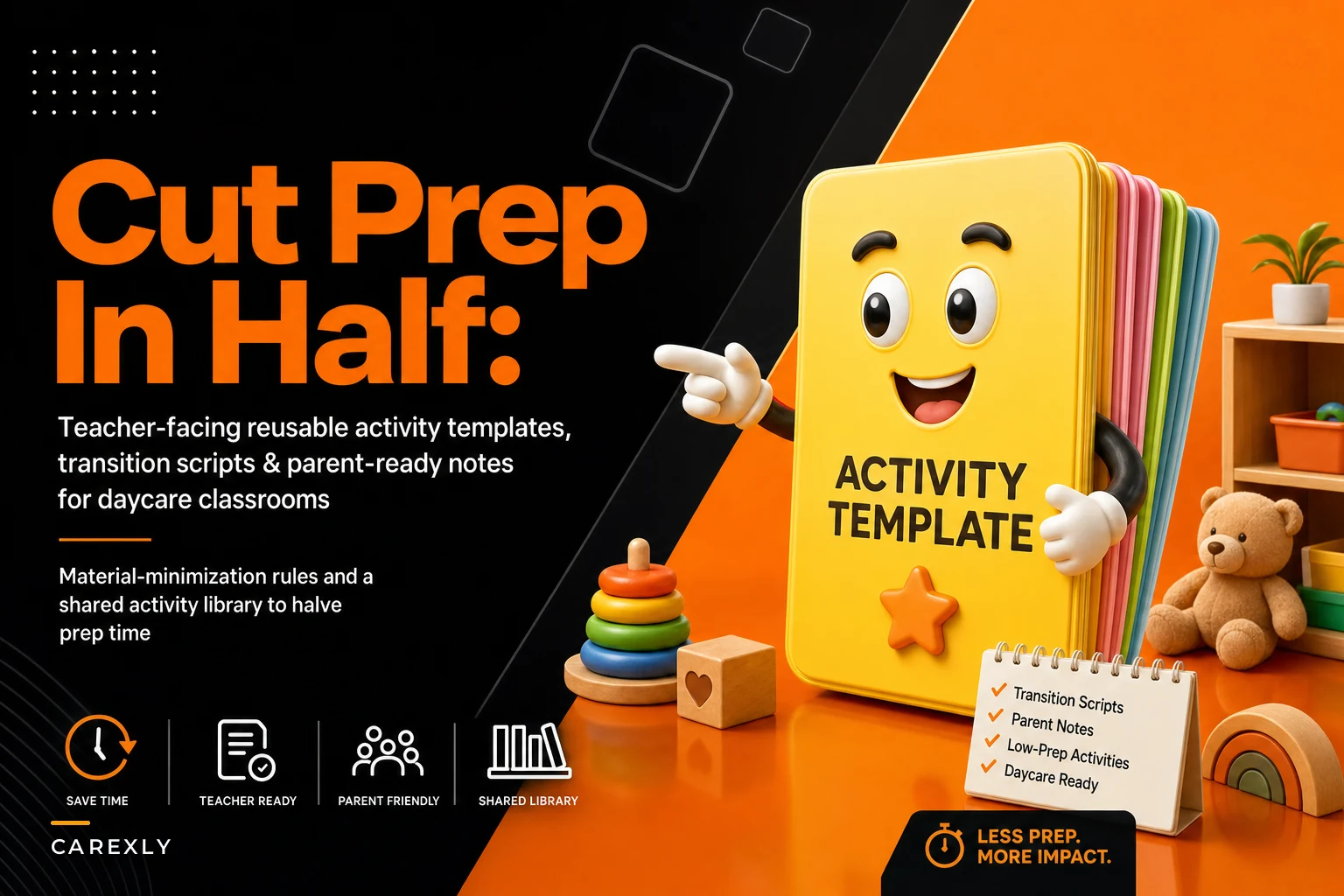
This post is about fixing that with a specific structure: a teacher-facing reusable activity library, tight rules on materials, transition scripts that don't fall apart when the room gets loud, and take-home notes that actually connect to curriculum goals instead of being an afterthought. If you've been searching for daycare activity planning templates that hold up in a real classroom instead of looking pretty on Pinterest, this is the operational version.
Why prep eats so many hours (and why it hides from you)
Prep time rarely shows up as a line item, which is exactly why it never gets fixed. It gets buried inside "planning time," folded into unpaid evenings, or absorbed during nap when a teacher should be documenting or resting. Nobody tracks it, so nobody manages it.
The pattern across centers of every size looks like this: activities live in individual teachers' heads and personal folders. When a teacher is out sick, the sub gets a shrug and a crayon bin. When a strong teacher leaves, her entire library walks out the door with her. New hires spend their first two months building from zero because there's no shared starting point.
A typical toddler room runs somewhere around 15–20 distinct activities a week across sensory, gross motor, language, and free play. If a teacher spends even 20–30 minutes designing and prepping each new one — and half of those are things the center has technically done before — you're paying for the same activity to get invented four or five times a year. Multiply that across five classrooms and the number stops being cute.
The deeper problem isn't effort. Teachers want to prep. It's that the effort isn't compounding. Every hour spent should make the next month easier. Instead it evaporates.
The core fix: a reusable library, not a lesson-plan folder
A lesson-plan folder is a graveyard. Things go in, nothing comes out. A reusable activity library is different because it's built to be pulled from, remixed, and reused without editing.
Eliminate administrative bottlenecks.
Carexly helps you manage enrollments, attendance, and staff schedules effortlessly.
- Streamlined child enrollment
- Automated parent notifications
- Staff shift and activity scheduling
No credit card required
The unit of the library isn't a "week." It's a single activity card — one activity, fully specified, tagged so a teacher can find it in ten seconds. The whole point is that a teacher planning next week's toddler schedule should be assembling from existing cards 80% of the time and only building something new when there's a real reason to.
Each card should contain a fixed set of fields. Keep this ruthless — the moment cards vary in format, the library gets slow to scan and people stop using it.
Each card should contain a fixed set of fields.
| Field | What it holds | Why it matters |
|---|---|---|
| Activity name | Short, searchable | Teachers search by name and skill |
| Age band | Infant / toddler / 2s / preschool / pre-K | Prevents age-mismatch reuse |
| Curriculum goal | The specific skill it targets | Ties activity to what regulators and parents care about |
| Materials | Exact list + quantities | Enables material-minimization (below) |
| Setup time | In minutes | Lets teachers plan realistic days |
| Transition script | 2–3 lines said out loud | Keeps the room from unraveling between activities |
| Take-home note | Pre-written parent blurb | Connects home and classroom without extra writing |
| Portfolio capture | What to photograph/collect | Turns the activity into documentation |
The card does triple duty. It runs the activity, feeds parent communication, and feeds portfolio documentation — all from one place a teacher already has open. You stop treating planning, parent updates, and documentation as three separate jobs.
You stop treating planning, parent updates, and documentation as three separate jobs.
Material-minimization rules (the part everyone skips)
Most "template" collections online ignore materials completely, which is why they fall apart in a real budget. A good library isn't just reusable in time — it's reusable in stuff.
Material-minimization means writing activities around a small, standardized set of core supplies, then designing variety on top of that base. The goal is fewer specialty items, less prep waste, and supply lists that are predictable enough to actually stock.
A practical rule set:
-
Cap specialty materials. Any activity requiring more than one item you don't already keep in bulk needs justification. If it needs three special things, it's a "special occasion" activity, not a weekly one.
-
Standardize the base kit. Define a core supply set per room — paper, tape, containers, natural materials, art basics — that 70–80% of activities draw from.
-
Reuse physical setups, not just ideas. A sensory bin base can support six different activities across a month by swapping one element. Tag those variations so teachers see them together.
-
No single-use prep for weekly activities. If something has to be re-cut, re-laminated, or rebuilt every single time, redesign it or demote it. Laminate once, reuse for a year.
-
Write quantities, not vibes. "Some pom-poms" causes over-ordering. "One cup of pom-poms per table" doesn't.
Laminate once, reuse for a year.
This is where the library and your supply ordering finally start talking to each other. When materials are specified precisely on every card, your par levels and reorder cadence stop being guesswork — you know exactly what next month's planned activities will consume before the week starts, instead of discovering you're out of glue sticks on a Tuesday morning.
Transition scripts: the hidden reason days fall apart
Transitions — cleanup to circle, circle to outside, outside to lunch — are where classroom control leaks out. A great activity followed by a chaotic transition still feels like a bad day, and it burns teacher energy faster than almost anything else.
Most centers leave transitions entirely to individual teacher instinct. That works fine for veterans and is brutal for new hires and subs. Putting a two- or three-line transition script directly on each activity card fixes this without a training binder.
> "When you hear the bell, freeze like a statue. Now put ONE thing in the bin. Now walk like a turtle to the blue carpet."
The value isn't the specific words. It's that the words exist, are consistent across teachers, and give a sub something concrete to say when a room of two-year-olds is deciding whether to cooperate. Consistency across classrooms also means a child moving up a room hears familiar cues, which cuts friction on internal transitions noticeably.
Transitions get worse when they're vague ("okay, clean up!") and better when they're broken into small, obeyable steps. Scripting them into the library is how you make that repeatable instead of dependent on who's working that day.
Take-home notes tied to curriculum goals
A mistake that comes up constantly: parent communication and curriculum documentation get treated as two separate chores done at two separate times, both usually rushed. The take-home note gets written at pickup in thirty frantic seconds and says "had a great day!" — which tells a parent nothing and proves nothing to a licensor.
> "Today we practiced counting objects one at a time up to five (early math). At home, try counting stairs together as you climb them."
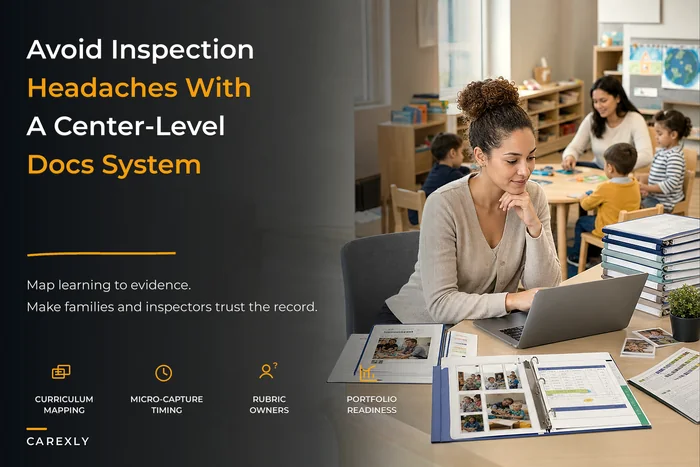
The parent gets something specific. They get a way to extend it at home. And you've generated a clean piece of evidence that the activity mapped to a real learning objective. This is the same discipline that makes licensing visits calmer — a center that can show activity-to-goal mapping without scrambling is in a completely different position than one improvising documentation on the spot. If that's a live concern, it connects directly to building a center-level learning and documentation system families and regulators trust.
The efficiency gain is real: one field on one card produces the parent note AND the curriculum tag AND the prompt for what to capture for the portfolio. Three outputs, one moment of writing — and it was written once, when the activity was designed, not fifty times at fifty pickups.
Portfolio capture without the end-of-month panic
Portfolios usually get assembled in a frantic burst before conferences or licensing, which means the photos are inconsistent and half the "evidence" is reconstructed from memory. Building the capture instruction into the activity card fixes the timing problem — capture happens in the moment, because the card tells the teacher what to grab.
The capture field should be specific. Not "take a photo" — that produces 400 identical circle-time shots. Instead: "Photograph the child sorting by color; save one work sample." When capture is tied to the curriculum goal, every photo already has meaning attached, and the portfolio assembles itself over the term instead of in one exhausting weekend.
A real scenario
A mid-sized center running five classrooms, around 70 kids, had classic prep sprawl. Leads were putting in an estimated 4–6 hours a week each on planning and prep, a big chunk of it rebuilding activities that already existed in someone else's binder. Sub days were rough. New-hire ramp-up dragged on for weeks.
They spent about six weeks building a shared library — roughly 120 activity cards to start, each with materials, a transition script, a take-home blurb, and a capture note. Nothing fancy. Just standardized.
The change wasn't dramatic on day one. But within a couple of months, prep time per lead dropped to somewhere around 2–3 hours a week because they were assembling from existing cards instead of inventing. Sub days stopped being a gamble — a sub could pull three cards and run a real day. Parent notes got noticeably more specific, and the director stopped dreading portfolio season. Supply ordering also got more predictable once activities carried exact quantities. Not a miracle. Just a lot of recovered hours and noticeably less friction.
When this makes sense — and when it doesn't
This is worth building if: you run more than a couple of classrooms, you're seeing turnover, sub days feel chaotic, or your teachers are clearly duplicating each other's work. The library pays off fastest when multiple people can share it.
This is a bad idea if you build it wrong: if cards vary in format, if there's no owner keeping it current, or if you try to launch with 400 cards on day one, it'll collapse under its own weight. Start with the 100–120 activities you actually run most, and grow it from real classroom use.
Who should hold off on this: a single-classroom home-based program with one consistent teacher and no turnover probably won't recover enough hours to justify the setup. The economics kick in with scale and shared use.
Making the library actually get used
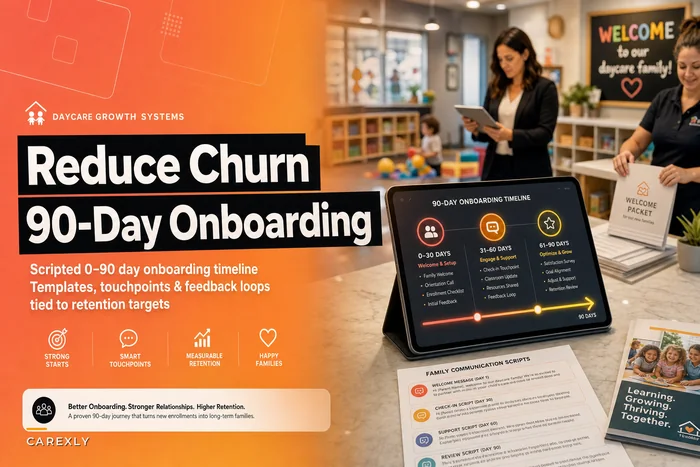
A library nobody opens is just a nicer graveyard. Adoption is the real work, and it's mostly about lowering friction and building the habit early — the same logic behind a strong staff onboarding sequence. New teachers should meet the library in their first week, not stumble onto it months later. If you're formalizing that process, it fits neatly into a scripted 90-day onboarding timeline.
A rollout process that tends to stick:
-
Inventory what already exists. Have each lead list their 20 go-to activities. You'll find heavy overlap — that's your starting core.
-
Standardize the card format and refuse to deviate from it. One format, every card.
-
Fill in the missing fields on those existing activities — transition scripts, take-home notes, capture instructions. Most already have the activity; they're just missing the connective tissue.
-
Assign an owner who reviews and approves new cards so quality stays consistent.
-
Make pulling from the library the default for weekly planning. New builds are the exception that needs a reason.
-
Review quarterly — retire dead cards, promote the ones teachers keep reaching for.
Before you go live, sanity-check the library against this list:
-
Every card uses the identical format
-
Materials list exact quantities from a standardized base kit
-
No weekly activity requires single-use prep
-
Every card has a transition script
-
Every take-home note maps to a stated curriculum goal
-
Every card specifies what to capture for portfolios
-
Someone owns updates and quarterly cleanup
Where operational software helps here is quiet but real. Keeping one shared library that every teacher and sub can actually search means cards don't fragment back into personal folders, and the material lists on those cards can feed supply planning instead of living in a separate spreadsheet. The library is the source of truth — the software just keeps it in one place and stops it from drifting back into chaos.
The library is the source of truth — the software just keeps it in one place and stops it from drifting back into chaos.
A simple rollout workflow looks like this:
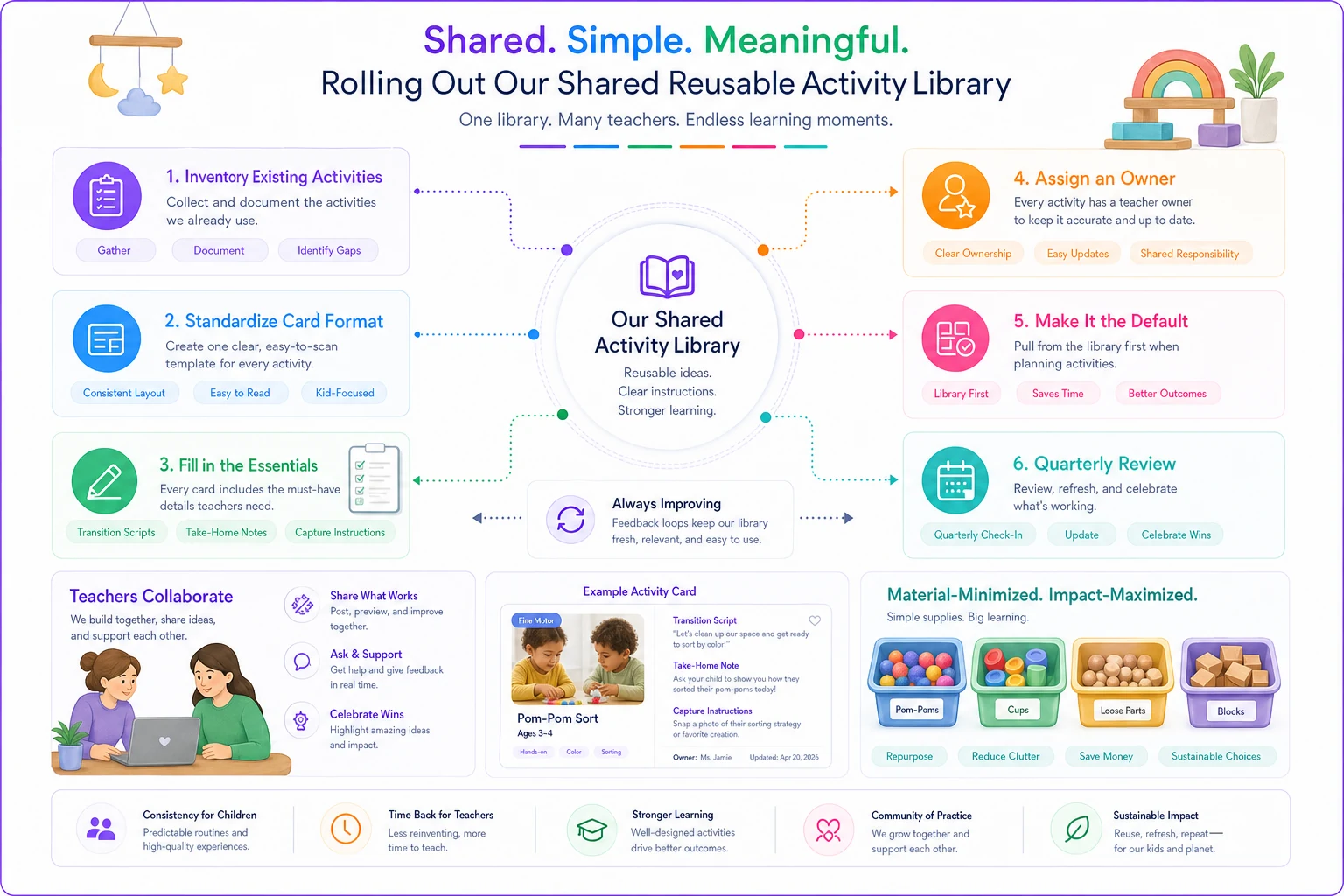
Use the workflow as a checklist during your first six weeks of building the library.
The point
Prep time isn't wasted because teachers are slow. It's wasted because the work doesn't accumulate — every good activity dies in a binder instead of feeding the next month. A reusable library with strict material rules, scripted transitions, and notes tied to real goals changes that math. You build once and pull from it for years, and the same card that runs the activity quietly handles your parent communication and your documentation too.
Start with the hundred activities you already run every week. Standardize them. Add the missing fields. That's most of the battle, and it's the version of daycare activity planning templates that actually survives contact with a real classroom on a loud Thursday afternoon.
Ready to transform your daycare operations?
Join hundreds of daycare centers using Carexly to save time, improve communication, and enhance child care quality.