


A toddler needs an afternoon dose of amoxicillin. The lead teacher is on a bathroom run with two other kids, so she asks the floater to "just give it, the bottle's in the fridge, mom already signed something." The floater gives it. No log entry. No dosage confirmation. Nobody remembers which floater it actually was.
Two weeks later a parent calls, upset, because their kid got a double dose one afternoon — and now you're trying to reconstruct who administered what, when, and under whose authorization, from memory and a smudged clipboard sheet.
This is the failure mode that turns a routine medication into a licensing complaint. And it almost never happens because someone was careless with the medicine itself. It happens because the delegation was informal and the record was optional. Those two gaps, together, are where daycare centers get burned.
This post is a tight, buildable daycare medication administration protocol focused on exactly that seam: who is allowed to give meds, how permission gets captured, and how every single dose leaves an auditable trail that holds up when a parent, a nurse, or a licensor asks questions.
Why delegation is the actual risk, not the medicine
Most centers already know the basics — meds stay locked, labels get checked, allergies get flagged. What breaks down is the handoff.
In real operations, medication problems cluster around three predictable moments:
-
The substitute or floater dose. The person who normally gives meds isn't the person who gave meds that day, and there was no written rule saying the floater was allowed to.
-
The verbal permission. A parent says "yeah, give him the Tylenol if his fever comes back" at pickup, nobody writes it down, and now there's a dose with no signed authorization behind it.
-
The end-of-day gap. The dose happened at 2
40 but got logged at 5:15 from memory, if it got logged at all.
None of these are clinical errors. They're workflow errors. A center can have a perfect med cabinet and still be one informal handoff away from a report they can't defend.
The fix isn't more training on "be careful." It's making the permission and the record impossible to skip. When the protocol forces both, the medicine part mostly takes care of itself.
The four pieces every protocol needs
A minimal-but-complete protocol has exactly four components. Skip any one and you reopen a gap.
Eliminate administrative bottlenecks.
Carexly helps you manage enrollments, attendance, and staff schedules effortlessly.
- Streamlined child enrollment
- Automated parent notifications
- Staff shift and activity scheduling
No credit card required
-
An intake permission template — signed, specific, and time-bounded.
-
Explicit delegation rules — who can give meds, and who can give them when the primary person is out.
-
A single-line capture format — so logging a dose takes 15 seconds, not two minutes.
-
Timestamped audit fields — that record who, what, when, and under whose authority, automatically.
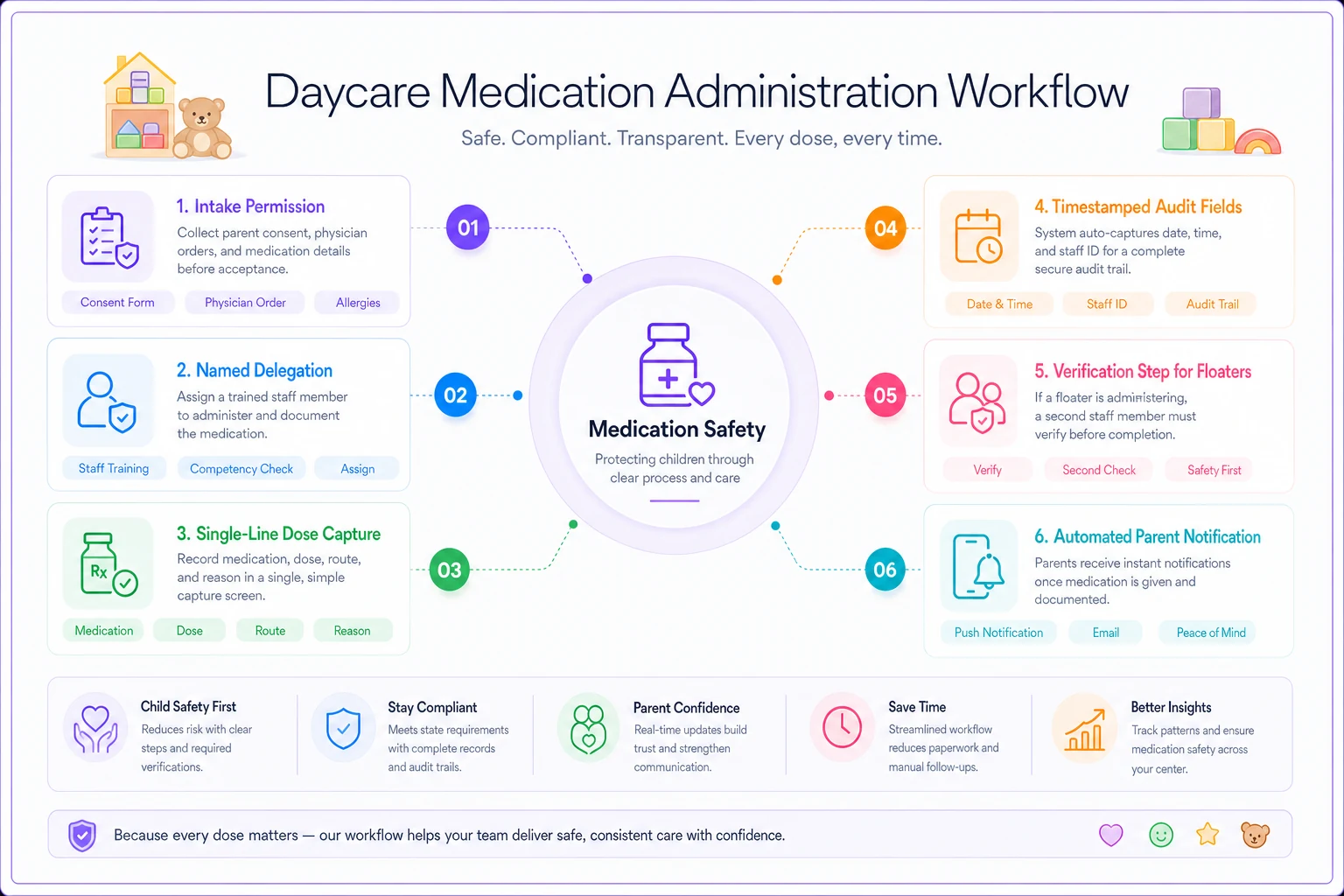
This diagram shows the flow from signed permission to an auditable dose entry and parent notification.
1. Intake permission templates that don't leave holes
The most common intake mistake is a permission form that says "administer as needed." As-needed is a landmine. Needed by whom? At what threshold? How many times a day before you call the parent?
A defensible permission template captures specific, bounded authorization. For each medication, you want:
-
Child's name and DOB
-
Medication name and strength (e.g., "Children's Ibuprofen, 100mg/5mL")
-
Exact dose and route ("5mL, oral")
-
Trigger condition, not just "as needed" ("if temp above 101°F, one dose, then call parent")
-
Earliest time the next dose is allowed
-
Max doses per day
-
Start and end date for authorization
-
Parent signature + date
-
Whether a prescription label is on file (required for prescription meds)
That end date matters more than people think. Authorizations without expiration dates are how a center ends up giving a med three weeks after the parent assumed it was done. A six-week-old permission with no boundary is basically no permission.
2. Delegation rules written before you need them
Here's the rule that prevents the opening scenario: nobody administers medication unless they appear on a named delegation list for that day. Not "any teacher." A named list.
A simple delegation structure that works on the floor:
| Role | Can administer? | Requires backup sign-off? | Notes |
|---|---|---|---|
| Med-trained lead | Yes | No | Primary for their room |
| Med-trained assistant | Yes | No | Covers when lead is out |
| Floater (med-trained) | Yes | Yes — second staff verifies dose | Only if on the day's coverage list |
| Untrained staff | No | — | Never, including "just this once" |
| Director/admin | Yes | No | Backstop for gaps |
The important line is the floater row. Floaters cover gaps constantly, which is exactly why they're the highest-risk administrators — they're less familiar with the specific kids. A second-staff verification on floater doses catches the wrong-child and wrong-strength errors before they happen.
Keep the named daily delegation list visible to staff on the floor so floaters know whether they're authorized that day.
And "untrained staff: never" needs to be a hard wall. The "just this once because we're short" dose is the one that ends up in an incident report. If you're chronically short on med-trained coverage, that's a scheduling problem to solve upstream, not a rule to bend.
3. Single-line tablet capture so logging actually happens
Long paper forms are why doses go unlogged. If recording a dose takes two minutes and three checkboxes, a teacher juggling eight kids will do it "later," and later becomes never.
[Child] Liam T. | Ibuprofen 100mg/5mL | 5mL oral | Temp 101.4 | 2:38 PM | Given by: R.Ortiz | Verified: —
A few more real examples so the format is concrete:
[Child] Ava P. | Amoxicillin 250mg/5mL | 5mL oral | scheduled dose | 12:05 PM | Given by: M.Chen | Verified: —
[Child] Noah K. | Albuterol inhaler | 2 puffs | wheezing after outdoor | 3:22 PM | Given by: J.Diaz (floater) | Verified: S.Bell
[Child] Mia R. | EpiPen Jr 0.15mg | 1 injection, thigh | hives + swelling, 911 called | 11:47 AM | Given by: R.Ortiz | Verified: S.Bell
Notice the floater and emergency entries both carry a Verified name. That's the delegation rule showing up in the record itself. When the trail shows a second person on high-risk doses, it demonstrates the protocol was followed — not just that a dose happened.
The single-line format also makes end-of-day review fast. A director can scan a full day's entries in under a minute and immediately spot anything missing a verifier or logged suspiciously late.
4. Timestamped audit fields that don't rely on memory
The audit layer is what separates a clipboard from a defensible record. Every dose entry should carry these fields, and the timestamp should be captured at the moment of entry, not typed by hand:
-
Administration time (when the med was given)
-
Entry time (when it was logged — if these are 40 minutes apart, that's a flag)
-
Administering staff (name, not initials)
-
Verifying staff (where required)
-
Authorization reference (which signed permission form this dose falls under)
-
Trigger note (temp, symptom, or "scheduled")
-
Parent-notified flag and notification time
That authorization reference field is the one most centers forget. Linking each dose back to a specific signed permission is what lets you answer "who said you could give this?" in three seconds instead of digging through a folder.
If any of this sounds familiar, it's the same principle behind a defensible incident workflow — capturing the minimum right data at the moment it happens rather than reconstructing it later. The same logic that makes a rapid minimum-data incident report hold up under scrutiny applies directly to medication logs.
Automated parent notifications: closing the trust gap
Parents don't get anxious because their kid got medicine. They get anxious because they found out late or didn't find out at all.
> "Hi Sara — Liam received Ibuprofen (5mL) at 2:38 PM today for a temp of 101.4°F, per your signed authorization. He's resting comfortably. — Sunrise Room"
Keep it factual: what, how much, when, why, and a one-line status. Don't editorialize about how the child is "doing great" unless you're sure — that's a promise you don't want in a written record if the afternoon goes sideways.
Centers with automatic dose notifications tend to get far fewer anxious pickup-time questions, because the parent already knows. The notification quietly does the reassurance work all afternoon.
A short real scenario
A mid-size center — around 90 kids across two toddler rooms — was running meds off a shared paper binder. Over one spring they had two "who gave this?" disputes with parents and one licensing visit where the inspector flagged three doses logged with no time and no authorization reference.
They didn't overhaul anything dramatic. They moved to single-line digital capture, added the floater verification rule, and turned on an auto-text to parents at the moment of logging. Within a couple months, the unlogged-dose problem essentially disappeared — end-of-day reviews showed near-complete entries instead of the usual two or three blanks — and pickup-time medication questions dropped off noticeably because parents were already notified.
The part the director cared about most: the next licensing visit, when asked about a specific afternoon dose, she pulled the exact line — staff, verifier, time, authorization, parent-notified — in under a minute. No binder-flipping.
Where software helps — and where it doesn't
Software doesn't make a bad protocol good. If your delegation rules are vague, a digital log just captures the vagueness faster.
Where an AI-assisted operational platform earns its place is in the enforcement — the parts humans skip when they're busy:
-
It can block a dose entry if the administering staff isn't on today's delegation list.
-
It can auto-flag any dose where entry time is far from administration time, or where a floater dose is missing a verifier.
-
It can pull the matching authorization automatically so the reference field is never blank.
-
It can fire the parent notification the instant the line is saved, so nobody has to remember.
That's really it — the value is that the protocol can't quietly erode on a chaotic Tuesday. The same auditable, role-mapped thinking that makes compliance workflows survive a surprise inspection is what you want under your med log: every action tied to a person, a permission, and a timestamp, without anyone having to think about it.
A quick implementation checklist
Before you consider your protocol done, run through this:
-
[ ] Every prescription med has a permission form with strength, dose, trigger, max doses, and an end date
-
[ ] "As needed" is banned — every authorization has a specific trigger condition
-
[ ] A named daily delegation list exists, and untrained staff are never on it
-
[ ] Floater and emergency doses require a second-staff verifier
-
[ ] Doses log in one line, in under 20 seconds
-
[ ] Both administration time and entry time are captured automatically
-
[ ] Each dose links to a specific authorization reference
-
[ ] Parents get an automatic notification at the moment of logging
-
[ ] A director scans the full day's med lines every evening for blanks and late entries
If you only change one thing this week, make it the named delegation list. Most of the medication liability daycare centers actually face doesn't come from the wrong drug — it comes from the wrong person giving it with no rule and no record behind them.
The one thing to fix first
If you only change one thing this week, make it the named delegation list. Most of the medication liability daycare centers actually face doesn't come from the wrong drug — it comes from the wrong person giving it with no rule and no record behind them.
Lock down who's allowed to administer, force a second signature on the risky doses, and make sure every dose leaves a timestamped trail with a name on it. Do that, and the "who gave this and who said they could?" phone call stops being a scramble and becomes a thirty-second lookup — which is exactly where you want to be standing when a parent, or a licensor, is on the other end.
Lock down who's allowed to administer, force a second signature on the risky doses, and make sure every dose leaves a timestamped trail with a name on it. Do that, and the "who gave this and who said they could?" phone call stops being a scramble and becomes a thirty-second lookup — which is exactly where you want to be standing when a parent, or a licensor, is on the other end.
Ready to transform your daycare operations?
Join hundreds of daycare centers using Carexly to save time, improve communication, and enhance child care quality.