

Most centers stumble into employer relationships by accident. A local HR manager calls because three of their employees are stuck on your waitlist, you work something out over email, and six months later you realize you never defined who pays for what, how referrals flow, or whether those "guaranteed" slots are actually being used. The arrangement quietly fizzles, the employer stops referring, and you've burned a channel that could've filled your toddler room.
An employer partnership daycare program doesn't fail because the idea is bad. It fails because nobody operationalized it. No agreement anyone can point to, no owner on either side, no numbers being tracked. This post is a tight pilot playbook: a short MOU you can actually sign, a benefit-coordination checklist that keeps subsidy and HR money from colliding, onboarding steps, and the handful of KPIs that tell you whether the thing is working before you scale it.
Scope is narrow on purpose. This isn't about marketing to employers or negotiating corporate contracts. It's about running a clean pilot with one or two employers and building the operational scaffolding that keeps it from falling apart.
Why these partnerships quietly collapse
The pattern is almost always the same. The relationship starts warm — a conversation, some goodwill, a vague promise of "priority access." Then reality hits all the gaps nobody filled in.
The employer assumed they were buying reserved slots. You assumed you were just giving their employees waitlist priority. Their HR team thought the childcare benefit stacked on top of state subsidy; your billing person didn't know the benefit existed and billed the family full tuition. Three families got confused invoices, two complained to HR, and now the HR manager associates your center with billing chaos.
This usually happens when the pilot has no single document defining the terms and no single person on each side who owns it. When the champion at the employer changes jobs — which happens constantly in HR — the whole arrangement evaporates because it lived in one person's inbox.
The other common failure is utilization. An employer "commits" to five slots, you hold them, and only two get filled. You've now got three empty spots you turned other families away for, and the employer feels like the program isn't delivering value either. Nobody wins because nobody was tracking the slots.
The short MOU: what actually needs to be in it
A pilot MOU should fit on two pages. The goal isn't legal armor — your attorney handles the real contract if the pilot graduates. The goal is clarity so both sides are operating from the same assumptions. Long agreements kill pilots because they trigger legal review on both ends and stall for months.
Eliminate administrative bottlenecks.
Carexly helps you manage enrollments, attendance, and staff schedules effortlessly.
- Streamlined child enrollment
- Automated parent notifications
- Staff shift and activity scheduling
No credit card required
-
Slot structure
Are these reserved slots held for a defined window, or priority waitlist access? Be explicit. "Priority placement ahead of general waitlist" is very different from "3 reserved infant slots held through [date]."
-
Who pays what
Define the employer contribution (flat subsidy per child, percentage of tuition, or enrollment fee coverage), what the family pays, and how it interacts with state subsidy. This is the clause most pilots skip and most pilots die on.
-
Referral mechanics
How does an employee get referred? A form, an HR email, a code? Who confirms eligibility?
-
Hold period and release rules
If a reserved slot isn't filled within, say, 21 days of becoming available, it releases back to the general waitlist. This protects your occupancy.
-
Named owners
One person at the center, one at the employer. Include backup contacts.
-
Pilot duration and review date
90 days is enough to see real patterns. Set the review meeting date in the MOU itself.
-
Data you'll share
Utilization numbers, fill times, maybe anonymized satisfaction. Nothing that violates family privacy.
That's it. If the MOU runs longer than two pages, you're probably negotiating a contract, not piloting.
The benefit-coordination checklist: where subsidy and HR money collide
This is the part that causes the most operational damage, so it gets the most detail. When an employer benefit and a public subsidy both touch the same family, the stacking order and billing logic have to be nailed down before the first invoice goes out. Get it wrong and you're clawing back money from families, which destroys trust faster than almost anything.
The core question: does the employer contribution apply before or after subsidy? The answer changes the family's out-of-pocket and your reimbursement math entirely.
Run every employer-referred family through this checklist before enrollment:
-
[ ] Confirm the family's subsidy eligibility status and award amount (if any)
-
[ ] Confirm the employer benefit type
flat amount, percentage, or fee-only
-
[ ] Determine stacking order — document whether employer benefit reduces the subsidized portion or the family-pay portion
-
[ ] Verify the employer benefit doesn't disqualify or reduce the subsidy (some programs count employer childcare assistance as income)
-
[ ] Calculate the family's net out-of-pocket and put it in writing to the family before they sign
-
[ ] Set up the billing split so each payer is invoiced correctly and separately
-
[ ] Confirm how and when the employer is invoiced or reimbursed
-
[ ] Document the renewal/re-verification date for both the subsidy and the employer benefit
That third and fourth item trip up most centers. A family on state subsidy whose employer adds a benefit can, in some programs, see their subsidy adjusted because the assistance counts toward household income. If you don't check, you're setting up a billing arrangement that breaks at the family's next subsidy redetermination — and they get a surprise balance.
If you're already running clean subsidy intake, this layers on top of it. If you're not, fix that first — our subsidy intake checklist that passes audits is the foundation this whole program sits on. Employer benefits make subsidy intake more complex, not less, so sloppy intake becomes very expensive very fast once two payers are involved.
A quick comparison of contribution models
| Model | How it works | Best when | Watch out for |
|---|---|---|---|
| Flat per-child subsidy | Employer pays fixed $/month per enrolled child | Employer wants predictable budget | May not cover much of high-cost infant care |
| Percentage of tuition | Employer covers X% of tuition | Employer wants proportional support | Your tuition increases change their cost mid-pilot |
| Fee coverage only | Employer covers registration/enrollment fees | Low-commitment first step | Minimal family relief, weak differentiation |
| Reserved-slot retainer | Employer pays to hold slots regardless of fill | Employer needs guaranteed access | You lose the slot revenue if they underfill |
The retainer model protects your occupancy best, but it's also the hardest sell for a first pilot. Most small centers do better starting with a flat per-child subsidy and graduating to a retainer once the employer sees utilization data they trust.
Onboarding steps for an employer-referred family
Employer-referred families need a slightly different onboarding path than walk-ins, mostly because of the billing coordination and because the employer is watching how it goes. A clumsy first enrollment can sink the whole pilot from the employer's perspective.
Here's the sequence that keeps it clean:
-
Referral received — HR submits the employee through the agreed channel (form or email). Log it immediately with a timestamp. This timestamp matters later for your fill-time KPI.
-
Eligibility and benefit confirmation — Within 2 business days, confirm the employee works for the partner employer and determine their benefit tier. Don't let this drag; slow confirmation is the number one reason employer leads go cold.
-
Slot match and benefit-coordination run — Match to an available slot and run the benefit-coordination checklist above. Calculate net out-of-pocket.
-
Written cost summary to the family — Send the family a plain-language breakdown: full tuition, subsidy portion, employer portion, their portion. One page. No surprises later.
-
Standard enrollment — Move them into your normal enrollment, documentation, and immunization workflow. The employer channel changes billing, not your core compliance.
-
Billing setup verification — Before the first invoice runs, have a second person confirm the payer split is configured correctly. The first invoice is the one everyone remembers.
-
Employer confirmation — Notify HR that the employee enrolled, with the start date. Keeps the employer's champion looking good internally, which keeps referrals coming.
A simple workflow diagram shows the sequence and handoffs.
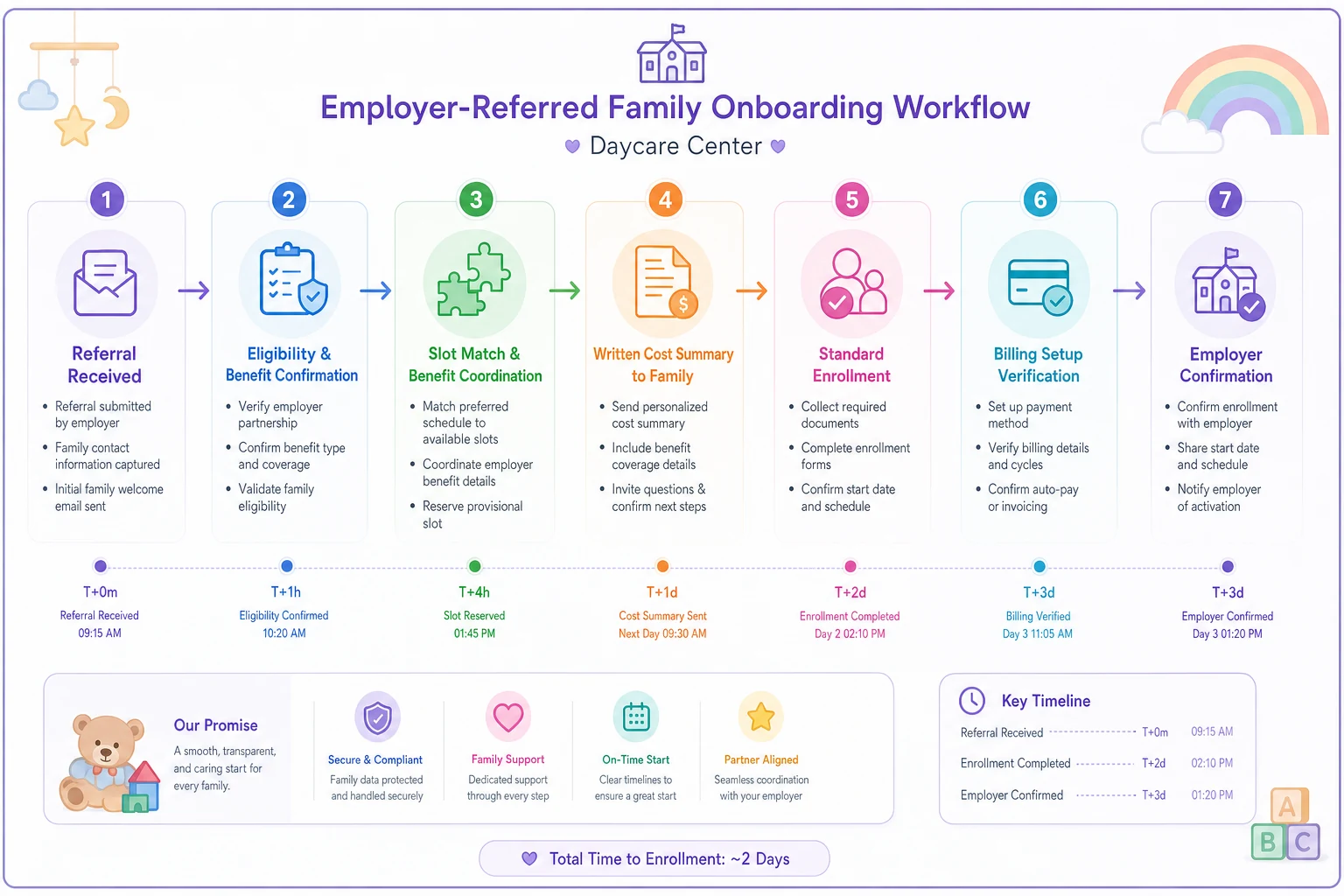
The family experience from referral to confirmation should feel fast and certain. When an employee tells their coworkers "that was easy," you've just built your best referral engine inside that company for free.
The KPIs that tell you if the pilot is working
A pilot with no numbers is just a favor you're doing. At the 90-day review, you need to know whether to kill it, keep it, or scale it. Track these — and only these — so the measurement stays light enough to actually maintain.
Track these — and only these — so the measurement stays light enough to actually maintain.
-
Referral-to-enrollment rate
Of employees referred, how many actually enrolled? Below roughly 40% usually means your confirmation step is too slow or the net cost to families isn't compelling.
-
Referral fill time
Median days from referral received to enrollment confirmed. This is your responsiveness score. Aim for under 10 days.
-
Subsidized slot utilization
Of the slots committed or held, what percentage are filled and billing correctly? This is the number the employer cares about most.
-
Billing accuracy on employer-referred families
Percentage of invoices with no corrections needed in the first 60 days. Corrections here are trust-killers.
-
Retention of employer-referred families at 90 days
Are they staying? Employer channels can send you families who are a good fit or ones placed under pressure — retention tells you which.
Focus reporting effort on fill time, utilization, and billing accuracy so the pilot stays light and sustainable.
Notice what's not on the list: activity metrics like "number of conversations with employers." Pilots drown in those. Fill time, utilization, and billing accuracy are the three that actually forecast whether this becomes a real channel.
A realistic pilot scenario
A mid-size center with roughly 90 licensed slots had a chronically soft infant room — usually 4 to 5 empty spots, which at their rates meant somewhere around $4k–$5k in monthly revenue sitting idle. A nearby logistics company with a lot of shift-working parents had employees stuck looking for infant care.
They ran a 90-day pilot: priority placement plus a flat employer subsidy of around $200/month per child, stacked carefully on top of state subsidy for the families who qualified. No reserved slots in the first round — just fast-tracked referrals and clean billing coordination.
The employer referred 11 employees over the pilot period. Seven enrolled. Two of those seven had subsidy, so the benefit-coordination checklist caught a stacking issue before it hit a single invoice — the center adjusted the billing split and avoided a clawback situation entirely. Fill time landed around 8 days median. The infant room went from 4–5 empty spots to 1–2.
Not a dramatic transformation, but a steady one. More importantly, the employer's HR lead got internal credit, kept referring into the next quarter, and the center converted the arrangement into a reserved-slot agreement for the following year because the utilization data gave both sides confidence.
When this makes sense — and when it doesn't
An employer pilot is worth running when you have consistent open capacity in a specific room and a nearby employer whose workforce demographics match your empty slots. Infant and toddler rooms are usually where the demand-supply mismatch is sharpest, which makes them the most logical pilot targets.
It's a bad idea when you're already at or near capacity. Holding or prioritizing slots for an employer when you have a healthy general waitlist just means you're turning away ready families to chase a maybe. In that case the partnership costs you more than it gives.
Who should not do this yet: centers with messy subsidy intake or shaky billing. If your invoices already have errors, adding a second payer multiplies the chaos. Fix your billing and subsidy foundation first. Layering employer benefits onto broken billing is how you lose an employer relationship in the first billing cycle.
One more honest caution: these relationships live and die on the employer-side champion. Build the MOU with named owners and backups precisely because that champion will eventually change roles. The documentation is what lets the next HR person pick it up instead of letting it quietly die.
Keeping the channel alive after the pilot
If the 90-day numbers look good, the mistake centers make next is treating the relationship as finished. Employer channels need the same lifecycle thinking you'd apply to any family relationship — there's an inquiry, an onboarding, an ongoing engagement, and a renewal. Mapping the full relationship the way you would in a family engagement lifecycle keeps the employer connected instead of forgotten between review meetings.
Schedule the next review before the current one ends. Send the employer a short utilization recap quarterly — three numbers and a sentence, not a report nobody reads. Keep the benefit-coordination checklist running on every new referral, because the moment you get casual about stacking order is the moment a family gets a surprise balance and HR hears about it.
The whole point of running this as a tight pilot — short MOU, clear checklist, a handful of KPIs — is that it's small enough to do well and measurable enough to know if it's working. Start with one employer, one soft room, and clean billing. Prove it, then expand. That's a channel you can actually build on, instead of another arrangement that lived in someone's inbox until they left.
The whole point of running this as a tight pilot — short MOU, clear checklist, a handful of KPIs — is that it's small enough to do well and measurable enough to know if it's working. Start with one employer, one soft room, and clean billing. Prove it, then expand. That's a channel you can actually build on, instead of another arrangement that lived in someone's inbox until they left.
Ready to transform your daycare operations?
Join hundreds of daycare centers using Carexly to save time, improve communication, and enhance child care quality.