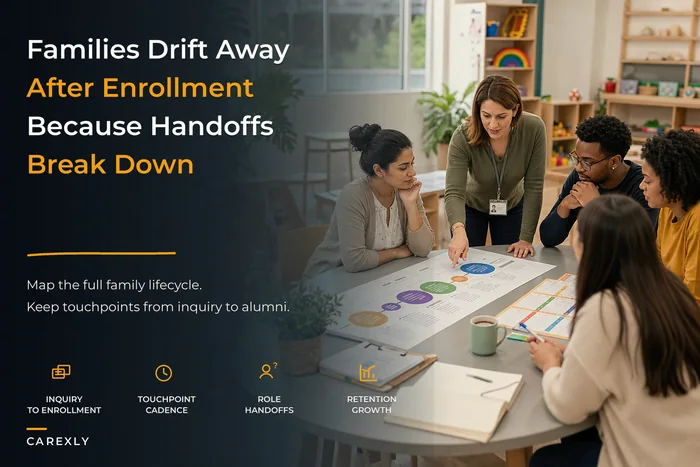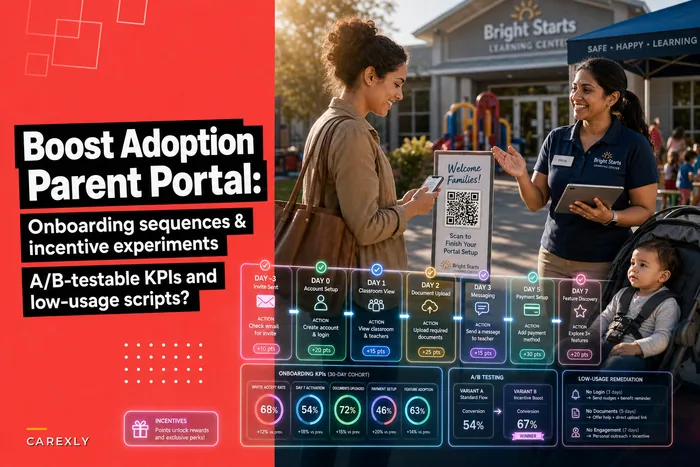

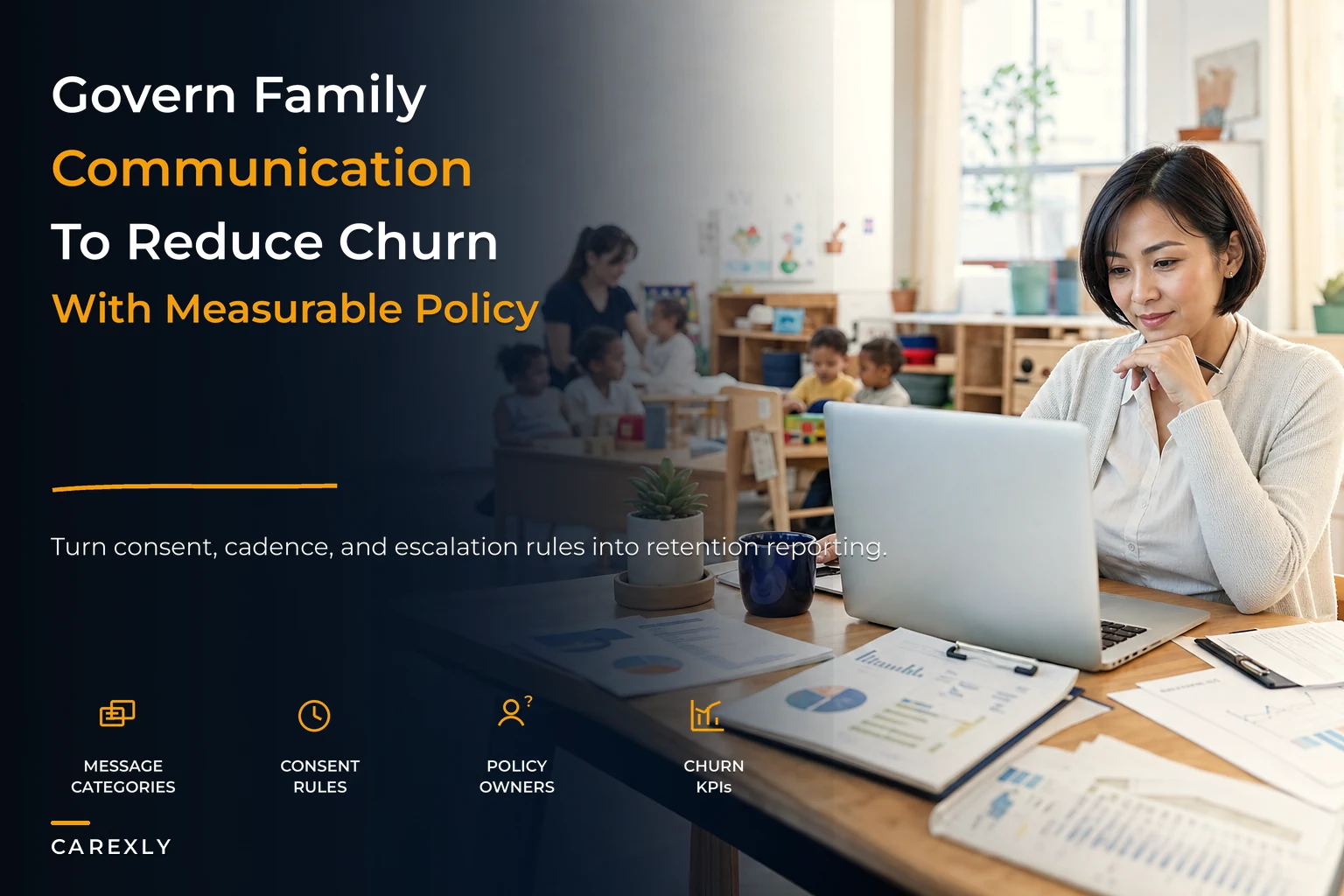

Most centers treat family communication like weather — something that just happens rather than something they actually run. Messages go out when a teacher remembers, reminders land at random times, and consent to text or email lives in a folder nobody's touched since intake. At 40 kids, it's fine. At 120, it quietly falls apart.
What owners miss is that communication isn't some soft skill sitting off to the side. It's an operational system that touches billing, retention, compliance, and staffing. When it's ungoverned, you don't just get frustrated parents — you get avoidable churn, subsidy paperwork slipping through cracks, and directors spending their evenings answering the same question fifteen different ways.
This is a governance problem. The reason family communication governance daycare operators should care isn't because it sounds official — it's because ungoverned communication has a measurable dollar cost, and that cost scales faster than your enrollment does.
Why communication drifts into chaos at almost every center
A center starts small, and communication is basically the director's personality. She knows every family, texts the ones who are late, calls the ones whose kids are sick, and remembers who prefers email. It's warm, personal, and completely undocumented.
Then the center grows. A second director comes on. A lead teacher starts messaging her classroom's parents through her personal phone. The front desk sends billing reminders on paper. Now three people are communicating with families through three different channels, with three different tones, and zero shared record of what was said.
The failure isn't that anyone is doing a bad job. It's that there's no policy defining who communicates what, through which channel, how often, and with what consent. So the same family might get a payment reminder by text, a photo update through an app, a policy change on paper in the cubby, and a health notice via email — and nobody at the center can see the full picture of what that family actually received.
-
Consent gets murky. You think you have permission to text a family about billing. You actually only have permission to email them about their child's day. Depending on your state and the message content, that's not just awkward — it can be a real compliance exposure.
-
Cadence becomes noise or silence. Some families get messaged constantly; others get radio silence for weeks. Both erode trust, just in opposite directions.
-
Nobody owns the outcome. When communication is everyone's job, it's no-one's metric. And a metric no one owns never improves.
At scale, this creates three specific breakdowns:
When communication is everyone's job, it's no one's metric. And a metric no one owns never improves.
Why this connects directly to churn
Families who leave rarely leave because of one dramatic event. They leave because of accumulated small signals that the center doesn't have its act together — a missed message about a closure, a billing surprise nobody warned them about, a slow creeping feeling that they're a number rather than a family.
Eliminate administrative bottlenecks.
Carexly helps you manage enrollments, attendance, and staff schedules effortlessly.
- Streamlined child enrollment
- Automated parent notifications
- Staff shift and activity scheduling
No credit card required
Communication quality is the earliest visible symptom of operational health. A parent can't see your ratios or your payroll or your inspection history. But they can absolutely feel whether the center communicates clearly and consistently. And that perception is what they renew or cancel on.
This is why communication governance and retention are really the same conversation. If you've already mapped your family journey the way we've written about in the inquiry-to-alumni family engagement lifecycle, governance is what makes that lifecycle actually repeatable instead of dependent on one heroic director. And if you've done the work of getting families to actually use your platform through solid parent portal adoption sequences, governance is what keeps that channel from turning into spam once adoption climbs.
Building the governance layer: categories first
You can't govern communication until you've categorized it. Lumping "we're closed Friday" together with "your tuition is past due" together with "here's a photo of finger painting" guarantees inconsistency, because each type has completely different consent rules, urgency, and ownership.
Start by sorting every message your center sends into clear categories. A workable structure:
| Category | Examples | Owner | Default channel | Urgency |
|---|---|---|---|---|
| Operational / logistics | Closures, schedule changes, weather | Director | App + text | High |
| Billing & financial | Invoices, past-due, autopay failures | Admin/finance | Email + text | High |
| Health & safety | Illness exposure, incident notice, medication | Director/lead | Phone + written follow-up | Critical |
| Daily engagement | Photos, activity updates, milestones | Classroom teacher | App | Low |
| Community & relationship | Events, surveys, newsletters | Director | Low | |
| Compliance & policy | Handbook changes, consent renewals | Owner/director | Email + signed record | Medium |
The insight here isn't the specific categories — adjust them to your center. It's that each category needs its own rules. A billing message and a finger-painting photo should never follow the same cadence, channel, or consent logic. In ungoverned centers, they do, because there's nothing separating them.
This simple workflow shows how to go from categories to owned policy.
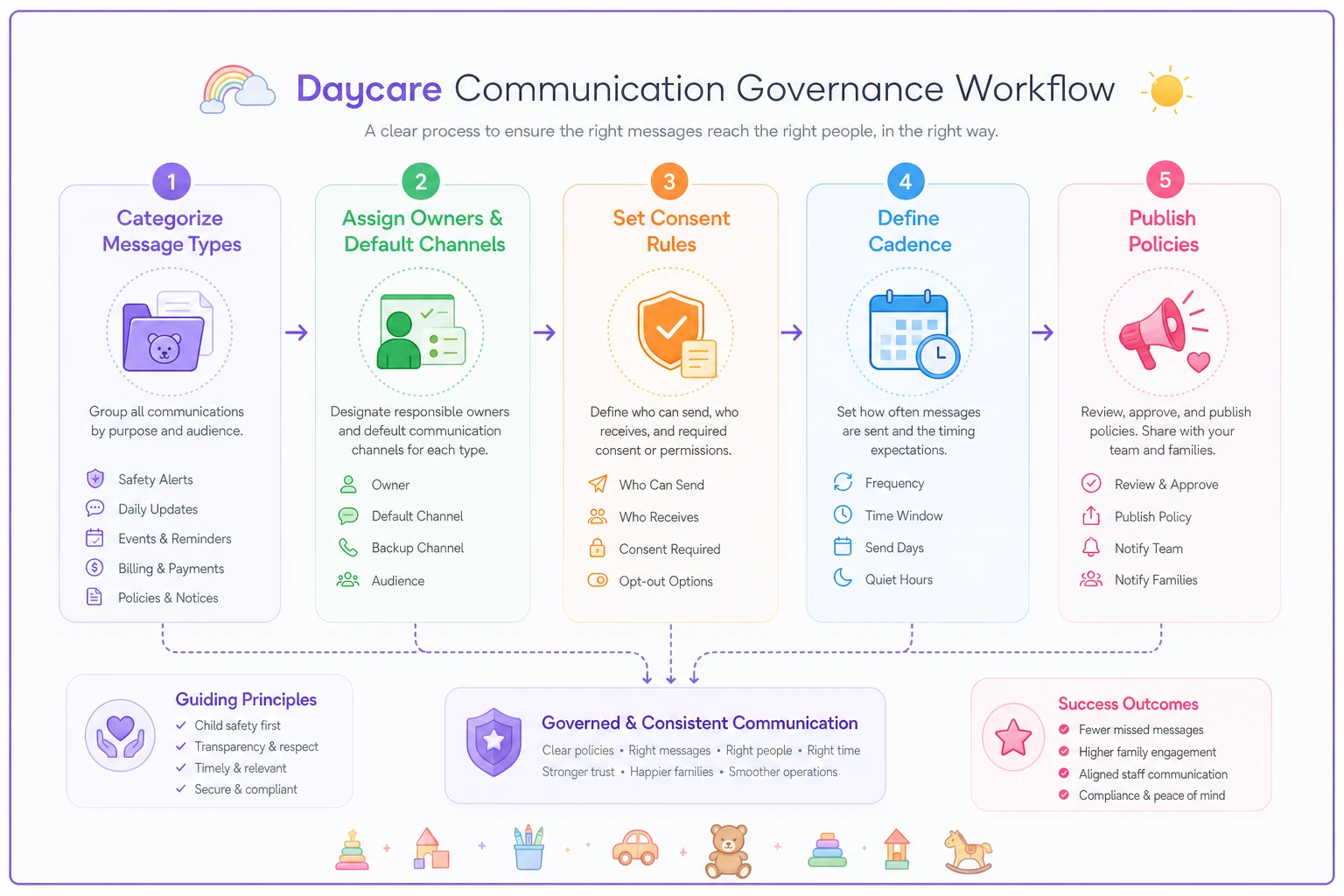
Each category also implies a different kind of relationship with the parent. Operational and billing messages carry authority and urgency. Daily engagement messages are about warmth and connection. When those bleed into the same channel with no distinction, families stop knowing which messages actually matter — and that's when they stop opening them.
Consent rules that actually hold up
Consent is where most centers are quietly exposed. The common mistake is treating it as a single yes/no at enrollment — "can we contact you?" — when in reality consent should be granular by category and channel.
One family might happily accept daily photos through your app but not want billing texts to their work number. Another might want everything by email and nothing by text. If your consent record is one checkbox, you can't honor any of that. You're either annoying families or flat-out ignoring their preferences.
A sample consent matrix structure worth adapting:
| Category | SMS/Text | App push | Phone call | |
|---|---|---|---|---|
| Operational | Opt-out | Opt-out | Opt-out | — |
| Billing | Opt-in | Opt-in | Opt-out | Reserved for past-due |
| Health/safety | Always | Always | Always | Always |
| Daily engagement | Opt-out | — | Opt-in | — |
| Community | Opt-in | — | Opt-out | — |
A few principles that make this hold up:
-
Health and safety overrides preference. If there's a communicable illness exposure, you contact everyone regardless of opt-out status. Make that explicit in your handbook so it's understood from day one.
-
Billing consent should be captured separately from engagement consent, because the tone and legal weight are different.
-
Consent has an expiration. Re-confirm annually, ideally at re-enrollment, so your records don't quietly go stale.
The reason to write this down as actual policy rather than operate on instinct is straightforward: when a parent claims "you never told us," you want a record showing exactly what they consented to and what was sent. That record protects the center — and forces the discipline that prevents the complaint in the first place.
Cadence: the difference between rhythm and noise
Cadence is probably the most under-managed part of family communication. Most centers oscillate between over-messaging — five app notifications a day during a busy week — and under-messaging — three weeks of silence, then a sudden fee change that surprises everyone.
Governance means defining a baseline rhythm per category:
-
Daily engagement — at least one meaningful touchpoint per child per day during settling-in (first 30 days), then a sustainable 2–3 per week.
-
Billing — invoice on a fixed date, reminder 3 days before due, past-due notice on a defined ladder, never ad hoc.
-
Operational — as needed, but always through the same primary channel so families know where to look.
-
Community — one newsletter or roundup on a predictable schedule. Monthly works for most centers.
-
Consent/policy — an annual review cycle plus event-triggered updates.
Front-loading touchpoints in the first month is one of the highest-leverage retention moves a center can make.
New families need more communication. Existing families need more consistent communication. Front-loading touchpoints in the first month is one of the highest-leverage retention moves a center can make, and it only happens reliably when cadence is a defined policy rather than a teacher's good intentions on a slow afternoon.
The consistency piece matters more than most owners realize. Families aren't consciously tracking whether they heard from you this week — but they feel it. A center that communicates on a predictable rhythm feels stable and trustworthy. One that communicates in bursts and silences feels chaotic, even if the actual care quality is identical.
KPIs that link communication to retention
If you can't measure it, you're back to weather. Centers that actually reduce churn through communication track a small, focused dashboard rather than drowning in vanity metrics.
A director-level dashboard worth building:
| KPI | What it tells you | Healthy signal |
|---|---|---|
| Message open/read rate by category | Whether families actually see key messages | Billing & operational above ~80% |
| Response time to family inquiries | Coordination and staffing health | Under 1 business day |
| First-30-day touchpoint count per family | Onboarding communication discipline | Meets defined baseline |
| % families with complete consent records | Compliance exposure | 100%, refreshed annually |
| Communication-linked complaints per month | Early churn warning | Trending down |
| Renewal rate by communication engagement tier | The whole point | High-engagement families renew more |
That last row is the one worth obsessing over. When you segment families by how much they engage with center communication and then look at their renewal behavior, the correlation is usually pretty obvious — engaged families stay, disengaged families drift. That insight tells you exactly which families to flag before they cancel, not after.
The mistake is tracking everything and acting on nothing. Pick five or six metrics that connect a communication behavior to a retention outcome, review them monthly, and let the rest go.
Escalation templates so nothing falls through
Governance without escalation is just a nice document. The real value shows up when something goes wrong — a family stops opening messages, a billing reminder gets no response, a complaint comes in.
A simple escalation ladder for a disengaged family:
-
Trigger Family hasn't opened key communications in 2+ weeks, or missed a daily-engagement threshold.
-
Step one Automated gentle check-in through their preferred channel.
-
Step two (no response in 3 days) Personal message from the classroom teacher.
-
Step three (still nothing) Director makes a direct call, flags the family as a retention risk, logs the conversation.
-
Step four Add to the monthly at-risk review with a specific owner and next action.
For billing, the ladder is tighter and more formal. For complaints, it should route to the director within hours, not days. The point is that escalation gets defined in advance and owned by a specific role — so nobody's improvising when it actually matters.
Most centers don't have this written down anywhere. Which means when a family quietly disengages, nobody notices until they submit their withdrawal notice — and by then, the window to intervene has already closed.
A real scenario
A two-site center running around 150 kids total had a churn problem nobody could quite explain. Enrollment looked fine on paper, but they were losing roughly 3–4 families a month, mostly in the first 90 days. When they actually mapped their communication, they found messages going out through five uncoordinated channels, no consent records beyond the initial enrollment form, and no visibility into which families were engaged versus quietly checked out.
They rebuilt it as policy: six categories, a real consent matrix, a defined cadence with heavy front-loading for new families, and a monthly dashboard the directors reviewed together. Nothing complicated. Within about two quarters, early churn dropped to closer to 1–2 families a month, and the directors reported spending noticeably less time fielding repetitive questions because the messaging was finally consistent and traceable.
The families didn't get new services. They just got a center that communicated like it had its act together — and that perception is what they renewed on.
Where software fits (and where it doesn't)
You can run all of this on spreadsheets and discipline if your center is small enough. Plenty do. But two things break at scale: enforcing consent rules manually, and tracking cadence and engagement across dozens or hundreds of families without it becoming a part-time job on its own.
An operational platform with communication management earns its keep here — not by replacing the relationship, but by enforcing the policy. Consent captured per category and channel, cadence scheduled and logged automatically, engagement tracked so at-risk families surface without a director hunting for them, escalation triggers that fire without someone remembering to check. AI-assisted automation is genuinely useful for the repetitive parts: flagging families who've gone quiet, catching consent records that need renewal, keeping message categories from bleeding into each other.
The governance decisions — categories, consent logic, cadence, KPIs, escalation ownership — those are yours. The tooling just makes them repeatable across every family, every teacher, and every location. Software enforces the system you design. It won't design the system for you, and it won't make a bad cadence good.
When this level of governance makes sense — and when it doesn't
If you're a single-site center under about 50 kids with one director who genuinely knows every family, a full governance framework is probably more structure than you need right now. Write down the consent rules and a basic cadence, and move on.
But the moment you add a second location, a second director, or cross roughly 80–100 kids, ungoverned communication starts costing real money in churn and staff time. That's the threshold where this stops being optional. And if you're already planning to grow, building the governance layer before the chaos is far easier than untangling five channels and missing consent records after the fact.
The centers that reduce churn measurably aren't necessarily the ones with the warmest directors. They're the ones who turned that warmth into a system — so it survives a busy week, a staff change, and a second location without breaking. Communication governance is how you make consistency a property of the center instead of a property of one person.
The centers that reduce churn measurably aren't necessarily the ones with the warmest directors. They're the ones who turned that warmth into a system — so it survives a busy week, a staff change, and a second location without breaking. Communication governance is how you make consistency a property of the center instead of a property of one person.
Ready to transform your daycare operations?
Join hundreds of daycare centers using Carexly to save time, improve communication, and enhance child care quality.