
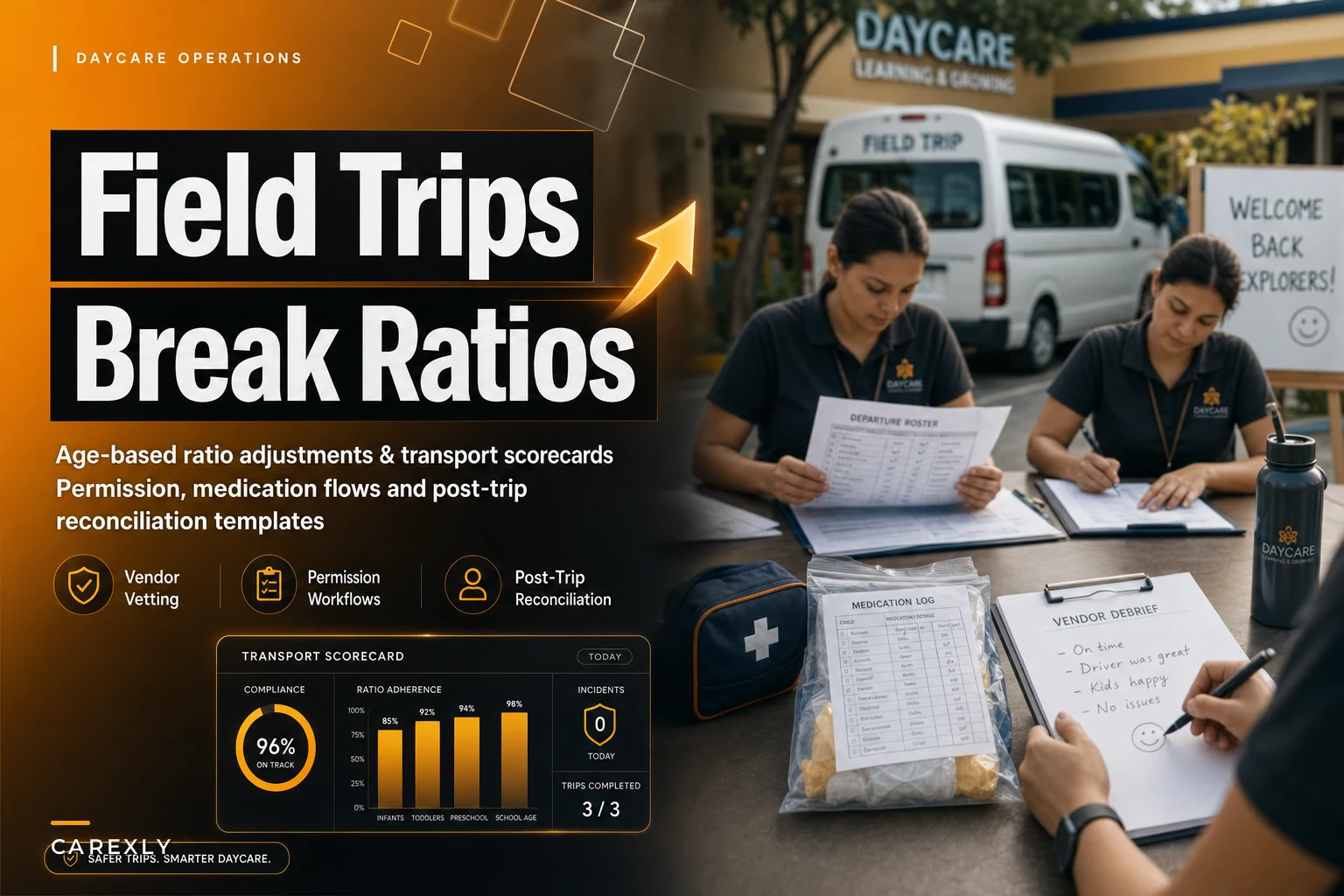

Most centers treat field trips like a fun break from the normal day. Then the bus is late, two kids have EpiPens nobody remembered to pack, your ratio is technically broken the second you load the vans, and a parent calls at 4:45 asking why their child isn't on the pickup list because they're still at the apple orchard.
Field trips take your most carefully controlled environment — fixed ratios, fixed rooms, known exits — and move it somewhere you don't control. The orchard doesn't care about your licensing requirements. The bus company doesn't know your allergy list. And the moment you step off the property, every weak spot in your documentation surfaces at once.
This post is narrow on purpose. It's about the operational side of a daycare field trip policy that actually holds up: the pre-trip risk assessment, the ratio math that's different off-site, vendor and transport vetting, how you handle emergency contacts and meds in the field, and the reconciliation you do when everyone's back. No fluff about how enriching trips are. You already know that part.
Why field trips quietly break ratios (and nobody notices until it's too late)
Your in-center ratios assume a stable setup. One teacher, a set group, a room with four walls. Off-site, three things shift at once and each one chips away at supervision:
The group splinters. At a children's museum, a group of twelve four-year-olds doesn't stay in a tidy cluster. Half go to the water table, three wander toward the dinosaur exhibit, two need the bathroom. A 1:10 ratio that works in a classroom is functionally useless when kids can scatter across 8,000 square feet.
Transitions multiply. Loading a van, unloading, walking to the entrance, regrouping after lunch, bathroom trips, loading again. Each transition is a counting moment, and each one is where a child gets left behind. Most "left child" incidents don't happen at the destination — they happen in the parking lot or the restroom during a transition.
Staff get pulled off supervision. One teacher is dealing with the vendor's entry desk. Another is handling a kid who threw up. Suddenly your 1:8 is actually 1:12 because two adults are doing logistics instead of watching children. On paper you brought enough staff. In practice, at the moment it mattered, you didn't.
The pattern worth internalizing: in-center ratio is a starting point for field trips, not the standard. You need tighter ratios off-site, and you need to assume at least one adult will be unavailable for supervision at any given moment during transitions.
Age-based ratio adjustments for off-site trips
Licensing minimums tell you the floor. Field trips are where you deliberately exceed the floor, and the younger the group, the more you tighten.
Eliminate administrative bottlenecks.
Carexly helps you manage enrollments, attendance, and staff schedules effortlessly.
- Streamlined child enrollment
- Automated parent notifications
- Staff shift and activity scheduling
No credit card required
| Age group | Typical in-center ratio | Off-site working ratio | Why the tighter number |
|---|---|---|---|
| Toddlers (18–36 mo) | 1:4 – 1:6 | 1:3 or avoid trips entirely | Can't follow verbal safety direction reliably; wander fast |
| Preschool (3–4 yr) | 1:8 – 1:10 | 1:5 – 1:6 | Scatter in open spaces, bathroom needs, impulsive |
| Pre-K (4–5 yr) | 1:10 | 1:6 – 1:8 | Better listeners but still bolt toward exciting things |
| School-age (5+) | 1:12 – 1:15 | 1:8 – 1:10 | Most reliable, but larger groups roam wider |
Two rules that matter more than the exact numbers:
-
Buddy-pair the kids and assign named adults to named children. Not "the group" — a specific list. Teacher A is responsible for these six kids by name. When you count, you count your six, not a vague cluster. This single change prevents most left-behind incidents.
-
Count on a schedule, not on a feeling. Every transition, plus every 15 minutes at the destination. Say the count out loud to another adult who confirms it. "I have six, all accounted for." A silent nod is how miscounts survive.
One thing people consistently skip: the ratio has to survive one adult leaving. If a child needs to go back to the center sick, or a teacher gets hurt, does your remaining ratio still hold? If the answer is no, you didn't bring enough adults. Build in the redundancy before you leave.
The pre-trip risk assessment (do this before you book anything)
A pre-trip risk assessment isn't paperwork for the file. It's a decision tool that tells you whether the trip is worth running at all, and what you need to control if it is.
-
Water, roads, and open exits. Does the venue have unfenced water, busy adjacent roads, or multiple unmonitored exits? A splash pad or lake changes everything — you need near-constant visual contact and probably a 1:3 effective ratio around water regardless of age.
-
Crowd density. A quiet nature preserve on a Tuesday is a different trip than a packed zoo on a school-holiday Monday. Crowds swallow children. Ask the venue about expected attendance for your date.
-
Medical access. How far is the nearest ER? Is there cell signal the whole time? A farm 40 minutes from the nearest hospital with spotty reception is a real constraint for any child with a serious allergy or seizure history.
-
Bathroom logistics. How many, where, and can you supervise the approach? Bathrooms are the single most common spot for a child to get separated.
-
Weather dependency. What's your call threshold and who decides? Making that call at 6 a.m. in the parking lot with parents already dropping off is chaos. Set the rule in advance.
The best centers do this assessment once per venue and keep a reusable file. The first time you visit an orchard it takes an hour. Every year after, you pull last year's assessment, confirm nothing changed, and move on. Over time you build a small library of vetted venues and the exact controls each one requires.
When a trip is genuinely a bad idea
Some trips you should just decline:
-
Toddlers to any venue with open water or heavy traffic exposure.
-
Any trip where you can't maintain cell contact with the center.
-
A venue that won't give you attendance numbers or a quiet entry window.
-
A date where you can't staff the tighter off-site ratio without stripping the center so thin that the kids who stayed are now under-supervised.
That last one gets missed constantly. A field trip that breaks ratio back at the center is just as much a violation as one that breaks ratio at the orchard.
Vendor and transport vetting scorecard
Two vendor categories matter: the destination and whoever moves the children. Both need to clear a bar before you commit, and transport is where most centers are dangerously casual.
-
Licensing and insurance. Current commercial transport license, proof of insurance, named coverage amounts. Get the certificate, don't take their word.
-
Driver screening. Are drivers background-checked and drug-tested? Ask directly and get it in writing.
-
Vehicle safety. Seatbelts/restraints appropriate for ages, recent inspection, functioning A/C, working seatbelt count that matches your headcount.
-
Capacity match. Does the vehicle seat your group plus adults with correct restraints? A 14-seat van for a group of 12 kids plus 3 adults doesn't work.
-
Contingency. What happens if a vehicle breaks down? Do they have a backup? How fast?
Rate each item pass/fail, and treat licensing, insurance, driver screening, and restraint adequacy as hard gates. Fail any one of those and the vendor is out, no matter how cheap or convenient. The softer factors — punctuality history, communication, A/C — you weight and compare.
For the destination itself, the vetting is lighter but still real: confirm they allow group entry on your date, have the bathroom and space situation you expect, and have a plan for lost children on their end. Good venues have a "lost child" protocol already. If they look confused when you ask, that tells you something.
The mistake to avoid: booking the cheapest bus because the budget's tight, then discovering on trip day that the restraints are wrong for your toddlers or the driver has no clean background check on file. Vet transport like it's a staffing decision, because functionally it is — the driver is supervising your children in motion.
Emergency contact and medication workflows in the field
This is where field trips create liability fast, because you're taking medical responsibilities off-site without the systems you rely on at the center.
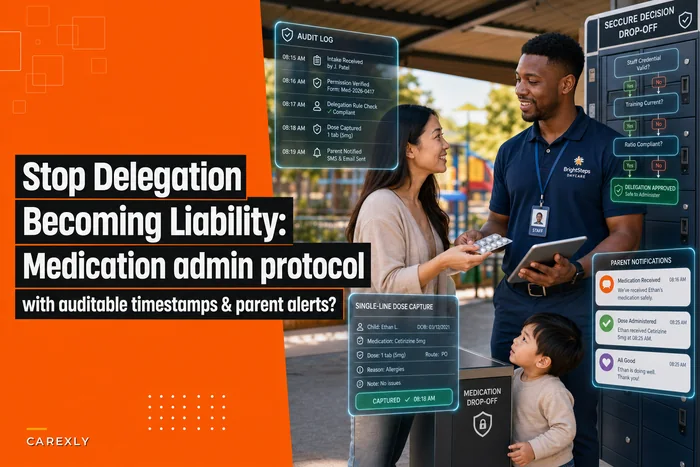
The medication side. Every child who takes medication during center hours needs their meds packed, labeled, logged, and administered by an authorized person — same as in-center, but now in a parking lot or picnic area. The sloppy version is one teacher throwing EpiPens in a backpack with no log. The clean version mirrors your in-center protocol exactly. If you haven't tightened up how medication delegation gets documented, that's worth fixing before you ever leave the building — the same medication administration protocol with an auditable trail you use at the center travels with the group.
Practical field medication rules:
-
A single named medication captain per trip who carries the locked med bag and the administration log. Not "whoever has room in their bag."
-
Every emergency med (EpiPens, inhalers, seizure rescue meds) packed with the child's name, dose, and instructions — and a printed list of which children have which.
-
A paper log that gets signed at time of administration, because cell signal fails and you need the record regardless.
The emergency contact side. Each adult leader carries a trip roster with every child's emergency contacts, authorized medical info, and allergy list. Not back at the center — with them. If a child reacts at the venue and the lead teacher is the one riding in the ambulance, the remaining staff need instant access to that child's contacts and medical authorization.
Build the field packet so it works when your systems don't:
-
Printed roster with every child, their photo, emergency contacts, and medical/allergy flags.
-
Printed medication list and administration log.
-
Signed field-trip permission forms (destination-specific, not a blanket annual form).
-
The center's main line and a backup staff cell on every sheet.
-
A one-page emergency procedure
who calls 911, who calls the parent, who stays with the group, who rides along.
If something goes wrong on a trip, your incident documentation has to be just as tight as it is in-center — arguably tighter, because you'll be reconstructing it from memory later. The same minimum-data reporting and escalation workflow you use inside the building should travel with the lead teacher, so an off-site incident gets captured cleanly in the moment instead of patched together that evening.
A short real scenario
A preschool program ran a trip to a local farm with 18 preschoolers and three staff — a 1:6 off-site ratio, which looked fine on paper. Two of the children had food allergies, and the meds were split across two different teachers' bags with no central log. During lunch, one child grabbed a snack from another kid's bag and started reacting. The EpiPen was in the other teacher's backpack, who'd walked a group to the bathroom. It worked out — the medication captain model didn't exist yet, so staff scrambled, found it, and administered in time — but it was close.
After that, the program made three changes: one named medication captain carrying a single locked bag, printed rosters with allergy flags in every adult's hands, and a buddy-pair system so no child moved without a counted partner. The next farm trip ran with the same 18 kids and the same three staff, but nobody lost track of a med, and the one minor incident that did happen (a scraped knee) got logged on the spot instead of reconstructed that night. Same resources, dramatically tighter execution.
Post-trip reconciliation: the step everyone skips
The trip isn't over when the van pulls back in. Reconciliation is the close-out that catches what went wrong before it becomes a parent complaint or a licensing finding.
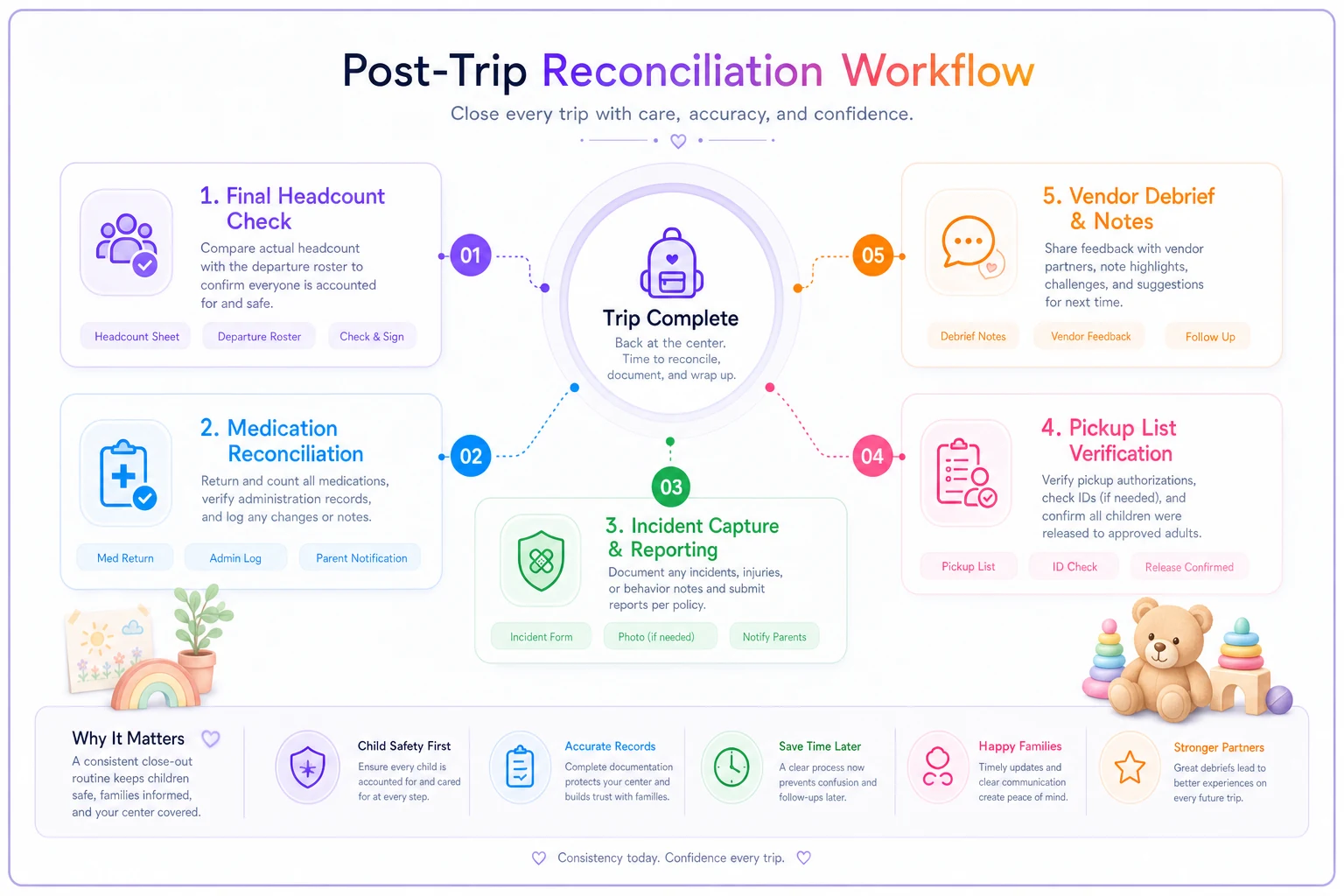
Run this every time, within 30 minutes of return:
-
Final headcount at the center, matched against the departure roster. Same count out, same count back, by name. This is non-negotiable and it's the step people skip because they're tired.
-
Medication reconciliation. Every med that left comes back (or was administered and logged). Count the EpiPens. Confirm the log matches.
-
Incident capture. Anything that happened — near-misses included — gets documented while it's fresh. The scraped knee, the kid who wandered for 30 seconds, the bus that was 20 minutes late.
-
Pickup list check. Confirm every child is accounted for and the pickup process resumes normally. Make sure parents know the trip ran late if it did.
-
Vendor debrief note. Two lines
did transport show up on time, was the venue as expected? This feeds next year's risk assessment.
The reconciliation also feeds back into your venue library. If the orchard's bathrooms were a nightmare or the bus was consistently late, that goes in the file so next year's trip gets planned around it. Over a few seasons, your trips get noticeably smoother — not because your staff got better, but because your institutional memory did.
Here's a quick visual of the reconciliation workflow:
Centers that treat the return as the end of the trip repeat the same problems every year. Centers that treat reconciliation as part of the trip build a tighter operation each season.
Where systems help without taking over
Most of what's above is paper and discipline, and that's fine — paper works in a parking lot when cell signal doesn't. But a few pieces are genuinely easier when your center's software holds the underlying data cleanly.
Pulling an accurate trip roster with current emergency contacts, allergy flags, photos, and medication authorizations shouldn't mean hand-copying from five different files. When that information already lives in one place and stays current, generating the printed field packet takes a few minutes instead of an hour of error-prone copying. The same goes for reconciling attendance — matching your return headcount against who was marked present that morning is faster when it isn't a manual cross-check.
Print your field packet the morning of the trip from the live system to avoid stale data.
The point isn't to automate supervision; a system can't watch children. It's to make sure the roster you carry off-site is actually accurate, because a packet built from stale data is worse than no packet at all. Keep the human controls human — the counting, the named-adult assignments, the medication captain — and let your records system handle the boring accuracy work of keeping contacts, meds, and allergies current so the paper you print is trustworthy.
The bottom line for your field trip policy
Field trips fail for boring, preventable reasons: a ratio that worked in the classroom but not in a crowd, a med in the wrong backpack, a transport vendor nobody vetted, a count nobody did at the right moment. None of it is dramatic. All of it is fixable with a policy that's specific about off-site ratios, honest about which trips to decline, serious about transport vetting, and disciplined about the packet you carry and the reconciliation you run on return.
Write the policy once, build your venue library over time, and the trips get safer and smoother every season. The kids get the orchard and the museum. You get to run them without holding your breath in the parking lot.
Ready to transform your daycare operations?
Join hundreds of daycare centers using Carexly to save time, improve communication, and enhance child care quality.