

The second location almost never fails because of demand. It fails because the systems that ran the first center were living in one director's head, and that director can't be in two buildings at once.
That's the core tension nobody warns you about. Your first daycare works because you—or one trusted director—catch problems before they compound. A ratio slips, you fix it in the hallway. A parent complaint comes in, you handle it before lunch. Billing looks off, you pull the records yourself. None of that scales. The moment you open center number two, every informal correction you used to make by walking the floor becomes a governance question: who decides, who's accountable, and how do you even find out something went wrong before it costs you a licensing citation?
This playbook is about the decisions, not the inspiration. Expansion advice usually stops at "hire a good regional manager and document your SOPs." That's not wrong, it's just useless—it doesn't tell you when to add that role, what to centralize versus leave local, or how information should flow so you're not learning about a Center B enrollment collapse three weeks late.
The real reason single-site SOPs break at two locations
A single-site SOP is written for a world where the person following it and the person enforcing it are the same team. "Front desk confirms the day's ratios by 7:30 AM" works fine when the director sees the front desk every morning. Copy that exact sentence into Center B's binder and it quietly stops meaning anything, because now nobody's watching whether it happened.
-
Enrollment drift. Center B fills differently than Center A—maybe the infant room lags while the preschool room overflows. At one site you'd notice in a walk-through. Across two, you notice when the numbers get bad enough to hurt.
-
Staffing improvisation. Center B's director starts solving coverage gaps their own way—calling in floats, shuffling ratios, approving overtime—because there's no shared rule for who has authority to do what.
-
Data that no longer agrees. Two locations, two ways of logging attendance, two interpretations of "enrolled," and suddenly your consolidated numbers are fiction.
That last one deserves its own emphasis. Getting a single, trustworthy version of your numbers is hard enough at one site—we've written a full breakdown of that in our piece on single-source governance and reporting cadence. At multiple sites, disagreeing data isn't an annoyance—it's what makes you unable to manage at all, because you can't govern what you can't measure consistently.
Don't expand on a calendar. Expand on triggers.
A common mistake worth naming directly: operators add locations, management layers, or shared services based on time ("we've been open two years, let's grow") instead of operational thresholds. Time-based expansion is how you end up with a regional manager overseeing 1.5 centers worth of actual work, or a corporate billing function that costs more than the errors it prevents.
Eliminate administrative bottlenecks.
Carexly helps you manage enrollments, attendance, and staff schedules effortlessly.
- Streamlined child enrollment
- Automated parent notifications
- Staff shift and activity scheduling
No credit card required
Better approach: define explicit step triggers—measurable conditions that tell you it's time to change your structure. The two most useful ones for childcare are occupancy stability and revenue density.
Occupancy stability means a center is holding steady enrollment (consistently above 85% of licensed capacity for a full quarter) with a functioning director who isn't in daily crisis mode. If Center A can't hit that, there's no business case for opening Center B—you'll just be duplicating an unstable system.
Revenue density is the one operators under-use. It's roughly your monthly revenue per active center, and it tells you when you can actually afford to add non-teaching overhead—a shared bookkeeper, an enrollment coordinator across sites, a regional lead. If two centers are each running around $70k–$90k monthly and you're still doing all the back-office yourself at 11 PM, revenue density says it's time to centralize a function, not open a third door.
A workable trigger ladder:
| Stage | Trigger condition | What changes | What stays local |
|---|---|---|---|
| 1 center | — | Owner-operator does everything | Everything |
| 2 centers | Center A stable ≥1 quarter, revenue density supports one shared hire | Add a shared back-office role (billing/enrollment); owner shifts to oversight | Daily ops, staffing, parent relationships |
| 3–4 centers | Two centers stable, owner spending >50% time firefighting | Add a regional/multi-site director layer; formalize the decision matrix | Classroom-level ops, local hiring input |
| 5+ centers | Consistent revenue density across sites, standardized reporting live | Split functions (finance, compliance, talent) into shared services | Site culture, family engagement, floor decisions |
Let revenue density guide whether a shared hire actually makes financial sense before you create the role.
The table isn't a promise—your ratios and your state's licensing structure will shift the exact numbers. The point is that each structural change is earned by a condition, not scheduled.
The centralization decision matrix: what to standardize, what to leave alone
The single most expensive mistake in multi-site growth is centralizing the wrong things. Over-centralize, and you kill the local judgment that made your first center feel like a real place. Under-centralize, and every location reinvents your policies badly.
Run every function through three questions:
-
Does inconsistency here create legal or financial risk? (Compliance, incident reporting, payroll, billing → lean toward centralize.)
-
Does this depend on local relationships or on-the-floor judgment? (Family engagement, classroom culture, day-to-day staffing calls → lean toward local.)
-
Does centralizing it actually save money at your current revenue density? (If the shared role costs more than the errors and duplicated effort, wait.)
A practical split most operators land on:
| Function | Centralize | Local | Why |
|---|---|---|---|
| Billing & invoicing | ✔ | Errors compound across sites; one process, one export | |
| Compliance & licensing standards | ✔ | Non-negotiable consistency; audit risk is existential | |
| Payroll rules & timekeeping standards | ✔ | Wage/hour mistakes multiply per location | |
| Enrollment funnel & waitlist rules | ✔ (rules) | ✔ (execution) | Standard scoring, local outreach |
| Daily staffing & ratio decisions | ✔ | Needs real-time floor judgment | |
| Family communication & culture | ✔ | Relationships don't centralize | |
| Hiring standards | ✔ (role KPIs) | ✔ (candidate calls) | Consistent bar, local fit |
The hiring split matters more than people expect. You want the standard—what a strong lead teacher looks like, target fill times, the KPIs each role owns—defined once and applied everywhere. You do not want corporate interviewing every floater. If you haven't built that standard yet, do it before you expand. We laid out the full approach in the hire-to-retain staffing lifecycle guide. Multiplying an undefined hiring process across three sites is how you end up with three different definitions of "qualified."
Org charts that actually match the stage you're in
Org charts fail when they're aspirational—drawn for the company you hope to be, not the one you are.
Two centers. You're still the hub. Both directors report to you directly. The only new box is a shared back-office role (often part-time at first) handling billing and enrollment admin across both sites so your directors stay on the floor. Resist the urge to create a "regional" title here—you don't have enough work for one to do.
Three to four centers. This is where the owner-as-hub model physically breaks. You add a multi-site director between yourself and the site directors. Their job isn't to run centers—it's to enforce standards, spot drift early, and handle cross-site problems (a director quits, two centers competing for the same hire). The back-office role usually splits into billing/finance and enrollment/family coordination around this stage.
Five and up. Functions start reporting into functional leads—finance, compliance, talent—rather than everyone funneling through a single regional person. This is where "shared services" becomes real rather than just a fancy name for you doing extra work.
One thing worth holding onto: add the coordination layer one stage before you think you need it, but add the specialized functional roles one stage after. Coordination prevents the slow drift that kills you quietly. Specialization is expensive and premature until volume justifies it.
Reporting cadence: the nervous system of a multi-site operation
Structure and org charts are the skeleton. Reporting cadence is the nervous system—it's how the top of the org finds out something's wrong while it's still cheap to fix. Most multi-site problems aren't failures of policy. They're failures of timely visibility.
Daily (automated, exception-based). Nobody should be reading full daily reports from every center. Instead, define exception thresholds—ratio breaches, unfilled shifts, an incident report filed, attendance below a set percentage—and let those surface automatically. The site director sees everything; the layer above only sees exceptions.
Weekly (short, standardized). Each site director submits the same handful of numbers every week: current occupancy by room, fill-time on open roles, overtime hours, outstanding billing, any incidents. Same format, same day, every site. The consistency is the whole point—it's what lets you compare Center B to Center C without translating between two people's habits.
Monthly (owner/regional review). Trends, not snapshots. Revenue density per site, enrollment trajectory by age group, staffing stability, margin. This is where you decide whether a center is hitting the triggers for the next structural step—or slipping backward.
A simple weekly reporting template most operators can start with tomorrow:
-
Occupancy by room (infant / toddler / preschool), as % of licensed capacity
-
Open roles and days-to-fill for each
-
Overtime hours vs. prior week
-
Outstanding/late billing total
-
Incidents filed this week (count + escalation status)
-
One-line "what needs the regional director's attention"
That last line is underrated. It forces the site director to synthesize rather than just dump data, and it's usually where the real problems announce themselves.
Here's a simple visual of that reporting workflow.
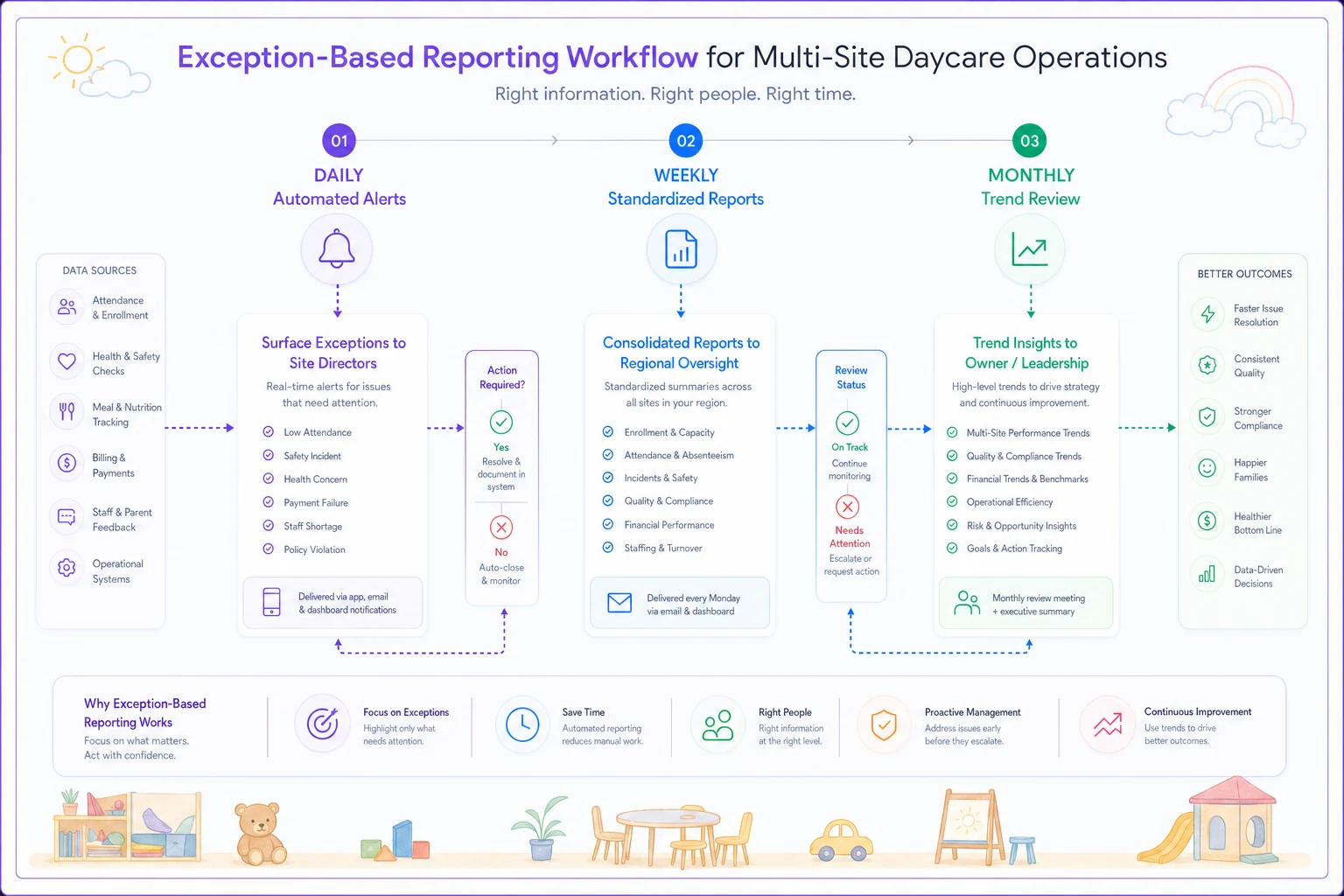
This puts the focus on surfacing exceptions early so someone who can fix them sees them fast.
A real scenario: two centers, one failing quietly
A small operator running two centers in the same metro—roughly 140 combined licensed slots—was profitable on paper and stressed in reality. Center A ran near-full. Center B hovered around 70% occupancy for months, and the owner kept assuming it was a marketing problem.
The actual problem was invisibility. Center B's director was quietly under-filling the toddler room because their enrollment process differed from Center A's, and nobody was comparing the two on a consistent cadence. The owner found out the scale of it only at the quarterly financials—by then, somewhere in the range of $8k–$10k a month in unrealized tuition had been leaking for a full quarter.
The fix wasn't dramatic. They standardized a weekly reporting format across both sites, defined enrollment rules centrally while keeping outreach local, and added a shared enrollment coordinator once revenue density clearly justified the role. Within a couple of quarters, Center B climbed into the mid-80s on occupancy. The change that mattered most wasn't the coordinator hire—it was that the owner could now see a site drifting within a week instead of a quarter.
When this actually makes sense — and when it doesn't
Building formal multi-site governance is real work, and it's the wrong move for some operators.
When it makes sense:
-
Your first center is genuinely stable and not dependent on you being physically present
-
You have at least one director capable of running a site without daily rescue
-
Revenue density supports at least one shared overhead role without straining margin
-
You're expanding within a region where consistency is a feature, not a constraint
When it's a bad idea:
-
Center A still needs you on the floor to function—duplicating instability just doubles the fire
-
You're expanding to escape a problem (bad margins, high turnover) rather than because you've solved it
-
The new location is a fundamentally different model that won't share your SOPs anyway
Who should probably wait: operators whose numbers don't agree even at a single site. If you can't produce a trustworthy occupancy figure for one center, adding a second won't clarify anything—it'll multiply the confusion. Fix the single-source problem first, then expand.
Where software fits — quietly, not as the hero
None of this requires software to be true. The triggers, the matrix, the cadence—those are decisions and disciplines. But the practical friction of running a multi-site cadence by hand is real: chasing five directors for weekly numbers in five formats, reconciling attendance logs that don't match, catching a ratio breach three days late because it lived in a spreadsheet nobody opened.
The honest role for an operational platform in multi-site childcare is making exception-based visibility actually work. Instead of manually compiling reports, standardized numbers flow up automatically, and the layer above only gets flagged when something crosses a threshold you defined. That's less about automation and more about not learning bad news late. The governance model is yours—good software just shortens the distance between "something's off at Center B" and "someone who can fix it knows."
The bottom line for operators thinking about center number two
Multi-site expansion isn't a scaled-up version of running one great center. It's a different job—one where your value shifts from catching problems personally to designing the system that catches them for you. The operators who grow well aren't the ones with the best SOPs. They're the ones who defined clear triggers for when to change structure, made deliberate choices about what to centralize, and built a reporting cadence that surfaces drift while it's still cheap.
Start with the trigger ladder. Get your single site genuinely stable and measurable. Decide, function by function, what has to be consistent and what has to stay local. Then build a cadence boring enough that the same numbers arrive the same way every week from every site. Do that, and the second location stops being a leap of faith and starts being a decision you can actually manage.
Start with the trigger ladder. Get your single site genuinely stable and measurable. Decide, function by function, what has to be consistent and what has to stay local. Then build a cadence boring enough that the same numbers arrive the same way every week from every site. Do that, and the second location stops being a leap of faith and starts being a decision you can actually manage.
Ready to transform your daycare operations?
Join hundreds of daycare centers using Carexly to save time, improve communication, and enhance child care quality.