


Nap time is where a lot of centers quietly fail an inspection they'd otherwise pass. Not because staff aren't watching kids — they usually are — but because there's no proof they were. A licensing visitor walks through the toddler room at 1:40 PM, sees two teachers in the corner, cribs along the wall, and asks: "How often do you do visual checks during sleep?" The answer varies depending on who you ask, nothing is written down, and suddenly a routine nap period becomes a finding.
This post is narrow on purpose. It's about the operational layer around sleep supervision — the rounds, the notes, the parent messages, and the director-level audit — not sleep safety guidelines themselves (your state and the AAP already cover those). The goal is a system where nap time produces evidence automatically, so supervision stays consistent whether your best teacher is in that day or not.
Why nap time is the weakest documented hour in most centers
Walk the schedule of almost any center and nap is the one block with the least structure. Mornings have circle time, centers, outdoor play. Afternoons after nap have snack and pickup chaos that forces attention. But the nap window — roughly 12:30 to 2:30 in most infant and toddler rooms — is the stretch where the room goes quiet, lights dim, and supervision becomes passive.
That passivity is the problem. One teacher goes on lunch, ratios technically hold, the remaining staff member is prepping cots or doing paperwork, and "watching the room" becomes glancing up occasionally. Nobody's negligent. But if anything goes wrong — a child who stops breathing, a toddler who wanders, a parent allegation — there's no timeline to defend what actually happened.
A few patterns come up repeatedly:
-
Checks happen but aren't recorded. Staff genuinely do visual sweeps, but without a timestamp, it never existed as far as a regulator is concerned.
-
The log is a clipboard nobody fills honestly. Pre-filling a nap sheet at 2:15 with tidy "every 15 min" checkmarks is both common and a disaster if an inspector notices the pen never left the hook.
-
Supervision degrades when the lead is out. The whole routine lives in one person's head. When a sub covers nap, it falls apart.
-
No one owns the audit. Directors assume rooms are doing checks. Rooms assume the director would say something if it mattered. Nobody actually verifies.
Nobody actually verifies.
The four artifacts that make nap supervision defensible
You don't need a thick policy binder. You need four operational artifacts that work together: nap-check rounds, timestamped supervision notes, parent messaging templates, and a director audit checklist. Each covers a gap the others can't.
Eliminate administrative bottlenecks.
Carexly helps you manage enrollments, attendance, and staff schedules effortlessly.
- Streamlined child enrollment
- Automated parent notifications
- Staff shift and activity scheduling
No credit card required
| Artifact | What it proves | Who owns it | How often |
|---|---|---|---|
| Nap-check rounds | Children were physically observed on a set interval | Room lead (and designated backup) | Every 10–15 min during sleep |
| Timestamped supervision notes | Specific observations and exceptions were recorded in real time | Whoever is covering the room | At each round + any exception |
| Parent messaging templates | Families got consistent, non-alarming updates about sleep | Room lead | Daily + as-needed |
| Director audit checklist | Someone independent verified the above is actually happening | Director or assistant director | Weekly spot-check + monthly full |
The point of splitting it four ways is separation of accountability. The people doing checks shouldn't be the only ones confirming checks happened — that's exactly how you end up with the clipboard-filled-at-2:15 problem.
Artifact 1: Nap-check rounds that don't rely on memory
A nap-check round is a physical walk of the sleep area on a fixed interval where you confirm each child by name, note position and breathing, and log the time. The failure mode isn't that teachers don't know to do this — it's interval drift. A round at 12:30 feels urgent. By 1:20, with a quiet room, the interval stretches to 25 minutes without anyone consciously deciding to let it slip.
Make the interval something the room can't ignore. A visible timer on a 12-minute cycle, reset after each round, turns "I think it's been a while" into a concrete prompt. The teacher does the walk, then resets. If the timer goes off and the lead is mid-diaper-change, the backup does the round. That's the detail most centers skip: every nap-check interval needs a named backup, not just a primary.
Here's a quick view of the nap-check rounds workflow.
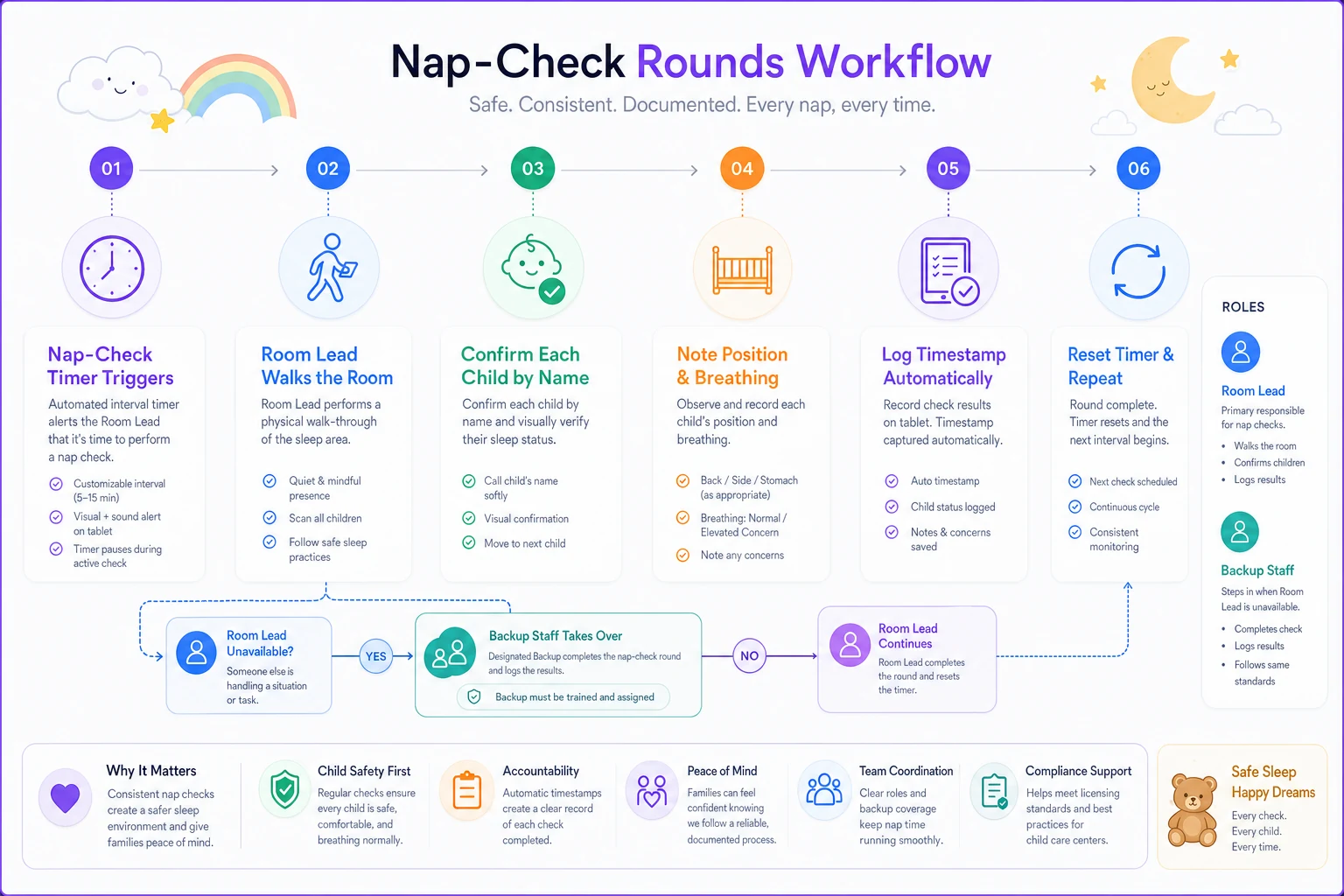
Keep it simple: short rounds, a visible timer, and a named backup.
-
Time of the round
-
Each child confirmed (name or crib/cot number)
-
Position noted for infants (on back)
-
Any exception — fussy, congested, moved to a new spot, parent note about a cold
-
Initials of the staff member doing the round
Put the named backup on the visible timer label so it's obvious who covers the round.
If a round takes more than that, it won't survive a busy afternoon. Teachers abandon logs that eat 90 seconds to fill.
Artifact 2: Timestamped supervision notes that hold up later
Rounds prove you looked. Supervision notes prove what you saw — and that's what matters when a parent calls two days later asking why their child seemed "off" at pickup, or when an incident needs reconstruction.
The difference between a note that protects you and one that doesn't is whether the timestamp is real. A nap log where every entry is spaced exactly 15 minutes apart with identical handwriting reads as fabricated, even when it isn't. Real supervision notes have texture: a 1:07 entry about a toddler who woke early and moved to quiet play, a 1:34 note that an infant was congested and checked more frequently, a gap explained by "fire drill 1:15–1:22."
This same documentation discipline is what keeps incident handling clean. If something during nap escalates into a reportable event, your supervision notes become the backbone of the report — which is why it helps to already have a rapid, minimum-data incident reporting and escalation workflow that notes can flow into directly instead of being reconstructed from memory hours later.
Where AI-assisted operational software earns its place here is quietly. Instead of a paper clipboard, staff tap a check on a tablet and the timestamp is captured automatically — no back-filling possible, because the system records when the entry was actually made. The round interval can trigger a reminder so drift stops happening. When the director pulls records for a specific afternoon, they get an accurate timeline rather than a clipboard that may or may not reflect what actually happened. The supervision still comes from the teacher's eyes; the software just makes the record honest and retrievable.
Artifact 3: Parent messaging templates that prevent nap anxiety
Nap is one of the most emotionally loaded topics for parents of infants and young toddlers. A vague message creates more worry than no message. "Had a short nap today" makes an anxious parent assume something's wrong. A consistent template removes that ambiguity.
Build two or three reusable templates so every family gets the same calm, specific framing regardless of who's sending it:
-
Normal nap "[Child] napped from about [start] to [end] today and woke up in a good mood. Ready for afternoon snack."
-
Short or no nap "[Child] rested quietly but only slept about [X] minutes today — totally normal on some days. We kept the room calm and offered quiet play. May be ready for an earlier bedtime."
-
Flagged observation "Wanted to let you know [child] seemed a little congested during nap, so we checked on them more frequently. No fever, slept comfortably. Flagging in case it continues at home."
The operational value isn't the wording — it's consistency. When messaging is templated, a new teacher or sub sends the same reassuring message the lead would. Families stop reading tone into randomness. Centers that already run a center-level learning and documentation system can slot nap templates into the same daily-communication rhythm instead of treating them as a separate task.
Artifact 4: The director audit checklist nobody wants but everyone needs
Rounds, notes, and messages can all exist on paper and still be theater if no one independent ever checks them. The director audit is what converts "we have a nap policy" into "our nap supervision is actually verified."
Weekly spot-check (10 minutes, unannounced):
-
Walk into a sleep room mid-nap without warning and observe for two full round intervals.
-
Confirm a round actually happens on schedule while you're standing there.
-
Pull that day's nap log and compare logged times to what you just watched.
-
Check that the designated backup knows they're the backup.
-
Note one thing that worked and one thing to fix — on the spot, with the lead.
Monthly full review:
-
Pull nap logs for a random week across every room.
-
Look for interval drift — entries creeping past your stated interval.
-
Look for suspicious uniformity — identical spacing suggests back-filling.
-
Cross-check exceptions in nap notes against any incident reports from the same days.
-
Review parent messages for a sample of children — are families getting consistent nap updates?
-
Confirm every room's current backup assignments are documented.
The spot-check being unannounced is the whole point. A room that knows the director is coming at 1 PM will perform. The audit's value is catching the ordinary version of nap time, not the rehearsed one.
A real scenario: the center that failed on paper, not on practice
A two-room center licensed for infants and toddlers — around 38 kids enrolled — had a decent nap routine. Teachers did checks. Nothing bad had ever happened. But their nap log was a shared clipboard filled near the end of the period, and intervals in the toddler room were routinely drifting past 20 minutes once the room settled down.
A licensing visit landed at 1:45 PM. The inspector watched for ten minutes, never saw a round happen, then asked for the log — which showed neat 15-minute checks, including one timestamped 1:40 that clearly hadn't occurred while she was standing there. That contradiction turned a non-event into a documentation finding and a corrective action plan.
What changed afterward wasn't dramatic. A visible 12-minute timer went into each room, they moved to tablet-based timestamped checks so entries couldn't be back-filled, assigned a named backup per interval, and the director started doing one unannounced 10-minute spot-check a week. Within a couple of months, interval drift basically disappeared — logged intervals held in the 11–14 minute range instead of stretching past 20 — and the next licensing visit passed without any comment on nap supervision. No new staff, no new policy binder. Just the gap closed.
When this level of structure makes sense — and when it's overkill
When it's worth building fully: Any center with infants or young toddlers in cribs or on cots. The supervision stakes are highest and regulatory attention is sharpest. Multi-room centers also need it because consistency across rooms doesn't happen by accident.
When a lighter version is fine: A small single-room preschool where "nap" is really a 30-minute quiet rest for 3-to-5-year-olds who mostly don't sleep carries far less risk. You still want timestamped rest-period notes, but the tight interval rounds matter a lot less than they do for infants.
Who should not over-engineer this: A tiny home-based or micro-center with one or two caregivers and direct line-of-sight on every child the entire nap period — a lightweight paper log with honest timestamps may genuinely be enough. Don't build a four-artifact audit system to supervise five kids you can all see at once. Match the structure to the actual risk and headcount. A bloated system that staff resent gets abandoned, and an abandoned system proves nothing.
The thing most centers get backwards
When nap supervision feels shaky, the instinct is to write a longer policy. More rules, more signatures, more required fields on the log. That almost always makes things worse, because the heavier the paperwork, the less honestly it gets filled out — and a dishonest log is more dangerous than no log.
The fix runs the other way. Make the actual observation easy and frequent, make the record automatic and tamper-resistant, template the parent communication so it's consistent without extra effort, and have one independent person verify it weekly. Short rounds, real timestamps, calm messages, a ten-minute unannounced audit. That combination gives you supervision you can actually defend without turning nap into a bureaucracy — and it holds up whether your most reliable teacher is in the room that day or home sick.
That combination gives you supervision you can actually defend without turning nap into a bureaucracy — and it holds up whether your most reliable teacher is in the room that day or home sick.
Ready to transform your daycare operations?
Join hundreds of daycare centers using Carexly to save time, improve communication, and enhance child care quality.