
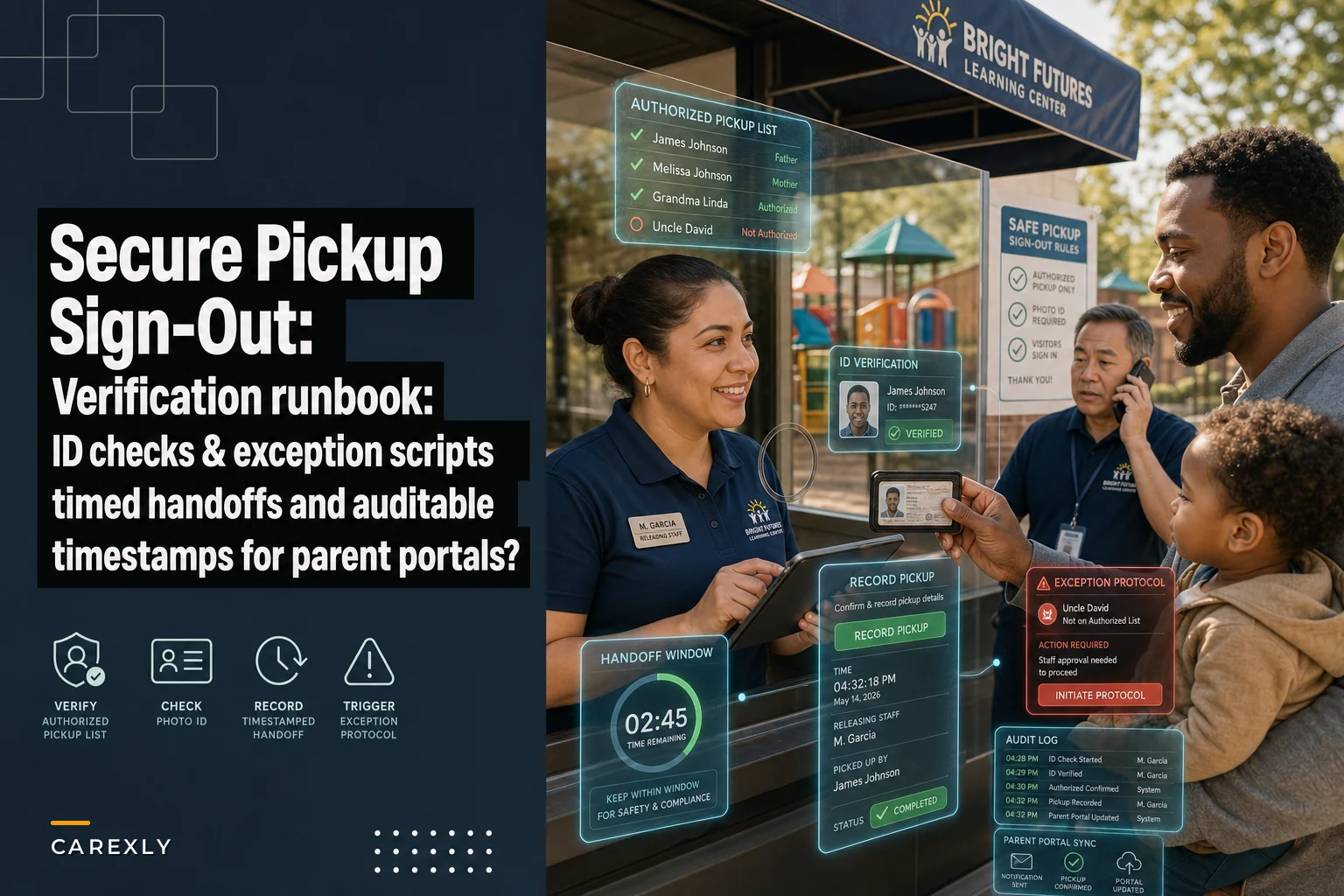

The scariest thing that can happen at pickup isn't a late parent. It's the calm, confident adult who walks in at 4:45, says "I'm here for Mason," signs a clipboard, and walks out — while nobody on staff actually confirmed they were on the authorized list. Most of the time nothing goes wrong. But "most of the time" is not a standard you want protecting a four-year-old.
The problem with pickup isn't that centers don't have rules. It's that the rules live in a binder, or in one lead teacher's head, or on an enrollment form filled out eight months ago. When the room is loud, three parents arrive at once, and a float teacher is covering the closing shift, the verification step is the first thing that quietly disappears.
This is a workflow problem, not a trust problem. Below is how to build a verification process that stays intact even on your worst-staffed, most chaotic afternoon — including how to handle the exceptions that break every clipboard system, and what your logs actually need to capture to be useful later.
Where sign-out actually breaks
Watch closings across a week and the failures cluster into a few predictable spots. None of them are dramatic. That's exactly why they slip through.
The authorized-pickup list is stale. A grandparent was added in September. The custody situation changed in January. The form was never updated. The teacher at the door has no way to know which version is current, so they default to "the adult seems fine."
The person verifying isn't the person who knows the family. Your lead teacher can recognize every parent by face. Your closing float can't. When verification depends on facial recognition by a specific human, it collapses the moment that human isn't in the room.
Multiple kids, one adult, no cross-check. A parent picking up two siblings from two rooms signs out in one room, and the second room assumes it's handled. Now you have a child marked "picked up" who is still physically in the building — or the reverse, which is worse.
The "I called ahead" exception. A parent phones and says their neighbor is grabbing their kid today. Whoever took the call may or may not write it down, may or may not know the neighbor's name, and may or may not be at the door when the neighbor arrives. This single scenario causes more near-misses than anything else.
The common thread: verification depends on informal memory and verbal handoffs. The fix is making the workflow explicit enough that any staff member — including someone covering a shift for the first time — can run it correctly.
The core sign-out rule: verify identity, not familiarity
The foundation is simple to state and hard to enforce: release is authorized by a check against a current list plus an ID confirmation, not by recognition.
Eliminate administrative bottlenecks.
Carexly helps you manage enrollments, attendance, and staff schedules effortlessly.
- Streamlined child enrollment
- Automated parent notifications
- Staff shift and activity scheduling
No credit card required
Recognition can speed things up for known parents, but it can never be the only control. Because the day recognition fails is precisely the day something is wrong — a new person, an unusual arrangement, a custody flag nobody mentioned.
-
Every release is checked against the current authorized-pickup list for that child — not last month's, not the enrollment form.
-
Anyone not personally known to the releasing staff member gets a photo ID check, no exceptions, no apologies.
-
The child is signed out with a timestamp, the pickup person's name, and the staff member who released them — all three, every time.
-
Any deviation triggers the exception protocol (below) instead of a judgment call at the door.
Rule 4 is the one people skip. A good workflow doesn't ask a stressed teacher to decide whether something is okay. It gives them a script for what to do when something is off, so the decision is already made.
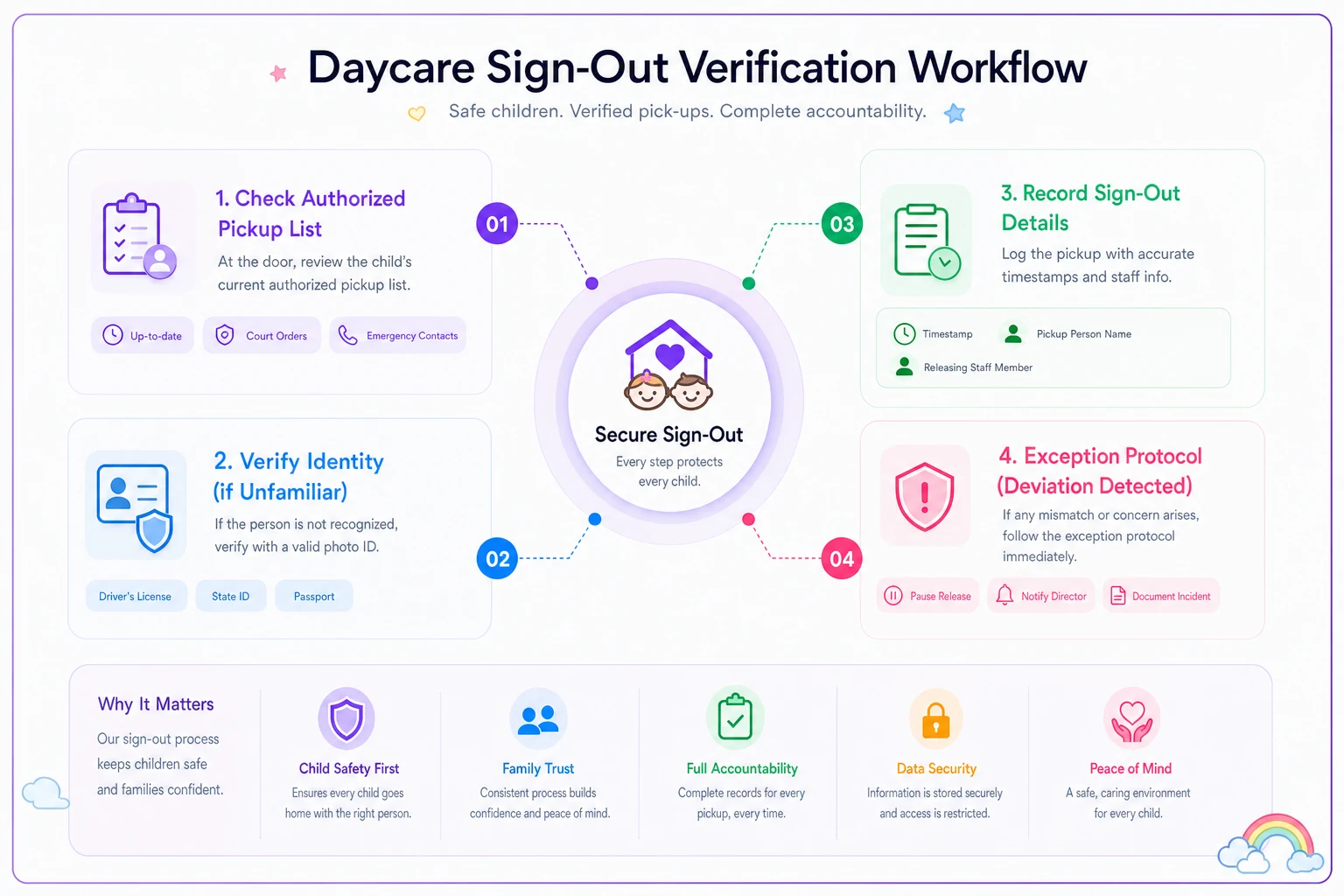
This diagram shows the verification steps and the exception trigger.
The exception protocol: for when the list says no
Exceptions are where centers get hurt. This deserves more space than the happy path.
The categories that come up repeatedly:
-
A parent calls to authorize someone new, same day
-
An adult arrives who isn't on the list at all
-
A custody dispute where one parent is restricted
-
A pickup person is on the list but nobody can confirm their identity
-
A child whose paperwork flags "release requires additional verification"
For each of these, the staff member at the door should not be improvising. Here's a clean structure:
Same-day verbal authorization. Accept it only through a defined channel — a call to the office line, verified by asking the parent a pre-agreed question (something a stranger wouldn't know). Log who took the call, the time, and the temporary authorization. The new person still shows ID at the door, and the name must match what the parent gave. If it doesn't, release doesn't happen.
Unknown adult, not on list. Release is refused. Full stop. The staff member contacts the primary guardian while the child stays inside. This should feel uncomfortable — that discomfort is the control working.
Custody flags. These need to be visible at the point of release, not buried in a file. The most useful thing you can do is make custody restrictions appear on the same screen or sheet used to sign the child out, so nobody has to remember to go check.
A short escalation ladder keeps this from turning into a standoff:
| Situation | First action | If unresolved |
|---|---|---|
| Name mismatch on ID | Refuse release, call guardian | Hold child, notify director |
| Person not on list | Refuse release, call guardian | Guardian must come or add authorization through verified channel |
| Custody restriction triggered | Do not release to restricted party | Notify director immediately, document attempt |
| Guardian unreachable | Child stays, continue attempts | Follow after-hours/late protocol |
The point of the table isn't to memorize it. It's to make sure the answer to "what do I do right now" exists before the moment happens.
The timed handoff problem between rooms
The sibling scenario deserves its own fix because it's a coordination failure, not an identity failure.
When one adult picks up children from multiple rooms, each room needs to know the child left the building, not just the room. A reliable pattern:
-
The releasing staff member marks each child out at the moment of physical handoff, room by room
-
A child isn't considered "gone" until every room they belong to shows the sign-out
-
End-of-day closing includes a hard reconciliation
attendance-in count must equal sign-out count, and any mismatch stops the closing
That last step — the reconciliation — catches ghost sign-outs where a child was marked out somewhere but the handoff never actually completed.
Running it every single day, even when you're sure, is what turns it from a nice idea into an actual safeguard.
What your logs actually need to capture
Most sign-out sheets are useless the moment you actually need them. A signature and a scrawled time don't reconstruct what happened if a parent later disputes a release, or a licensing visit asks how you verify pickups.
A log entry worth keeping records:
-
Child name and room
-
Exact timestamp of release (not "afternoon," not the hour — the minute)
-
Pickup person's name as verified
-
Verification method used (known to staff / ID checked / verified call authorization)
-
Staff member who released the child
-
Any exception triggered and how it resolved
That "verification method" field is the one almost every center leaves out, and it's the one that matters most in a dispute. There's a real difference between "released to a recognized parent" and "released to someone who presented a matching ID," and your record should say which one it was.
Make the "verification method" a required field on the sign-out form so it's captured at the moment, not later.
If you already keep tight documentation for other high-risk events, this is the same discipline. The logic mirrors what makes a rapid minimum-data incident reporting workflow defensible: capture the few fields that answer "who, when, and how did you confirm," and capture them at the moment, not reconstructed from memory afterward.
A real scenario
A two-room center, around 40 kids, kept sign-out on paper clipboards by the door. Closings were usually run by whichever afternoon staff happened to be around, often a rotating float.
The near-miss that forced a change: a father showed up for a child whose custody arrangement restricted his unsupervised pickup. The restriction was in the file. The float covering the room had never seen the file. He was two minutes from leaving with the child when the lead teacher happened to walk past and recognize the situation.
Nothing bad ultimately happened — which is the only reason it got treated as a wake-up call instead of a lawsuit.
What they changed over the following month wasn't complicated:
-
Custody flags moved to the top of the sign-out record, visible to whoever was releasing
-
The ID-check-for-anyone-not-known rule became mandatory instead of "use judgment"
-
Sign-out captured the verification method, not just a signature
-
Closing added a two-minute reconciliation of in-count vs. out-count
The measurable change was small but telling: end-of-day discrepancies — kids marked present but with no matching sign-out — dropped from something they hit a few times a week to almost never. More importantly, float staff stopped having to make identity judgments they weren't equipped to make. The rule made the call for them.
Where software quietly removes the weak points
None of this requires software. Plenty of centers run it well on paper. But the two places paper reliably fails are currency (is this list actually up to date?) and visibility at the moment of release (does the person at the door see the custody flag?).
This is where an operational platform earns its place — not by replacing staff judgment, but by making the right information appear at the right second. When a parent updates their authorized-pickup list through a parent portal, the change is live at the door instead of sitting in someone's inbox. When a custody restriction is entered once, it surfaces automatically on the sign-out screen for that child. Timestamped logs write themselves, with the verification-method field captured as a required step rather than an optional note someone forgets to add.
The integration piece matters too: if authorized-pickup names, custody flags, and emergency contacts all flow from the same records parents maintain in their portal, you stop maintaining three versions of the truth. The list the teacher checks is the list the parent updated. That single fact eliminates the stale-data problem entirely.
It's the same operational logic behind cutting late pickups — a tight, scripted process beats good intentions. If you've worked through testing reminder timing and escalation scripts for late pickups, you already know pickup runs smoother when the rules are explicit and consistent rather than reinvented each afternoon.
When to keep it simple, and when not to
A single-room home-based program where the same two people run every closing and know every family probably doesn't need a formal ID protocol for regular pickups. The overhead would slow down a process that's already safe. What they do need is the exception protocol — because even a tiny program eventually faces the same-day-neighbor call and the complicated custody situation.
A larger multi-room center with rotating afternoon staff is the opposite case. Recognition-based release is actively dangerous there, because the person at the door changes constantly. Formal verification, current lists, and daily reconciliation stop being optional.
The mistake to avoid is the middle ground where you have rules on paper but no enforcement — a protocol that everyone agrees to and nobody runs when it's busy. A written rule that only works when things are calm isn't a control. It's a hope.
The bottom line
Pickup verification fails quietly, in the gap between a rule that exists and a rule that actually runs. Fix the four weak points — stale lists, recognition instead of verification, uncoordinated multi-room handoffs, and undocumented exceptions — and the scary door scenario stops being a matter of luck.
Write the exception protocol down. Make custody flags visible where release actually happens. Capture how each release was verified, not just that it occurred. And reconcile your counts every single day, especially the days you're sure you don't need to. The whole point is that the process protects the child even when the most experienced person in the building isn't the one standing at the door.
Ready to transform your daycare operations?
Join hundreds of daycare centers using Carexly to save time, improve communication, and enhance child care quality.