

Wednesday afternoon, the infant room is down to four diapers and one pack of wipes. Someone's already texted the director. The director's now checking three different closets, a spreadsheet nobody updated since August, and a Costco receipt in her purse. Meanwhile a teacher is covering the shortfall by asking a parent to "bring a few extra for the week."
That's not a supply problem. That's a cadence problem.
Most centers don't run out because they underbuy. They run out because ordering is reactive — someone eyeballs a shelf, decides it looks low, and puts in an order whenever they get a spare minute. The result is a weird mix of overstocked construction paper and chronically empty diaper bins. Getting your daycare inventory reorder cadence right is less about buying more and more about buying on a schedule tied to how each room actually consumes.
Here's how to build that system so you stop firefighting mid-week.
Why classrooms run out even when the budget is fine
The core issue is that consumption is wildly different by room, but ordering usually isn't. Infants burn through diapers, wipes, formula, gloves, and sanitizing supplies at a rate that has nothing to do with how a preschool room burns through glue sticks, paper towels, and paint.
When you order for the whole building off one list, two things happen. The high-velocity items — diapers, wipes, food — hit zero fast because order quantities were set for some "average" room that doesn't actually exist. And the slow-movers pile up because someone keeps reordering them just in case.
-
No one owns the shelf count, so "someone will notice" becomes the whole system
-
Order quantities are round numbers (one case, two cases) instead of tied to weekly usage
-
Lead time isn't factored in — the order goes out the day the item hits zero, and the vendor needs three days
-
Enrollment shifted but nobody adjusted the par levels
That last one is sneaky. A center adds six infants in September and the diaper burn jumps by roughly 40–50 changes a day, but the standing order stays exactly what it was in July. Three weeks later they're short every Thursday and nobody connects it to the enrollment change.
Par levels, by room, not by building
A par level is just the target amount you want on hand for a given item. The trick is setting it per classroom type, because that's where usage actually diverges.
Eliminate administrative bottlenecks.
Carexly helps you manage enrollments, attendance, and staff schedules effortlessly.
- Streamlined child enrollment
- Automated parent notifications
- Staff shift and activity scheduling
No credit card required
The logic: take average weekly usage, add a buffer for a busy week, and make sure the number covers your vendor's lead time plus a little slack. If wipes get used at about 8 packs a week in the infant room and your vendor delivers in 3 days, your par can't be "8" — it needs to cover the reorder gap plus safety stock.
A workable starting point for par tables looks like this:
| Item | Infant room (per week) | Toddler room (per week) | Preschool room (per week) | Suggested par (on hand) |
|---|---|---|---|---|
| Diapers (size varies) | ~180–220 | ~90–120 | — | 2 weeks' usage |
| Wipes (packs) | 7–9 | 4–6 | 2–3 | 2 weeks' usage |
| Gloves (boxes) | 3–4 | 2 | 1 | 1.5 weeks' usage |
| Paper towels (rolls) | 6–8 | 6–8 | 5–7 | 2 weeks' usage |
| Cleaning/sanitizer | 2–3 | 2–3 | 2 | 2 weeks' usage |
| Construction paper | low | medium | high | 4 weeks' usage |
| Glue sticks | — | low | medium | 4 weeks' usage |
| Formula (if provided) | varies by child | — | — | 2 weeks' usage |
Set pars per room even if you store centrally.
Notice the pattern: fast-consuming, hard-to-improvise items — diapers, wipes, gloves — get shorter par windows and tighter monitoring. Craft supplies get longer windows because running out of glue sticks on Thursday is an annoyance, not a crisis.
Min/max reorder rules that actually trigger an order
Par levels are the target. Min/max rules are what tell you when to act.
-
Max = your par level (the fullest you want to be)
-
Min = the point where you must reorder to avoid running out before the next delivery arrives
> Min = (average daily usage × lead time in days) + one busy-day buffer
Set it once per item, per room, and now "when do we order" stops being a judgment call. When the count hits the min, an order goes out. No debate, no "does it look low to you?"
Here's a quick reorder SLA template you can drop into a shared doc:
-
Trigger
on-hand count reaches MIN
-
Order placed within
1 business day of trigger
-
Vendor confirmation expected within
1 business day
-
Delivery expected within
[vendor lead time]
-
Escalation
if no confirmation in 24 hrs, contact backup vendor
-
Owner
[named staff role, not a person's name]
That last detail matters. Tie responsibility to a role — lead teacher counts, office manager orders — so it survives turnover. When it's tied to a specific person and they leave, the whole cadence tends to go with them.
A quick vendor scorecard so you're not loyal to a vendor that keeps failing you
Centers stick with vendors too long out of habit. You'll hear "we've always used them" while that same vendor short-ships wipes twice a month. A lightweight scorecard fixes this — you don't need procurement software, just four or five columns filled in after each order cycle.
Score each vendor 1–5 on:
-
Fill rate — did they deliver everything you ordered, or was it partial?
-
On-time — did it arrive within the promised lead time?
-
Price stability — are prices creeping up between orders without notice?
-
Substitution behavior — do they swap brands without asking? (a real issue for anything touching skin or food)
-
Responsiveness — how fast do they answer when something goes wrong?
A vendor scoring 4–5 across the board is your primary. Anyone consistently landing at 2–3 on fill rate or on-time is your signal to have a backup already lined up. The point isn't to fire everyone — it's to know before a crisis which supplier is actually reliable for your can't-run-out items.
One pattern worth flagging: the vendor with the lowest price is very often the one with the worst fill rate. If you're saving 8% per case but getting short-shipped once a month and sending a teacher out to cover the gap, the savings are gone and you've burned staff time on top of it.
Tying the whole thing to a 30/60/90 procurement calendar
Par levels and min/max rules handle the week-to-week. The 30/60/90 calendar keeps ordering aligned with your budget instead of blowing through it in a random month.
Every 30 days:
-
Review high-velocity items (diapers, wipes, gloves, food, sanitizer)
-
Recount pars against current enrollment
-
Confirm the month's spend against the monthly supply budget
-
Adjust any par where a room's enrollment changed
Every 60 days:
-
Review mid-velocity items (paper products, classroom cleaning supplies)
-
Run vendor scorecards and rank primary vs. backup
-
Check for price drift and renegotiate if a vendor has crept up
Every 90 days:
-
Review slow-movers (craft supplies, seasonal items, learning materials)
-
Reconcile total quarterly spend against your quarterly budget
-
Plan bulk buys ahead of predictable spikes (back-to-school, winter illness season)
This keeps the frequent, crisis-prone items on a tight loop and the low-risk stuff on a slower one. You're not spending equal energy tracking glue sticks and diapers — and you shouldn't be.
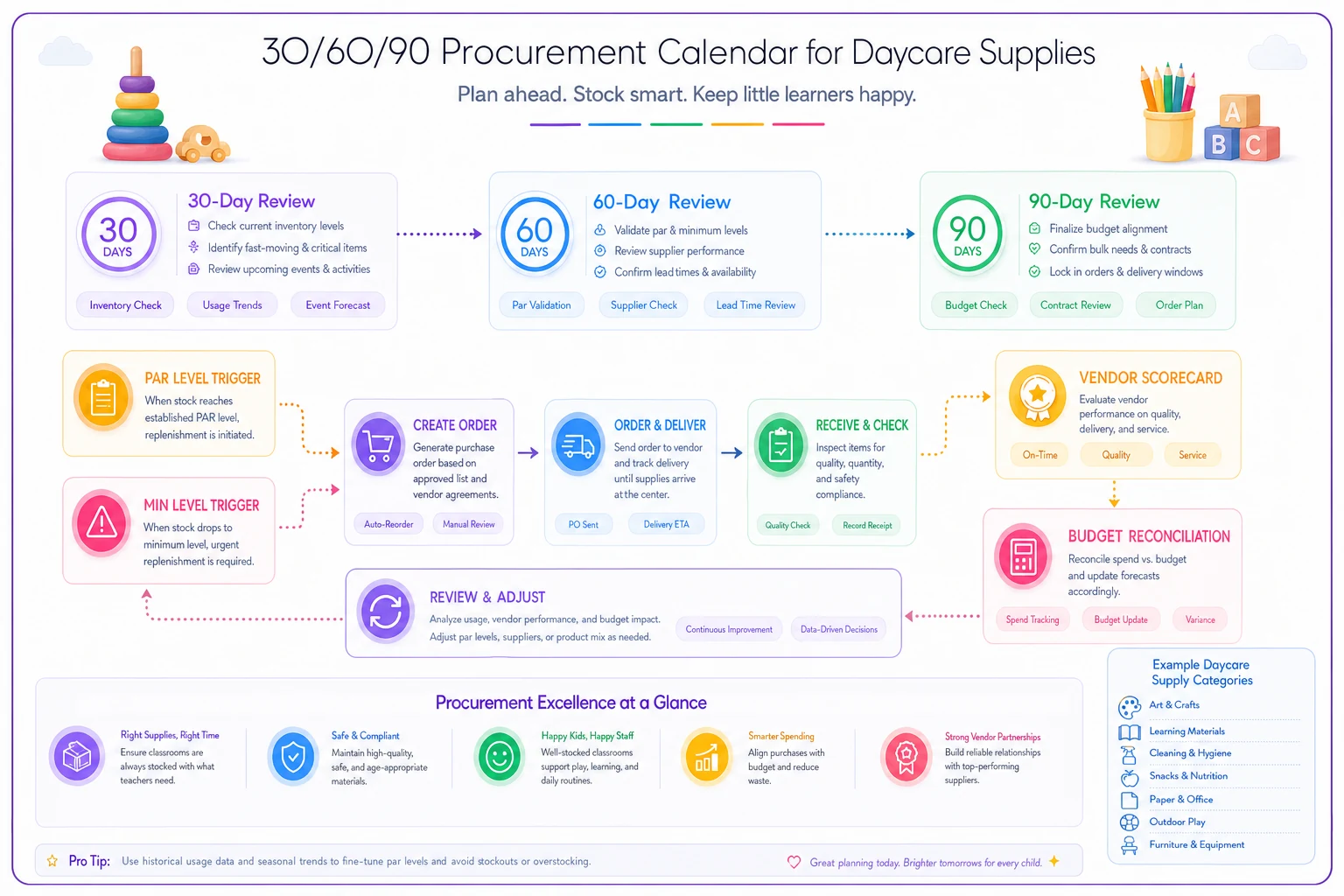
A simple visual that maps the recurring reviews to on-hand counts and vendor checks.
If you're already building batching routines for admin work, this slots right in. The same logic behind the batching schedule and automation recipes for enrollment and billing applies here. Recurring, scheduled review beats reactive scrambling every time.
A real scenario
A two-classroom center that expanded to four rooms — adding a second infant room in the fall — kept running short on wipes and gloves almost every week for about two months. They weren't underbudgeted. Spending was somewhere around $2,600–$2,900 a month on supplies, which was roughly in range. The problem was the ordering list hadn't changed when the new room opened, and every order went out the day something hit empty, which meant the vendor's 3-day lead time guaranteed a gap every single time.
They did three things: set per-room pars, built min triggers that included lead time (orders went out at around 120 diapers left, not 20), and moved to a fixed weekly count for high-velocity items instead of eyeballing.
Within about six weeks the mid-week shortages basically stopped. Monthly spend didn't shift much — it actually settled a little lower because they stopped the panic runs to the wholesale club at retail prices. The quieter win was that teachers stopped asking parents to bring backup supplies, which had been a small but ongoing embarrassment.
When a formal cadence is worth it — and when it's overkill
This full system makes sense once you're running three or more classrooms, or any time you've got more than one infant or toddler room, because that's where consumption gets volatile enough to burn you.
A single small room with one storage closet and stable enrollment doesn't need all of this — a weekly count, a simple min for diapers and wipes, one reliable vendor. That's enough. Building a full 30/60/90 procurement calendar for a 12-child home-based program is more structure than the problem needs.
One group that should not overthink this: brand-new centers still figuring out real usage. You need 4–6 weeks of actual consumption data before your par numbers mean anything. Set rough pars, track what really gets used, then tighten. Guessing pars on day one and treating them as gospel is how you end up overstocked on some things and short on others anyway.
Keeping the numbers honest over time
The most common failure isn't setting bad pars — it's setting good ones and never touching them again. Enrollment shifts, seasons change, a stomach bug tears through the toddler room and usage doubles for two weeks. Pars aren't a set-and-forget number; they're a living target you revisit at each 30/60/90 checkpoint.
Whatever you use to track counts, the goal is a single place where on-hand quantities, pars, min triggers, and vendor performance all live together — not four spreadsheets and a memory. When those live in one system that flags a room hitting its min automatically, the whole cadence runs itself and the Wednesday panic disappears. Some centers fold this into the same operational tooling they already use for scheduling and compliance tracking, which keeps supply records auditable the same way you'd want compliance workflows to stay auditable.
The centers that never run out mid-week aren't buying more than everyone else. They've just stopped letting a low shelf be their alert system — the count, the trigger, and the calendar do the noticing for them, before anyone's texting the director about four diapers left in the infant room.
Ready to transform your daycare operations?
Join hundreds of daycare centers using Carexly to save time, improve communication, and enhance child care quality.