

Most centers don't have an SOP problem. They have an enforcement problem. Walk into almost any established daycare and you'll find a shared drive packed with procedures — opening checklists, diapering steps, incident reporting flows, pickup verification rules. The documents exist. People have even signed off on reading them. And yet the same misses keep happening: the 7:15 opener who forgets to check the fridge temps, the classroom that's technically "following the nap SOP" but has no record of supervision rounds, the medication log that's complete on paper but tells you nothing about whether the dose actually went in on time.
The reason is structural. An SOP describes how to do a task. It says nothing about what good looks like, who's accountable when it slips, or what happens next. That gap is exactly where converting your daycare SOPs to SLAs comes in — and then pushing those SLAs up into OKRs. SOPs are instructions. SLAs are promises — measurable, time-bound, owned. OKRs are the direction those promises are pulling toward. With only the first layer, you're managing a pile of checklists. With all three, you're managing outcomes.
This is a practitioner's walkthrough. You'll get conversion templates, a role-accountability matrix, escalation gates, sample dashboard fields, SLA wording you can lift directly, and a 90-day adoption plan that actually sticks instead of dying in week three.
Why the SOP-only center plateaus
As a center grows past one or two rooms, the director personally becomes the enforcement layer. They walk the floor, spot the fridge temp that wasn't logged, remind the opener, and the system "works" — because one person is holding the whole thing in their head.
That model breaks the moment you add a second site, a float pool, or a director who takes a week off. SOPs don't scale because compliance is invisible until something goes wrong. You find out the pickup verification step was skipped after a kid left with the wrong adult. You discover the immunization renewal workflow stalled after a licensing visit flags three expired records.
SLAs change the unit of management from task completed to outcome delivered within a standard. Instead of "staff should log fridge temps," the SLA reads: "fridge temps logged twice daily, before 8:00 AM and before 2:00 PM, 100% of operating days, owned by the room lead." There's a number, a time, an owner, and a visible miss when it doesn't happen.
A quick diagnostic: ask your director "how do we know this is working?" If the answer is "I check," you're running on SOPs. If they give you a metric and a threshold, you're running on SLAs.
The three layers, and what each one is actually for
People blur these constantly, so it's worth getting the mental model straight before touching any templates.
Eliminate administrative bottlenecks.
Carexly helps you manage enrollments, attendance, and staff schedules effortlessly.
- Streamlined child enrollment
- Automated parent notifications
- Staff shift and activity scheduling
No credit card required
| Layer | Answers the question | Example | Who owns it |
|---|---|---|---|
| SOP | How do we do this? | Steps to administer medication with a witness and log | Staff performing the task |
| SLA | What's the standard we promise, and by when? | 100% of doses administered within 15 min of scheduled time, double-signed | Room lead / shift lead |
| OKR | Why does this matter and where are we heading? | Objective: Become the center families trust most on safety. KR: Zero medication timing misses per quarter | Director / owner |
The mistake most centers make is jumping straight from SOP to OKR — setting a goal like "improve safety" with no SLA in between. Without that middle layer there's nothing to measure week-to-week, so the OKR becomes a wish. The SLA is the connective tissue. It's what you review every Friday that tells you whether the quarterly objective is on track or quietly slipping.
Step 1: Pull the SOPs worth converting first
Don't try to convert all 40 of your procedures at once. That's the number one reason these initiatives collapse — you spend three weeks writing SLAs for how to restock the art closet while actual risk sits in medication, ratios, and pickup.
Prioritize by two filters: regulatory/safety risk and frequency of failure. High-risk and frequently missed goes first. The art closet SOP is low-risk and rarely a crisis — it stays an SOP, possibly forever, and that's fine.
-
Opening and closing safety checks (fridge temps, door locks, allergen board)
-
Ratio maintenance across shift changes and breaks
-
Medication administration and logging
-
Incident report completion and escalation timing
-
Pickup/sign-out verification
-
Immunization and credential expiry tracking
If you're not sure what's genuinely high-risk versus merely annoying, this pairs well with building an operational risk register — the register tells you where a miss actually hurts, and those are the SOPs you convert first.
Step 2: The SOP → SLA conversion template
Every SLA needs five components. Miss one and it won't hold up.
The five required fields:
-
The outcome (not the task) — what state must be true
-
The measurable threshold — a number, percentage, or time
-
The time window — by when, how often
-
The single owner — one role, never "the team"
-
The evidence — how we'll know it happened without asking
Worked example — converting the medication SOP:
> SOP (before): "Staff administer medication per parent authorization and the medication log, with a second staff witness." > SLA (after): "100% of scheduled medications administered within 15 minutes of the authorized time, each entry double-signed by administrator and witness, with time-stamped evidence captured at point of administration. Owner: Shift Lead. Review cadence: daily close-out."
Notice what changed. The SOP told staff how. The SLA tells the director what standard and how we verify it — "within 15 minutes," "double-signed," "time-stamped." You can now report on it. You can see Room 3 drifting to 20-minute windows before it becomes a liability.
SLA wording for three more common ones you can adapt:
-
Ratio SLA "Required ratios maintained 100% of operating minutes, including during breaks and transitions. Any ratio break resolved within 5 minutes and logged with cause. Owner: Floor/Shift Lead."
-
Incident reporting SLA "Minimum-data incident report started within 30 minutes of the event and parent-facing summary delivered same day. Serious incidents escalated to director within 15 minutes. Owner: Classroom Lead."
-
Pickup verification SLA "100% of releases verified against authorized-pickup list with ID check for unknown adults, exceptions logged in real time. Zero unverified releases. Owner: Front-desk/Closing Lead."
The wording discipline matters more than people expect. "Promptly," "as soon as possible," and "when able" are the phrases that let standards rot. Replace every one with a number.
Step 3: The role-accountability matrix
An SLA with no clear owner is a suggestion. But "owner" alone isn't enough when you're coordinating across shifts — you need to separate who performs, who's accountable, who gets consulted, and who's informed. A lightweight RACI prevents the classic failure where everyone assumed someone else had it.
| SLA | Responsible (does it) | Accountable (owns the miss) | Consulted | Informed |
|---|---|---|---|---|
| Medication timing | Administering staff | Shift Lead | Parent, nurse (if any) | Director |
| Ratio maintenance | Floor staff | Floor/Shift Lead | Scheduler | Director |
| Incident reporting | Classroom staff | Classroom Lead | Director | Owner (serious only) |
| Credential expiry | Each staff member | Office Manager | Director | Owner |
| Pickup verification | Closing staff | Front-desk Lead | — | Director |
Pro-tip: Put the single accountable role on any dashboard row so there's no ambiguity when a miss appears.
The most important column is Accountable. There can only be one name in it per row. The moment two roles share accountability, you've recreated the "I thought you had it" problem. Responsible can rotate across a shift. Accountable doesn't.
Step 4: Escalation gates — what happens when the SLA is missed
This is the part centers skip, and it's why their SLAs have no teeth. A standard with no consequence for breach is just a number on a wall. Escalation gates define, in advance, what triggers at each threshold — so nobody has to improvise in the moment.
Three-tier model:
-
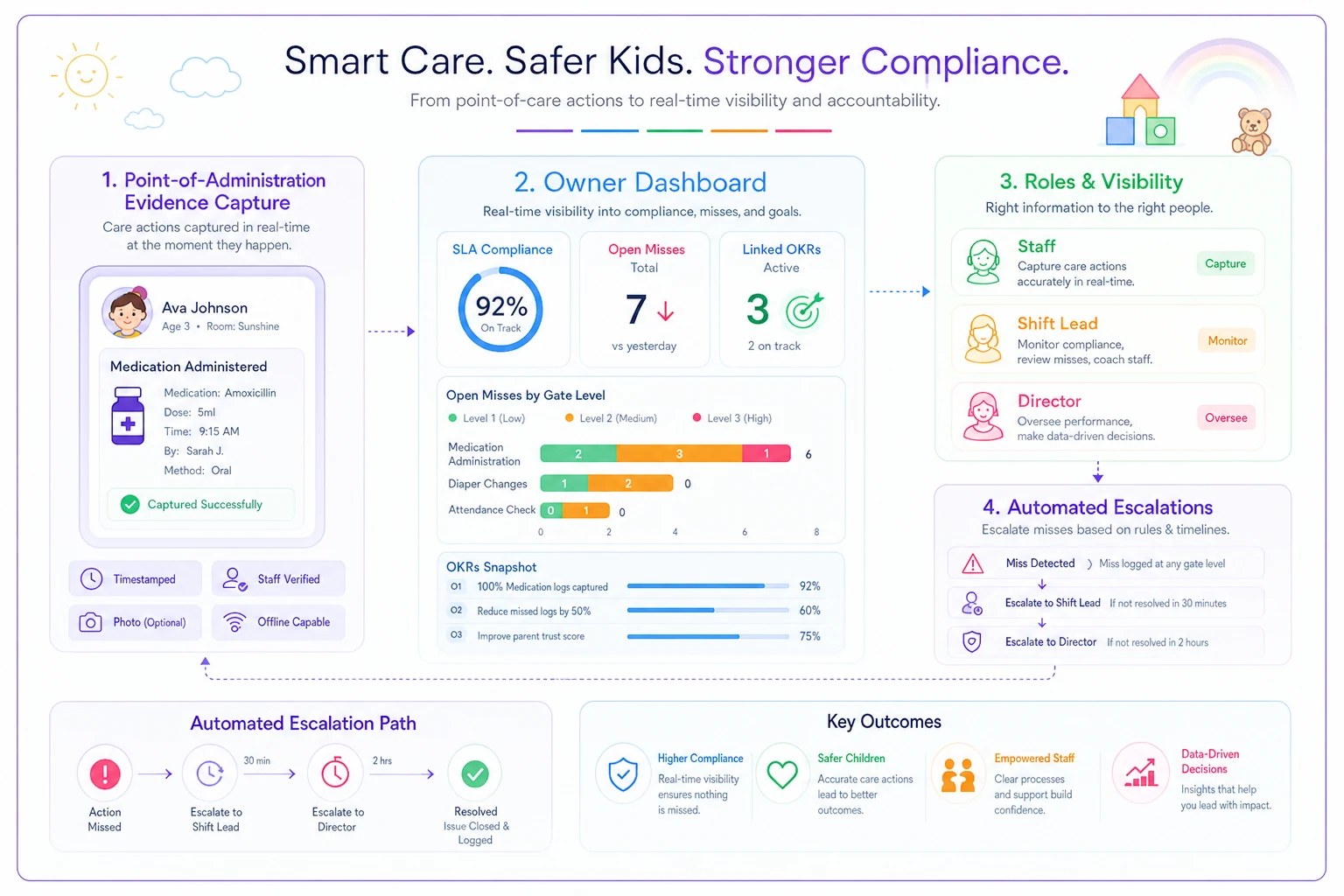
Gate 1 — Single miss (same-day correction) Owner logs the miss and cause, corrects it, no escalation. This is normal operational noise. The point is it's recorded, not punished.
-
Gate 2 — Pattern (3 misses in a rolling 2 weeks, or any safety-critical single miss): Auto-escalates to director. Director and owner do a 15-minute root-cause — is it training, scheduling, or a broken SOP? Fix the system, not just the person.
-
Gate 3 — Breach of a safety SLA (any unverified pickup, any ratio break over 10 minutes, any medication error): Immediate owner-and-director notification, documented, with a corrective action plan dated and signed within 24 hours.
Gate 2 is where the real leverage is. A single miss is usually human. A pattern is almost always the system — an understaffed shift, an SOP step that doesn't reflect reality, a transition window with no clear lead. If you treat Gate 2 patterns as staff performance issues instead of system design failures, you'll keep retraining people around a broken process indefinitely.
Step 5: The owner dashboard
You don't need sophisticated software to start, but you need a single view. The dashboard is where SLAs become visible instead of theoretical. A director should be able to check it Monday morning and immediately know where the week stands.
Fields worth including on a center-level SLA dashboard:
-
SLA name and current compliance % (rolling 7 and 30 days)
-
Owner role (so misses have a face)
-
Open misses (count, by gate level)
-
Gate 2+ items awaiting root-cause (the "needs attention now" list)
-
Trend arrow (improving / flat / slipping)
-
Linked OKR (so staff see why it matters)
A simple workflow for how evidence capture feeds the dashboard:
The most common dashboard mistake is piling in too many metrics. If you're tracking 25 SLAs with equal weight, directors tune it all out. Keep the primary dashboard to your 6–8 highest-risk SLAs — the same ones you'd surface in your owner-facing KPI set. Everything else lives in a secondary report reviewed monthly.
This is also where operational software earns its keep. When evidence capture is built into the workflow — the medication log timestamps itself, the ratio alert fires when a break drops you below threshold, the credential expiry escalates automatically — the dashboard populates without anyone manually tallying. Measurement that depends on someone remembering to measure will eventually fail. Automating the capture is what makes the SLA real instead of aspirational.
Step 6: Connecting SLAs up to OKRs
OKRs give SLAs a direction so staff understand they're not just hitting arbitrary numbers. One objective should sit over a cluster of related SLAs.
> Objective: Be the center in our area families trust most on child safety. > > Key Result 1: Zero medication timing errors per quarter (rolls up from the medication SLA) > Key Result 2: Ratio compliance ≥ 99.5% of operating minutes (rolls up from the ratio SLA) > Key Result 3: 100% of pickup verifications clean, zero exceptions unlogged (rolls up from the pickup SLA)
Each KR is the quarterly aggregate of a weekly SLA. That's the whole point — the OKR isn't a separate thing you go measure; it's the SLAs summed over time. If your SLAs are green all quarter, the OKR takes care of itself. If the OKR is red, you can trace it down through the SLA to the exact room and shift where the standard slipped.
This linkage also keeps OKRs honest. Centers that set quarterly goals with no weekly instrument underneath only find out they missed in week 12. With SLAs feeding the OKR, you get the warning in week 3.
The 90-day adoption ritual
Converting documents is the easy part. Getting the ritual to hold is where it lives or dies.
Days 1–30 — Convert and baseline. Pick your top 5 SLAs only. Write them using the five-field template. Assign one accountable owner each. Don't set targets yet — just measure and capture a baseline. You need to know you're actually at 82% medication-timing compliance before you promise 100%. Five SLAs done well beats twenty done sloppily.
Days 31–60 — Set thresholds and run gates. With real baselines in hand, set honest thresholds and turn on escalation gates. Run your first Gate 2 root-causes. Expect this phase to feel bumpy — you'll find some SOPs don't match how the room actually works, and some "misses" are really broken procedures. That's the system revealing itself. Fix the SOPs that don't reflect reality.
Days 61–90 — Embed the cadence. Lock in the rhythm: daily close-out logging by owners, a weekly 20-minute SLA review in the director's one-on-one, and a monthly roll-up to the OKR level. By day 90, the dashboard should be something staff check without being prompted, because it's tied to their shift accountability.
-
Top 5 SLAs written in five-field format
-
One accountable owner per SLA (no shared ownership)
-
Baselines captured before targets set
-
Three-tier escalation gates defined and posted
-
Weekly 20-minute review on the calendar
-
Monthly OKR roll-up scheduled
-
Evidence capture built into the workflow, not bolted on after
By day 90, the dashboard should be something staff check without being prompted, because it's tied to their shift accountability.
A real scenario
A two-room center — roughly 55 kids, nine staff — kept failing the same licensing finding: incomplete medication logs. Nothing dramatic had happened, but the gaps made every inspection a scramble and the director spent her Fridays reconstructing records from memory and sticky notes.
They converted exactly one SOP. The medication SOP became an SLA: every dose within 15 minutes, double-signed, timestamped at administration, owned by the shift lead, reviewed at daily close. Baseline came in around 80% on-time and about one in six entries missing the witness signature.
They didn't change the people. They changed the structure — one accountable owner per shift, a Gate 2 trigger on any pattern, and the log moved to a point-of-administration capture so the timestamp was automatic. Within about ten weeks, timing compliance was above 98% and the missing-signature problem had essentially disappeared because the entry wouldn't close without the second sign-off. The next licensing visit, medication wasn't even a conversation. The director got her Fridays back.
The lesson wasn't that software fixed it. An SOP everyone already knew became enforceable the moment it had a threshold, one owner, and a gate.
When this makes sense — and when it doesn't
When it's worth it: You're past a single room, you have shift changes and float staff, or you're prepping for accreditation or a second site. Any time the director can no longer personally be the enforcement layer, you need SLAs. Multi-site owners especially — without this structure, each site drifts to its own standard and you lose consistency entirely.
When to hold off: If you're a single small room where the owner is on the floor every day and genuinely sees everything, a full SLA/OKR system can be overkill. Keep tight SOPs and a couple of safety SLAs. Don't build a 15-metric dashboard for a six-child home-based program. The overhead won't pay for itself.
Who should not do this: Don't let a director who's already underwater try to convert 30 SOPs in a month to "fix accountability." That's how this becomes shelfware. Five SLAs, properly owned and gated, will outperform a comprehensive framework nobody maintains.
The bigger picture
The shift from SOPs to SLAs to OKRs is really a shift in what a director spends their day doing — from catching misses in person to managing a system that surfaces misses automatically. That's the only way predictability survives growth. Checklists depend on someone remembering to check. Standards with owners, gates, and evidence don't.
Building this out fits naturally alongside your broader financial governance playbook — the same discipline that makes safety predictable makes revenue, staffing, and compliance predictable too. Once the operation runs on measurable promises instead of hopeful procedures, you stop reacting to problems you discover too late and start managing outcomes you can actually see coming.
Once the operation runs on measurable promises instead of hopeful procedures, you stop reacting to problems you discover too late and start managing outcomes you can actually see coming.
Ready to transform your daycare operations?
Join hundreds of daycare centers using Carexly to save time, improve communication, and enhance child care quality.