

Most childcare owners don't lack awareness of risk. They have a dozen risks living in their head, a few more buried in email threads with their insurance broker, and a couple that only surface when a licensing specialist walks through the door. The problem isn't that risks are invisible — it's that they're scattered, un-owned, and disconnected from the one number that actually governs the center's survival: cash runway.
A proper childcare operational risk register fixes that by pulling every meaningful threat — regulatory, staffing, financial, data — onto a single page, scoring each one, assigning a named owner, and tying the whole thing to how many weeks of payroll you can cover if something goes sideways. Not a binder. Not a 40-tab spreadsheet. One page you actually look at every month.
This article walks through how to build that page, why most centers' informal version quietly fails as they grow, and how to run the monthly review that keeps it honest.
Why scattered risk tracking breaks exactly when you need it
A single-site center with 45 kids and one director can, honestly, run on memory. The director knows which teacher's CPR cert expires in March, knows the landlord's lease renewal is two years out, knows the state subsidy reimbursement runs 6–8 weeks behind. Risk management is a conversation she has with herself in the car.
That model collapses in three predictable ways.
The first is owner overload. When every risk lives in the director's head, nothing gets escalated because nothing is written down with a trigger. A credential lapses not because nobody cared, but because the one person tracking it was out sick during renewal week.
The second is cross-domain blindness. Risks don't respect categories. A staffing shortage forces you to run below ratio, which becomes a regulatory violation, which — if a parent files a complaint — becomes a legal and reputational event, which hits enrollment, which hits cash. In a scattered system, each of those lives in a different place and nobody sees the chain until it's already three links deep.
The third is scale. Go from one site to three and the informal model doesn't just strain, it shatters. Now you have three directors each holding their own mental register, no consistent scoring, and no way for the owner to compare risk exposure across locations. You find out site B has been running a broken fire-drill log only when the inspector finds it.
Centers that survive the chaos of growing past a second location tend to have one thing in common: they built a shared risk artifact before they needed it. The ones that didn't spent their second year fighting fires they'd already been warned about — just in a place nobody looked.
The four domains that belong on one page
A childcare risk register that only tracks compliance is doing a quarter of the job. The value comes from forcing four domains into the same frame so you can see how they trade off against each other.
Eliminate administrative bottlenecks.
Carexly helps you manage enrollments, attendance, and staff schedules effortlessly.
- Streamlined child enrollment
- Automated parent notifications
- Staff shift and activity scheduling
No credit card required
Regulatory risk covers ratio violations, expired staff credentials, lapsed immunization records, licensing renewal, background-check gaps, and inspection findings. These carry the sharpest teeth because consequences are external and often non-negotiable.
Staffing risk covers turnover exposure, single-point-of-failure roles (the one person who knows payroll, the only lead who can open), fill-time for open positions, and wage-competitiveness against the market. Staffing risk is the quiet driver behind most regulatory risk.
Financial risk covers cash runway, occupancy swings, subsidy reimbursement delays, tuition default rates, and major cost shocks like a rent increase or a minimum-wage jump. This domain is the one every other risk eventually flows into.
Data risk covers family PII exposure, loss of records, systems that disagree with each other, vendor failures, and the ability to produce documentation on demand during an audit or legal hold. It feels abstract until a ransomware incident or a lost laptop makes it very concrete.
The point of one page isn't to shrink the work. It's to make the connections unavoidable. When regulatory and financial risk sit in the same table, you naturally start asking: if we lose this lead teacher, what does that do to ratios, and what does running short do to enrollment, and how many weeks of runway buys us time to hire? That chain of questions is the whole value of the exercise.
Scoring that survives a disagreement
Impact-and-probability scoring sounds like consultant theater until you've watched two directors argue about whether a risk is "high." A simple, defensible scale ends those arguments fast.
| Score | Impact (if it happens) | Probability (next 12 months) |
|---|---|---|
| 1 | Minor annoyance, absorbed in a day | Very unlikely |
| 2 | Local disruption, handled in a week | Unlikely |
| 3 | Real operational hit, 2–4 weeks to recover | Plausible |
| 4 | Threatens compliance or significant cash | Likely |
| 5 | Center-closing or license-threatening | Near certain / overdue |
Impact × Probability gives you a 1–25 score. Anything scoring 15+ is a top-of-page priority. 8–14 is a watch item with active mitigation. Below 8 gets monitored but doesn't eat attention.
The honest mistake here is gaming impact down because the risk feels uncomfortable to own. A center that's been running one person short for months will rate "ratio violation" as probability 2 because it "hasn't been a problem yet." That's not probability, that's luck. Score what the operation actually looks like, not what you hope an inspector won't notice.
One thing worth adding to each row: a velocity note — how fast the risk moves from fine to crisis. A credential expiring is slow and visible; you get 60 days of warning. A data breach is instant. Two risks can share a score of 16 but demand completely different response speeds, and velocity tells you which one needs a same-day runbook versus a quarterly check.
Mitigation owners and the legal-hold trigger
Every row needs a named human. Not "the admin team." A name. Un-owned risks are the ones that rot.
The owner isn't necessarily the person who fixes the problem — they're accountable for watching it and raising the flag. On a small team, the director might own 15 rows, the assistant director 8, and the owner personally holds the financial and legal-hold rows. That concentration is fine as long as it's deliberate and the single-points-of-failure are themselves flagged as staffing risk.
Legal-hold triggers deserve their own column because they change your obligations instantly. The moment certain events occur — a serious injury incident, a regulatory complaint, a subpoena, a notice of potential litigation — your duty to preserve records kicks in, and routine deletion schedules become dangerous. Your register should name, in plain language, which events trip a hold and who gets notified within the hour. If you don't already have the mechanics behind this, the records governance and legal-hold runbook for center owners covers the preservation workflow this column should point to.
A typical legal-hold trigger set for a center looks like:
-
Any incident report involving injury requiring medical attention
-
A formal complaint to licensing or CPS
-
Written notice from an attorney representing a family
-
Any subpoena or records request
-
A data breach involving family PII
When one trips, the register row tells you: stop normal retention cycling, snapshot the relevant records, notify counsel, and log the hold date. That sequence written down beforehand is the difference between a defensible position and a very bad deposition.
Monitoring rituals — the part that actually keeps it alive
A register built once and filed is worse than useless because it creates false confidence. The living version runs on rituals at three cadences.
Weekly (director level): a five-minute scan of any risk with velocity "fast" or a score of 15+. Credential expiries inside 30 days, ratio coverage for the coming week, any subsidy payment that's now overdue. This is a glance, not a meeting.
Monthly (owner review): the main event, described in detail below. Every row touched, scores updated, mitigation progress checked against runway.
Quarterly (strategic): step back and ask what's not on the register that should be. New regulations, a lease approaching renewal, a vendor contract expiring, a competitor opening down the street. Quarterly is where new rows get born.
The pattern that separates centers that stay ahead of trouble: they attach monitoring to events that already happen. Credential checks ride along with the monthly payroll run. Ratio-risk scans attach to the weekly schedule build. Nobody has time for a standalone "risk meeting," so the risk work piggybacks on rituals that exist anyway. The resilience side of this — keeping staffing, facility, and data continuity intact when a monitored risk fires — is worth building out alongside, and the childcare resilience playbook for staffing, facility and data continuity pairs naturally with these rituals.
Pro-tip: attach credential checks to the monthly payroll run so they don't become a separate, skipped task.
This setup keeps the register visible without adding standalone meetings.
The monthly owner review, tied to cash runway
This is where the register earns its place. The monthly review takes about 30 minutes and follows a fixed sequence.
-
Pull current cash runway. Weeks of operating expenses covered by cash on hand. This number anchors everything that follows.
-
Scan the top rows (score 15+). For each, confirm the owner, check mitigation progress, and update the probability score based on the last 30 days.
-
Re-score anything that moved. A teacher gave notice? Turnover-exposure probability just jumped. A subsidy payment landed? Financial pressure eased slightly.
-
Check each high risk against runway. For every top risk, ask
if this fires this month, how many weeks of runway does it cost us? A regulatory shutdown of one classroom, a two-week delay in subsidy, an emergency hire at a premium — assign a rough runway impact.
-
Trigger legal-hold review. Did any hold-triggering event occur this month? If yes, confirm the hold is active and documented.
-
Update the roadmap. Move completed mitigations off the active list, promote the next priority up.
Step four is the one that changes behavior. When you force every risk to express itself in weeks of runway, priorities sort themselves fast. A low-impact risk stops stealing attention from the thing that could actually cost you eight weeks of cash. The financial mechanics behind that runway number — how occupancy, payroll timing, and reserves interact — sit in the childcare financial governance playbook for owners and directors, which is the right companion when a risk's runway impact looks ugly.
A simple visual of the monthly review workflow can help keep the 30-minute meeting focused.
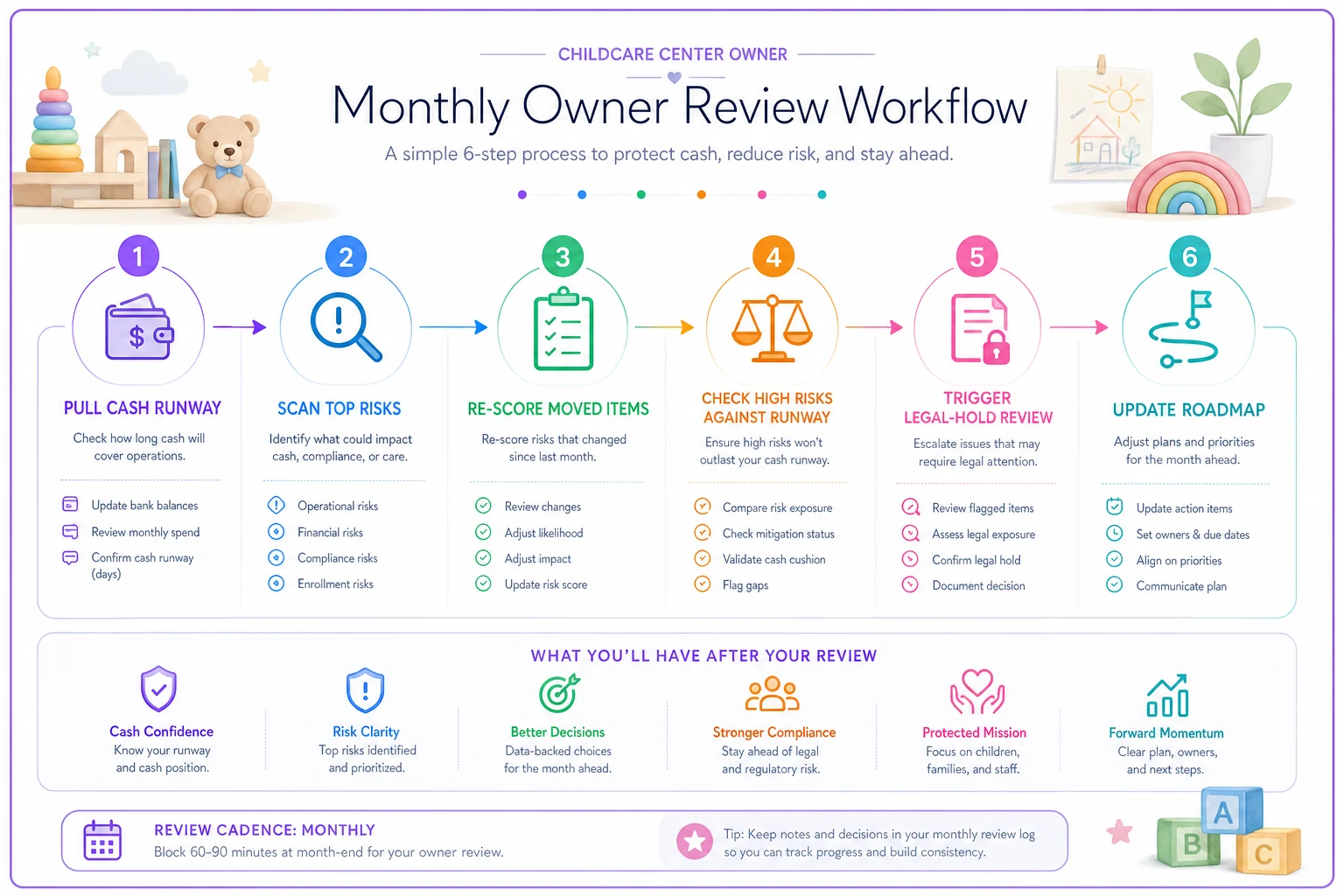
Use the visual as a checklist during the monthly review to keep the team on sequence.
A real scenario: the single-point-of-failure that nearly cost eight weeks
A center with about 60 kids and two classrooms per age band ran lean on administration — one director handled scheduling, payroll, subsidy intake, and the parent portal. On paper, efficient. On the register, a staffing risk scored at 20 (impact 5, probability 4) because everything funneled through one person with no backup.
The director didn't leave dramatically. She was out for six weeks on a medical leave nobody could have scheduled around.
In the first two weeks, subsidy intake stalled because nobody else knew the state portal workflow. Roughly three families' reimbursements — call it $4k–$5k — got pushed into the next cycle. Payroll got done, but late and with two errors that had to be corrected. A credential expiry slipped past because the person who tracked it was gone, and the center ran a classroom technically out of compliance for about nine days before anyone caught it.
The runway math got uncomfortable fast. Between the subsidy delay, the premium paid to a temp agency for coverage, and the general scramble, the center burned through close to six weeks of its cushion in two months.
What the register would have forced earlier: that score-20 row had been sitting there, un-mitigated, because the fix — cross-training a second person on subsidy and payroll — never felt urgent. The monthly runway question (what does losing this person cost us in weeks?) would have put a real number on the inaction. After the scare, the owner cross-trained the assistant director, documented the subsidy workflow, and dropped the probability score to 2. Same risk, a third of the exposure.
The prioritized mitigation roadmap
The register tells you what's dangerous. The roadmap tells you what to fix first, given you can't fix everything this quarter. Sort by score, then within each score band, sort by runway impact.
A working roadmap for a single-site center might look like:
-
This quarter (scores 15+) cross-train the payroll/subsidy single point of failure; close the two credentials expiring in 60 days; confirm data backup actually restores.
-
Next quarter (scores 10–14) formalize the ratio-coverage buffer for flu season; renegotiate or document the vendor contract approaching renewal; tighten incident-report escalation.
-
Backlog (scores 8–9) facility items with long warning windows; low-probability data risks with existing partial controls.
Data risk belongs on this roadmap more often than owners expect. A center confident in its records is usually one that's never tested a restore. If "loss of family records" or "systems disagree during an audit" sits on your register un-verified, the disaster recovery for childcare centers plan with real RTO/RPO targets is how you turn that row from assumed-fine to actually-fine.
When a formal register is overkill — and when it isn't
A brand-new center with 12 kids and two staff does not need a scored risk register. The director holds the whole operation in her head accurately, and the overhead of maintaining a formal artifact buys little. A single list of five known risks on a notecard is honestly enough.
The register starts earning its keep around the point where no single person can hold the full operational picture reliably — usually somewhere past 40–50 kids, or the moment you add a second location. If you've ever been surprised by a credential lapse, a subsidy delay, or an inspection finding you "sort of knew about," you've already outgrown the notecard.
It's also the wrong tool if nobody's going to run the monthly ritual. A register with no review cadence is just a document that makes you feel organized while nothing actually gets watched. Build the ritual first, or don't build the register.
Where tooling quietly helps
Most of this can run in a spreadsheet, and for a single site, it should — don't over-engineer a 60-kid center. The friction shows up at scale and in the connective tissue: when credential expiries, ratio coverage, subsidy status, and runway all live in separate systems, keeping the register's scores current becomes its own full-time chore. Stale scores are worse than no scores.
That's where an operational platform that already tracks the underlying signals — credential expiry dates, scheduled ratios, billing and subsidy status — can feed the register instead of you re-typing everything each month. When AI-assisted monitoring flags a lapsing cert or an overdue reimbursement automatically, the monthly review shifts from hunting for problems to reviewing what already surfaced.
The goal isn't to automate judgment. Scoring and runway trade-offs stay firmly with the owner. It's to automate the data-gathering so the human part — deciding what actually matters — gets your full attention instead of being buried under a pile of tabs you're trying to reconcile before the meeting starts.
The point of the one page
The register isn't paperwork. It's a forcing function. It makes you name who's watching each threat, score how bad it could get, and — the part most centers skip — connect every risk back to the weeks of cash that keep the doors open.
Done right, it turns a dozen vague worries living in the director's head into a single page you can actually act on, and a 30-minute monthly ritual that catches the credential lapse, the single point of failure, and the subsidy delay before they stack into a crisis.
Start rough. Five rows, honest scores, one owner each, and the runway question attached to the top three. Run it once a month for a quarter and you'll wonder how you operated without it.
Start rough. Five rows, honest scores, one owner each, and the runway question attached to the top three. Run it once a month for a quarter and you'll wonder how you operated without it.
Ready to transform your daycare operations?
Join hundreds of daycare centers using Carexly to save time, improve communication, and enhance child care quality.