


A center budget usually has a wages line, a benefits line, and maybe a training line. It doesn't have a line for the seven weeks the toddler room ran on overtime, a borrowed floater and the director stepping into ratio between tours. That cost is real, but it gets scattered across payroll, lost starts, a family or two who quietly leave, and a director who stops doing director work. Because it's scattered, almost nobody adds it up.
That missing number is why most childcare workforce planning stays reactive. If you don't know what a vacancy costs, a part-time floater who "isn't needed most days" looks like waste. Paying for an aide's CDA looks like a perk. Promoting your best assistant looks free, until you notice her old spot is now empty too.
This post covers the multi-year model that connects those decisions: an enrollment forecast that tells you how many ratio slots you'll need and when, bench-size rules for absorbing turnover, succession ladders so promotions don't hollow out classrooms, training spend timed to the forecast, and a payroll runway check that keeps all of it financially honest. Cost comes first, since everything else hangs off it.
What one empty lead position actually costs
Take a toddler room licensed for 12 with two teachers. The lead gives two weeks' notice in late spring. It takes about seven weeks to get a cleared, trained replacement into ratio, which is pretty normal once you count posting, interviews, background check turnaround and a bit of shadowing.
A realistic breakdown for those seven weeks is below. The wage and tuition figures are illustrative, so swap in your own.
| Cost component | How it shows up | Rough 7-week cost |
|---|---|---|
| Overtime for existing staff | ~22 extra hrs/week at time-and-a-half (~$33/hr) | ~$5,000 |
| Floater/agency coverage | ~12 hrs/week at ~$34/hr | ~$2,800–$2,900 |
| Delayed starts | 2 waitlisted toddlers can't start until room is fully staffed (~1.5 months each, ~$1,380/mo tuition) | ~$4,000–$4,400 |
| Family attrition | 1 family withdraws citing "too many teacher changes"; ~5 months of remaining enrollment lost | ~$6,500–$7,000 |
| Recruiting + onboarding | Ads, background checks, overlap/shadow hours, lead's training time | ~$1,500–$1,900 |
| Gross cost | ~$20k–$21k | |
| Minus wages you didn't pay | Departing teacher at ~$22/hr loaded, 7 weeks | –$6,800 to –$7,000 |
| Net cost of the vacancy | roughly $13k–$15k |
Two things in this table matter more than the totals.
The saved-wages line is one. Owners who try this math usually either ignore vacancy cost completely or overcount it by forgetting they stopped paying the person who left. Netting it out gives you a number you can defend to a partner or a lender, and it's still big.
The other is that the two largest items, delayed starts and family attrition, never appear on a payroll report. Payroll shows overtime and agency fees, which look manageable. The real damage is revenue that didn't arrive, so a center can look like it's handling turnover fine while losing five figures per departure.
The director's hours aren't in the table at all, because they don't cost extra cash. They cost tours not given, a subsidy renewal that slips, a parent conversation that doesn't happen. A director covering ratio 10+ hours a week for two months tends to show up later as a softer enrollment pipeline. Hard to measure, easy to recognize afterward.
Now multiply. A center with around 17 ratio-staff FTE and 34% turnover loses roughly six people a year. Even if only some of those departures are as messy as this one, you're probably looking at $40k–$80k a year in vacancy cost that no budget line owns.
Why centers keep paying it
It comes down to a mismatch in time horizons.
Eliminate administrative bottlenecks.
Carexly helps you manage enrollments, attendance, and staff schedules effortlessly.
- Streamlined child enrollment
- Automated parent notifications
- Staff shift and activity scheduling
No credit card required
Enrollment gets planned 9–12 months out. You know roughly when kids age up, when fall registration fills, when the infant waitlist converts. Staffing gets planned 2–6 weeks out, because it's triggered by notices, call-outs and someone saying "I need another person in Room 3." Credentials and training run on 3–12 months. A CDA takes months, and an infant/toddler qualification in many states needs coursework hours that can't be rushed.
So the setup is backwards. The slowest-moving input, qualified people, is managed on the fastest cycle.
A few patterns make it worse.
Turnover is seasonal, and centers plan as if it isn't. Departures cluster around late spring (summer jobs, school schedules, K-12 openings) and late summer (students heading back, people who held on through summer finally leaving). Enrollment transitions often land at the same points. Average your staffing needs across the year and you'll be fine in February and short in May and August, every year.
Promotions create vacancies too. Moving your strongest assistant into a lead role fills one gap and opens another. If she was also your informal floater, you just lost your bench. Owners often feel staffing got worse right after a good internal promotion, and they're right.
Growth gets staffed from the existing floor. A second infant room opens and the two best toddler teachers move over, because they're trusted. Now the toddler room has two new people at once, and that's usually where the family attrition line comes from.
The training budget gets cut first. When cash is tight, coursework reimbursement and paid training hours go. Nine to twelve months later you have a ladder with no one ready to step up.
None of these is a single broken process. They're separate decisions made by different people at different times, and nobody sees how they interact.
The five pieces and how they pull on each other
The model has five parts. Each is fairly simple alone, and the value comes from how they connect.
The enrollment forecast sets demand: how many ratio slots by age band, by month, for the next 2–3 years. Everything else follows from it.
Bench size is absorptive capacity, meaning qualified people who can step into ratio when someone is out or gone. Size it off turnover and absence rates, not off "how many floaters feel right."
The succession ladder is the internal supply line. Aides become assistants, assistants become leads, leads become room mentors or assistant directors. Each rung has a readiness definition and a credential requirement.
Training investment is what moves people up that ladder on time. It has a lead time, so it gets scheduled against the forecast and not against whatever's left in the budget.
Payroll runway is the limit on all of it. Bench positions, pay steps from promotions and pre-opening hires for new rooms are all permanent or semi-permanent payroll. You only commit if cash and contracted tuition can carry them through a bad quarter.
Say the forecast shows a second infant room opening in Q3 of next year. That room needs two infant-qualified people. Ideally one is promoted from inside, which means picking a ladder candidate this year and starting her coursework about six months before opening. Her promotion pulls her off the bench or out of a toddler room, so the bench has to grow ahead of the opening, which is a payroll commitment, which has to pass the runway check. One forecast line, all five pieces.
When any piece is missing, the failure looks the same: an emergency hire, overtime, a capped room.
Building the forecast: a template that actually gets used
It has to be simple enough to update quarterly in under an hour. If it takes a full day, it gets updated once and abandoned. That's the most common way these models die.
-
Forecast enrollment by age band, by quarter, for 12 quarters. Use current enrollment, known transitions (birthdays drive room moves), historical fall/summer patterns, and waitlist depth. Be conservative in years 2 and 3. You'll revise them anyway.
-
Convert enrollment to ratio slots. Divide each age band by your state's ratio and round up per room, since you can't staff 1.6 of a classroom. Use your actual room configuration, not total kids divided by an average ratio.
-
Apply a coverage factor to get FTE. A center open 11 hours with staff working 8-hour shifts plus breaks needs more than one person per ratio slot. Somewhere around 1.35–1.5 is typical depending on hours and arrival curves. Calculate yours from last quarter's actual scheduled hours divided by ratio slots. Don't guess it.
-
Estimate turnover replacements. Multiply average FTE by your trailing 12-month turnover rate. If you don't know the rate, count separations over the last year and divide by average headcount. It's usually higher than owners expect.
-
Add growth hires. This is the FTE change quarter over quarter. Positive changes mean hiring, negative ones mean you plan attrition instead of layoffs where you can.
-
Set the bench target using the heuristic in the next section.
-
Map the ladder against the gaps. For every lead or specialized role the forecast creates or turns over, name the internal candidate (or write "external hire") and when they need to be ready.
-
Back-schedule training. Ready date minus credential lead time gives the start date. That start date becomes a budget line in that quarter.
-
Price it and check runway. Add up wage changes, bench cost and training cost, then test against the payroll runway rule before approving anything permanent.
A stripped-down version of the template looks like this:
| Quarter | Infants | Toddlers | Preschool | Ratio slots | FTE needed (×1.4) | Expected turnover hires | Growth hires | Bench target | Ladder moves | Training starts | Added payroll vs. today |
|---|---|---|---|---|---|---|---|---|---|---|---|
| Y1 Q1 | 8 | 22 | 51 | 12 | 16.8 | 1–2 | 0 | 1.5 | — | — | — |
| Y1 Q4 | 8 | 23 | 52 | 12 | 16.8 | 1–2 | 0 | 1.5 | Asst → infant lead candidate named | Infant coursework (1 person) | Training ~$1.5k + coverage hrs |
| Y2 Q2 | 8 | 24 | 54 | 12 | 16.8 | 1–2 | 2.8 (pre-hire) | 2.0 | Candidate completes coursework | CDA cohort (2 aides) | +bench ~0.5 FTE |
| Y2 Q3 | 16 | 24 | 54 | 14 | 19.6 | 2 | 0 | 2.0 | Infant lead promoted | — | +2.8 FTE + pay step |
Turnover hires vary by quarter because departures cluster. Put 2 in your known heavy quarters and 1 in the quiet ones instead of spreading them evenly.
Bench-size heuristics that hold up
"Bench" means people who are cleared, trained and familiar enough with your center to go into ratio on short notice. That covers floaters, part-time subs on your roster, cross-trained aides who usually do prep or kitchen support, and an assistant director who can actually cover a room. Someone with an expired background check or no CPR doesn't count.
The sizing logic has two parts.
Vacancy coverage: Ratio FTE × annual turnover rate × average weeks to fill ÷ 52. This gives you how many FTE are vacant at any given moment, on average. For 17 FTE at 34% turnover and 6 weeks to fill, that's about 0.67 FTE.
Absence coverage: Ratio FTE × daily absence rate. Sick days, PTO, appointments and kids' illnesses usually run 4–6% in childcare, often higher in winter. At 5%, 17 FTE gives about 0.85 FTE.
-
Infant-heavy centers need more, partly because infant rooms usually have tighter qualification rules and partly because an infant room can't absorb an unfamiliar sub as easily. Families notice fast.
-
Seasonal peaks need temporary bench. If you know May and August are bad, add a seasonal sub (education students work well) for those windows instead of carrying the peak all year.
-
Credential mix matters more than headcount. Two floaters who can only cover preschool don't help when the infant lead calls out. At least one bench person should be qualified for your most restrictive room.
-
Part-time beats full-time for bench. Three people at 20–25 hours give you more flexibility than 1.5 full-timers, and they're more likely to pick up extra hours when someone is out.
As a sanity check, most single-site centers end up with bench at roughly 8–12% of ratio FTE. Under about 6% usually can't cover even absences, and you'll see it in overtime. Over about 15% usually means the bench is quietly doing some non-ratio job you never defined.
One mistake comes up a lot. An owner hires a floater, then lets her become the permanent second teacher in whichever room is weakest. Six months later the center still "has a floater" on paper and no bench in practice. Bench people need protected time off-room, doing prep, supporting transitions, covering breaks, so they're free when a real gap shows up.
Succession ladders that don't drain the floor
A ladder has rungs, readiness criteria for each, and rules about how fast people move. Most centers have the first. Few have the other two.
A typical ladder, from the bottom up:
-
Aide / support enters ratio with basic clearances and orientation.
-
Assistant teacher working toward or holding the credential your state requires for assistant roles.
-
Lead teacher meets lead qualifications; can run a room, do family conferences and handle documentation.
-
Senior lead / room mentor trains new hires, covers across age bands, unofficially the next in line.
-
Assistant director handles schedule, ratio decisions, family escalations; has run the building alone.
-
Director.
The rule that matters most is two-deep for critical roles. For your director, your infant lead, and any lead whose room has a specialized license requirement, you should be able to name two people who could step in within a month. They don't need to be fully ready, just on a path. If the honest answer is "nobody" or "me, the owner," that role is your biggest single point of failure, bigger than any facility or software risk.
Second, pace limits. Promoting three people in the same quarter feels great for morale and then breaks three rooms at once. For a single site, about one lead-level move per quarter is reasonable, timed away from your known turnover peaks if you can manage it.
Third, readiness is observed, not assumed. Before someone moves up, she should have actually done the work of the next rung for a stretch: running the room while the lead is out for a week, handling a family conference with backup, building a week of the schedule. It also makes the promotion easier for families, who've already seen her in charge.
Each rung usually comes with a pay step, often $1–$2.50/hr depending on market and credential. That's permanent payroll, and across a whole ladder it adds up. Put it in the forecast so it isn't a surprise when someone finishes her CDA. The hire-to-retain staffing lifecycle goes deeper on role KPIs and fill-time metrics for the hiring side. The ladder is what keeps that pipeline from being purely external.
Training investment is a forecast line, not a perk
Treat training as a perk and it gets funded when there's money and cut when there isn't. Treat it as part of the forecast and it gets funded when the ladder needs someone ready, which is often exactly when money feels tight, like right before an expansion.
Most of the cost is coverage hours, not tuition. Coursework reimbursement for a CDA or state-required credits might be $400–$1,500 depending on program and grants, and many states have scholarships that cut that further. The bigger expense is paying someone for training hours while also paying someone to cover her ratio slot. If you don't budget the coverage, either the training doesn't happen or it happens on unpaid evenings, which is a good way to lose the person you're investing in.
-
Run cohorts, not individuals. Two or three people working toward the same credential support each other, and you can schedule coverage in blocks.
-
Time cohort starts to quiet quarters. Starting coursework in September, when you're absorbing new enrollments and summer departures, usually means it stalls.
-
Use a retention clause carefully. A reasonable repayment agreement for larger investments (prorated over 12–18 months) is common. Keep it fair. Heavy-handed clawbacks hurt recruiting more than they protect you.
-
Track completion against the ladder map. If your planned infant lead is three months behind on coursework, you need to know now, not two weeks before the room opens.
There's a quieter return too. Staff who see a funded path upward stay longer, and that pulls down the turnover rate the whole bench calculation depends on. Even a few points of turnover reduction shrinks both the bench you need and the vacancy cost you eat.
Payroll runway is the limit on all of it
Every piece of this model adds payroll before it saves anything. Bench positions are ongoing. Pay steps are permanent. Pre-opening hires for a new room get paid weeks before the first tuition payment. If the forecast is wrong, or a soft economy cuts enrollment, those commitments stay.
So the runway check comes before approval.
A workable definition: runway = (cash on hand + contracted tuition for the next 60 days, net of known withdrawals) ÷ average monthly payroll. Some owners use a stricter version with cash only. Either works if you stay consistent.
-
Under ~1 month of runway no new permanent payroll. Fix cash first. Use seasonal or per-diem bench only.
-
1–2 months
temporary and part-time bench is fine. Promotions only when they fill a ratio-critical role. Defer non-critical training.
-
2–3 months
full bench target, planned ladder moves, training cohorts as scheduled.
-
3+ months
you can pre-hire for growth (new rooms, new sites) on the forecast's timeline.
Test the plan against a downside case as well. Knock 8–10% off forecast enrollment for the next two quarters and see whether the payroll commitments still clear the floor you set. If the plan only works under the optimistic forecast, it isn't ready.
Who approves what, and at what thresholds, is a governance question, and the childcare financial governance playbook covers approval limits and reporting cadence in detail. For this model the point is simpler: staffing commitments deserve the same scrutiny as a capital purchase, because over a year they often cost more.
Worked example: one center, three years
A single-site center licensed for around 96 children has 81 enrolled: 8 infants, 22 toddlers, 51 preschoolers. Ratios in this example are 1:4, 1:6 and 1:10 (check yours, they vary a lot by state). The owner wants to open a second infant room in Q3 of year 2, because the infant waitlist has sat at 9–12 families for most of the past year.
Year 1, as-is: 12 ratio slots. With a coverage factor of 1.4 from actual schedules, that's about 16.8 ratio FTE. Turnover has run around 34%, so 5–6 separations a year, clustered in May and August. The center has one full-time "floater" who has spent most of the past six months as the permanent second teacher in a toddler room. Effective bench is close to zero, and overtime runs around 6% of hours.
Fixing year 1 doesn't take new headcount so much as a redefinition. The floater goes back to a protected floating role, a part-time aide is hired into the toddler room, and one prep/kitchen staff member gets cleared and oriented for preschool ratio coverage. Effective bench goes from about 0 to about 1.5 FTE. Net added payroll is roughly one part-time position, around $22k–$26k a year loaded.
Worth it? If the center averages even three messy vacancies a year at $13k–$15k net, and bench cuts the cost of each by a third to a half (mostly by preventing capped rooms and director-in-ratio stretches), that saves somewhere around $13k–$22k. Add the overtime reduction and it roughly pays for itself, before counting family retention, which is the hardest to measure and probably the biggest.
Year 1, Q4, ladder decision: The owner names one toddler assistant as the planned infant lead. She has the experience but not the infant-specific coursework. Coursework starts in January, about six months before opening, with coverage hours budgeted. A backup candidate gets named too (two-deep), a preschool assistant who's interested but further away.
Year 2, Q2, pre-hire: The new infant room needs 2 ratio slots, about 2.8 FTE. One is the internal promotion, so external hiring covers about 1.8 FTE plus backfilling the promoted assistant's toddler spot. Bench target rises to around 2.0 FTE ahead of opening because the center expects a busier August. A two-person CDA cohort starts in April for aides who'll become year-3 assistant candidates.
Year 2, Q3, opening: Pre-opening payroll (new hires overlapping 3–4 weeks before infants arrive) runs roughly $8k–$10k with no matching tuition. Infant enrollment ramps over 6–8 weeks instead of filling on day one, even with a waitlist, because families have their own start dates. Monthly payroll is around $78k–$82k by now, so the owner wants at least two months of runway before signing offer letters. Cash sat at about 1.7 months in Q1, so the expansion moves from July to early September to let a summer of tuition build the cushion. That's a real tradeoff, and a few waitlist families go elsewhere. Opening on 1.7 months with a soft August would have been the bigger risk.
Year 3: Enrollment settles around 94–96. Ratio FTE is about 19.6, bench about 2.0. The two CDA graduates move to assistant roles in Q1 and Q2, one per quarter, not both at once. Turnover drifts down to around 30%, which is probably partly the ladder and partly luck.
No single decision made this work. The redefined floater, the named candidate and the delayed opening were each made with the other pieces in view.
What changes when you run multiple sites
Multi-site operators get one big advantage and a few new ways to fail.
The advantage is pooling. Vacancies and absences don't hit every site at once, so a shared bench covers more ground than separate ones. Take three sites with roughly 70, 110 and 85 children. Sized separately, their bench needs come to about 1.3, 2.0 and 1.6 FTE, close to 5 FTE total. A pooled model, with one part-time anchor at each site plus a two- or three-person float team covering all three, can often run at around 3.5 FTE. That's roughly $55k–$65k a year in payroll you don't carry.
The constraints are real, though:
-
Distance. A float team only works if sites are within about 20–25 minutes of each other. Past that, a floater driving across town for a 7 a.m. call-out arrives too late to help.
-
Licensing paperwork. In many states staff have to be on each site's roster with site-specific documentation. Do this ahead of time for every float team member at every site, or the pool exists only on paper.
-
Familiarity. Infant and young toddler rooms suffer from rotating faces. Keep at least one floater mostly assigned to infant coverage across sites so babies and families see the same person.
The new failure mode is site-to-site raiding. When you open site four, the easy move is to staff it with your best people from sites one through three. If each site gives up a strong lead and an assistant director, you've weakened three sites to open one, and the family attrition shows up at the old sites, not the new one. A reasonable rule: no existing site loses more than one lead-level person in any six-month window, and no more than roughly a third of a new site's opening team comes from internal transfers. The rest is external, with the transfers acting as culture carriers.
The ladder goes network-wide. At director level especially, "two-deep" gets easier across sites. An assistant director at your largest site who has run the building during the director's leave is your next site director, so make sure she gets that leave-coverage experience on purpose, not by accident. The multi-site operations playbook covers the broader decision structure for growing locations. Talent is usually what decides whether expansion timing is realistic.
Runway gets more complicated. One site's cash shouldn't silently carry another's pre-opening payroll unless someone decided that explicitly. Run the runway check per site and consolidated, and make inter-site transfers a visible decision.
Real scenario: two centers, one fragile infant program
Business: Owner-operator with two centers about 15 minutes apart, roughly 150 children combined, infant rooms at both sites.
Problem: For two straight years, the centers lost three to four lead teachers between April and September. The previous summer, one infant room ran capped at 6 of 8 for about two months because the replacement lead's clearance and training took that long. Overtime was running around 7–8% of total hours. Each director was covering ratio something like 10–14 hours a week through the summer. Turnover across both sites was a little over 40%.
The owner changed five things:
-
Built a 3-year forecast by site and age band, updated quarterly.
-
Replaced two "floaters" who had become permanent room staff with a three-person part-time float pool on both sites' rosters, one of them infant-qualified.
-
Named ladder candidates for both infant leads and both director roles (two-deep), with observed readiness steps.
-
Started a CDA cohort of three in a fall quarter, with budgeted coverage hours.
-
Adopted a runway rule
no new permanent payroll below two months of combined runway.
After roughly a year, the results looked like this:
-
Overtime dropped to around 3% of hours.
-
No room capped during the spring/summer turnover window. When an infant lead left in June, the infant-qualified floater covered in ratio within days while the replacement was hired.
-
Director time in ratio fell to a few hours a week, mostly break coverage.
-
Turnover dipped to the mid-30s. Better, but not dramatically. Most of the gain came from absorbing turnover, not preventing it.
-
Payroll rose by about $35k–$40k for the year (float pool plus training coverage). The owner's own estimate of avoided vacancy costs, mainly prevented room caps and a couple of families who likely would have left, came out somewhat higher. The numbers are fuzzy, but overtime savings alone covered a good share.
The owner's main takeaway had less to do with money than with summers. They stopped being a crisis, and both directors spent those months on enrollment work instead of covering rooms.
How the planning loop actually runs
The model only works if it runs on a schedule, so this is roughly what that looks like.
Monthly (about 30–45 minutes, director plus owner or office manager): Start with enrollment changes since last month: notices given, new starts confirmed, upcoming age transitions. Turn those into ratio slots by room for the next 90 days. Lay that against the current roster, including known departures, planned leaves and anyone whose credential lapses in that window. The output is the gap, by room and by week. For each gap, decide whether the bench covers it, whether it needs a hire, or whether a ladder move is due. Note anything that changes payroll and check it against runway before committing.
Quarterly (about 2 hours, owner-led): Re-run the 12-quarter forecast with three more months of data. Review the ladder: who's progressing, who stalled, whether two-deep still holds for critical roles. Confirm or adjust training cohort starts. Re-check bench size against updated turnover and absence rates. Run the downside scenario. Approve or defer permanent payroll changes.
Annually: Revisit the coverage factor from actual schedules, re-check market pay for each ladder rung, and set the year's training budget from the ladder map instead of last year's number.
Here's a simple visual of that monthly-quarterly-annual loop.
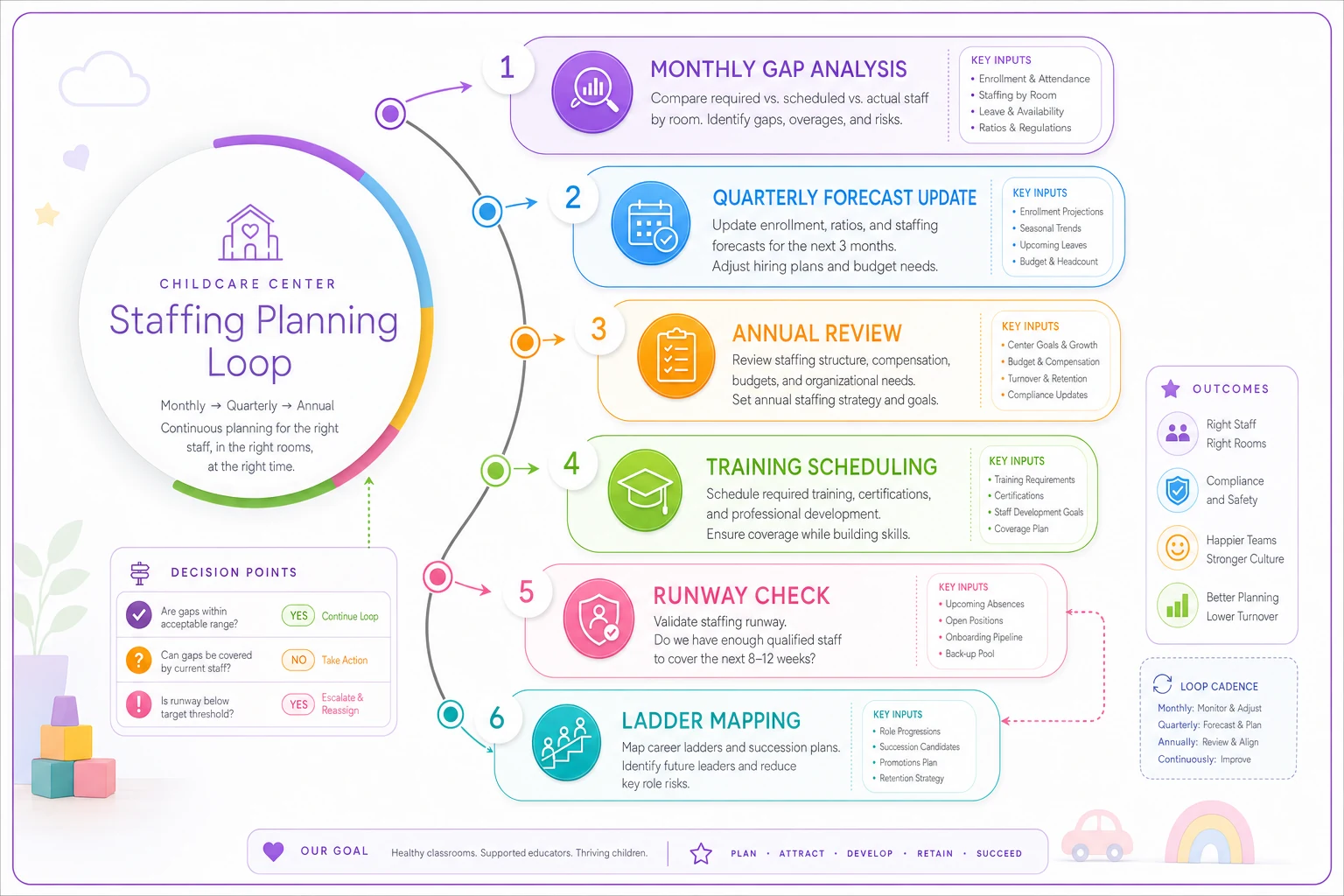
The handoff that breaks most often is between the monthly gap and the quarterly forecast. Directors see the gap and fix it with overtime, and the owner never hears that the bench is too small. Overtime above a set level, maybe 4% of hours in a month, should automatically land in the quarterly review as a signal instead of getting absorbed quietly.
Quarterly review checklist
Before the quarterly meeting, whoever owns the forecast should be able to answer yes to most of the items below. If several are a no, that's your agenda for the meeting.
-
Enrollment forecast updated by age band for the next 12 quarters, with years 2–3 marked as low-confidence.
-
Ratio slots recalculated by room, not by total headcount.
-
Coverage factor checked against last quarter's actual scheduled hours.
-
Trailing 12-month turnover and absence rates updated.
-
Bench target recalculated and compared to effective bench (people actually free to float, credentials current).
-
At least one bench member qualified for the most restrictive room.
-
Ladder reviewed
critical roles two-deep, no more than one lead-level move planned per quarter per site.
-
Training starts confirmed against ladder ready dates, with coverage hours budgeted.
-
Runway calculated per site and consolidated.
-
Downside scenario (–8 to –10% enrollment) tested against planned commitments.
-
Any month with overtime above your threshold explained.
Don't worry if the first couple of reviews take longer than two hours. Most of the time goes into finding data that should already be in one place.
When this actually makes sense
This model earns its keep when a center has enough moving parts that staffing decisions affect each other. Roughly, that means centers with 50+ children, or any center with an infant program, since infant rooms are the least forgiving of gaps.
It's especially useful in the 12–18 months before an expansion, whether that's a new room or a new site, because that's when ladder and training lead times decide whether the opening goes smoothly. It also fits if your summers look like the scenario above. If you can predict when you'll be short, you can plan for it.
When this is a bad idea
If enrollment is declining and you haven't figured out why, adding bench and funding a ladder treats the wrong problem. Fix the enrollment side first. A multi-year staffing plan built on a shrinking forecast mostly documents the decline.
It's also a bad fit if no one will run the monthly loop. A three-year forecast built once and never updated is worse than none, because it gives false confidence. If the director already has no capacity, start with just the bench calculation and the cost-of-vacancy math, which are useful on their own, and add the rest later.
Who should NOT do this (yet)
A few types of operators should hold off, or at least run a lighter version.
-
Very small centers (under about 35–40 children, two or three rooms). The bench math still applies, but a full 12-quarter model is overkill. A part-time sub on your roster and a named backup for each lead covers most of the benefit.
-
Centers with under a month of payroll runway. Every lever here adds payroll before it saves money. Stabilize cash first, then use temporary and per-diem coverage until you're past the threshold.
-
Owners planning to sell within a year. A ladder and training pipeline take 12–24 months to pay off. A buyer may value them, but you won't see the return yourself.
None of this means you should ignore staffing. It just means the full model isn't the right first move, and a smaller version of it usually is.
Where software fits, and where it doesn't
The model rarely fails on the math. It fails on stale inputs. Enrollment notices live in the management system, credentials sit in a spreadsheet someone updates when they remember, the schedule is on a whiteboard or a separate app, and payroll is with another vendor. Pulling it together each month is tedious, so it gets skipped, and the model drifts out of date.
Operational software that keeps enrollment, staff credentials, schedules and payroll in one place removes most of that friction. Add some AI automation and the monthly gap analysis can mostly assemble itself. A family gives notice, two toddlers age into preschool in November, a floater's CPR expires in six weeks, and the system recalculates ratio slots and flags that Room 3 will need a second teacher while your only qualified floater won't be cleared by then. Catching that a month early instead of the morning of is the whole point.
What it can't do is make the decisions: whether to delay an expansion to protect runway, which assistant is really ready, whether a transfer will weaken a site you need stable. Software keeps the information current and puts problems in front of you sooner. The judgment stays with the owner and director.
Where to start
You don't need the whole model this quarter. A sensible order:
-
Start with the cost-of-vacancy math on your last two or three departures. Use real overtime numbers, real delayed starts, any families who left around that time, and net out saved wages. That number changes how every other decision looks.
-
Next, calculate your effective bench, meaning people who can actually step into ratio today with current credentials and no permanent room assignment. For many centers the honest answer is far lower than the org chart suggests, and fixing it may mean redefining an existing role rather than hiring.
-
Then name names
who's next in line for your director, your infant lead and each lead role, and who's second. Wherever there's a blank, that's where training money should go first.
Build the 12-quarter forecast after that, once the pieces it connects to are real.
Update it every quarter, and treat staffing commitments with the same care you'd give a large capital purchase, because over a year they usually cost more.
Ready to transform your daycare operations?
Join hundreds of daycare centers using Carexly to save time, improve communication, and enhance child care quality.