


Most daycare owners don't lose money because they're bad at any one thing. They lose it in the gaps between things. Enrollment lives in one person's head or a spreadsheet. Staffing gets decided classroom by classroom based on who showed up this week. Subsidy paperwork sits in a folder until someone remembers to chase it. And the revenue forecast? Usually a gut feeling, maybe a number the owner updates once a quarter when the accountant asks.
Each of those systems works fine on its own. The problem is they don't talk to each other, and by the time they do, the decision window has already closed. You find out you're short-staffed when a teacher calls out and you're suddenly out of ratio. You find out subsidy revenue dropped when the deposit comes in light. You find out an age group is under-enrolled when payroll eats the month.
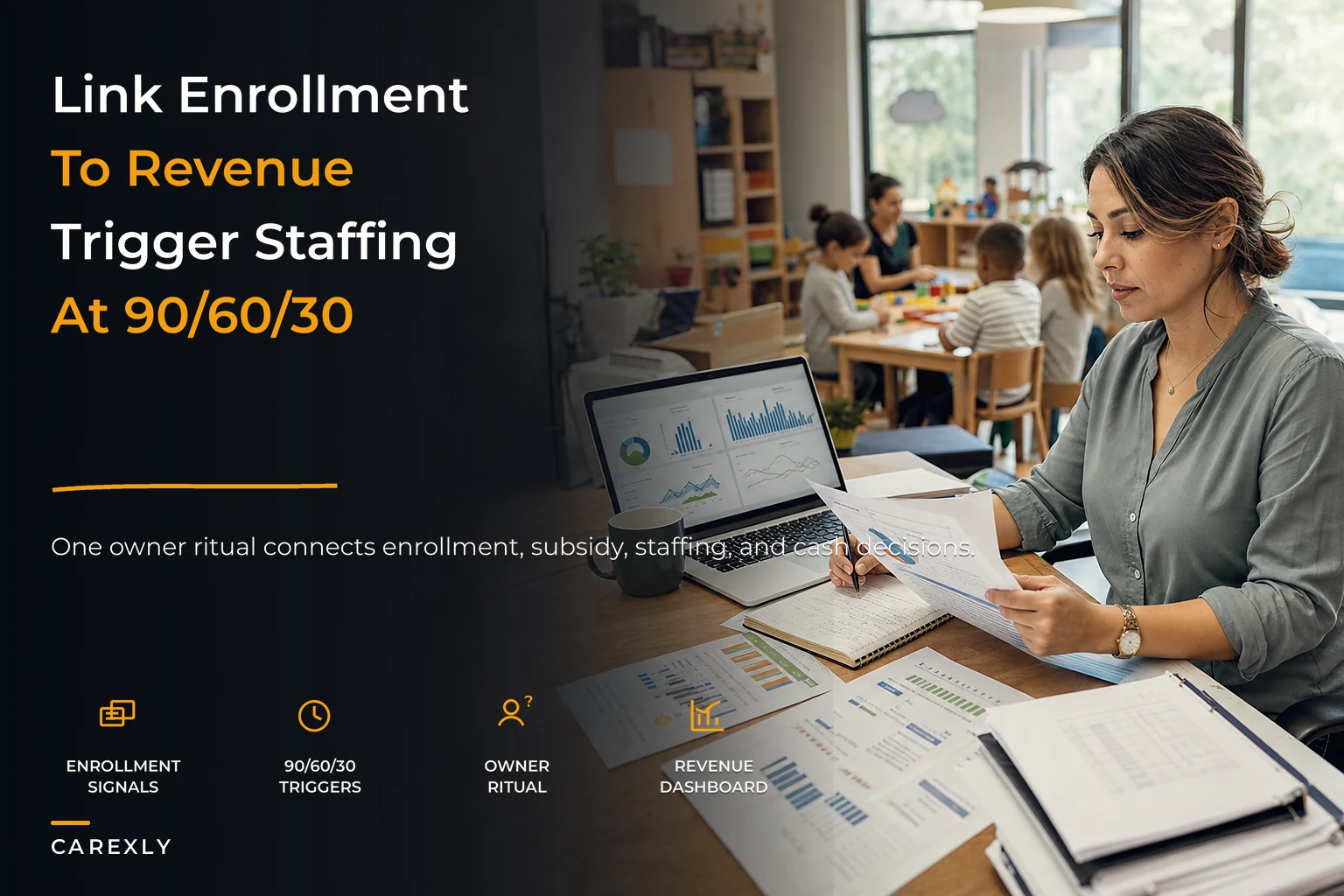
This is about building one connected operating model — what we've seen work across a lot of centers — where enrollment, subsidy status, and revenue projections feed a single owner ritual with clear decision triggers at 90, 60, and 30 days out. Not a dashboard you glance at. A rhythm that forces decisions before the money is already gone.
Why these three systems drift apart
The enrollment-to-revenue operating model daycare owners actually need isn't complicated math. It's a coordination problem. And coordination problems get worse, not better, as you grow.
A small center with 40 kids can run on memory. The director knows every family, knows which subsidy cases are pending, knows the two-year-old room is tight next month. The forecast lives in her head and it's usually right.
Then you hit 80, 100, 120 kids. Now there are three or four age groups moving at different speeds. Infants have a waitlist. The older toddler room has three empty spots that have been sitting empty for two months. Subsidy authorizations are expiring on a rolling basis you can't track by feel anymore. The director who used to "just know" is now firefighting, and the forecast becomes a guess dressed up as a number.
What breaks is the timing of information. The trouble usually starts when a decision depends on data that lives in a system nobody checks until it's urgent. Enrollment changes 90 days out should drive staffing decisions now. Subsidy expirations 60 days out should trigger re-authorization outreach now. But if those signals don't surface until they hit the bank account, you're always reacting.
The centers that stay profitable through growth aren't smarter. They've just connected the pipes so a change in one place shows up everywhere it matters, early enough to do something about it.
The 90/60/30 logic: why three horizons beat one forecast
A single annual budget is almost useless for operational decisions. It's too far out to act on and too rigid to adjust. Three rolling horizons, each with its own job, actually works.
Eliminate administrative bottlenecks.
Carexly helps you manage enrollments, attendance, and staff schedules effortlessly.
- Streamlined child enrollment
- Automated parent notifications
- Staff shift and activity scheduling
No credit card required
-
90 days out is for capacity and hiring decisions. This is where you look at projected enrollment by room and decide whether you're hiring, holding, or trimming. Hiring a qualified lead teacher takes 6–10 weeks in most markets, so a staffing gap you spot 90 days out is solvable. One you spot at 30 days means agency temps or blown ratios.
-
60 days out is for revenue protection decisions. Subsidy re-authorizations, expiring enrollment agreements, families who gave soft notice. Sixty days is enough time to chase a lapsing subsidy case or convert a waitlist family into a confirmed start.
-
30 days out is for cash and schedule lock decisions. Final staffing schedule, confirmed tuition and subsidy billing, and the near-term revenue number you'd actually bet on.
The reason to separate these is that each horizon triggers a different kind of action. Lumping them into one forecast means you treat a slow-filling toddler room (a 90-day hiring question) the same as an expiring subsidy (a 60-day revenue question). They're not the same problem and they don't share a solution.
The owner ritual is simple: once a week, you sit with one view that shows all three horizons and act on whatever crossed a trigger line since last week. Fifteen to thirty minutes. The discipline is doing it every week so nothing waits until it's a crisis.
What the owner actually looks at
The dashboard isn't the point — the decisions are. But you need a view that makes the triggers obvious at a glance. Here's a stripped-down version of what the weekly owner view should surface.
| Horizon | Signal to watch | Trigger line | Decision it forces |
|---|---|---|---|
| 90 days | Projected occupancy by room | Any room below 80% or above 95% | Hire, hold, or shift staff; open/close waitlist |
| 90 days | Confirmed starts vs. target | Behind target by 3+ spots | Push waitlist conversion, review pricing/tours |
| 60 days | Subsidy authorizations expiring | Any case within 60-day window | Start re-auth paperwork, notify family |
| 60 days | Soft/verbal withdrawal notices | 2+ in one room | Backfill outreach, exit conversation |
| 60 days | Projected monthly revenue vs. budget | Variance over ~5% | Investigate source, adjust spend |
| 30 days | Staffing schedule coverage vs. ratios | Any gap breaking ratio | Lock schedule, approve coverage |
| 30 days | Billing-ready families | Any unconfirmed subsidy/tuition | Resolve before invoice run |
| 30 days | Near-term cash projection | Below operating threshold | Timing on payroll/vendor, flag early |
The trigger lines matter more than the numbers themselves. A dashboard that just shows you occupancy is a report. A dashboard that shows you "this room crossed below 80% and that means decide on staffing" is an operating tool. The difference is whether the view tells you something or asks you to do something.
One mistake that shows up constantly: owners build detailed dashboards and then still make decisions by gut because the dashboard doesn't connect a number to an action. If a metric doesn't have a trigger line and a named decision behind it, it's decoration. Cut it.
The enrollment-to-revenue workflow, end to end
A single enrollment change should ripple through the whole model — this is where connected systems actually earn their keep.
-
Enrollment updates the projection. That confirmed start shifts the 90-day infant room occupancy up. If the room was at 85% and this pushes it toward 95%, a staffing trigger may fire — you might need another qualified staff member to stay in ratio.
-
Staffing checks against the trigger line. The 90-day view flags whether the new occupancy breaks ratio at any point. If it does, you're now in hiring territory with enough runway to actually hire.
-
Subsidy status gets attached. If the family is subsidy-eligible, the authorization timeline enters the 60-day watch list the moment it's known, so you're tracking the expiration before it's a problem.
-
Revenue forecast absorbs it. The confirmed start, with its tuition rate and subsidy portion, updates the 60- and 30-day revenue projections — not when the accountant reconciles, but the day it's confirmed.
-
Billing readiness flags at 30 days. As the start date approaches, the family either shows as billing-ready or gets flagged for missing subsidy confirmation or paperwork.
When these steps are manual and disconnected, each one is a chance for the signal to die. The enrollment gets written down but the forecast doesn't change. The subsidy case gets filed but nobody watches the expiration. The staffing need surfaces at 30 days when it's a scramble instead of 90 days when it's a hire.
The whole value of the operating model is that one input — a confirmed start — touches staffing, subsidy tracking, and revenue in the same motion. If you've ever dug into why specific age groups sit empty while others overflow, you already know the funnel problem and the revenue problem are the same problem viewed from two ends.
Visual workflow below shows the process from confirmed enrollment to staffing, subsidy, and billing updates.
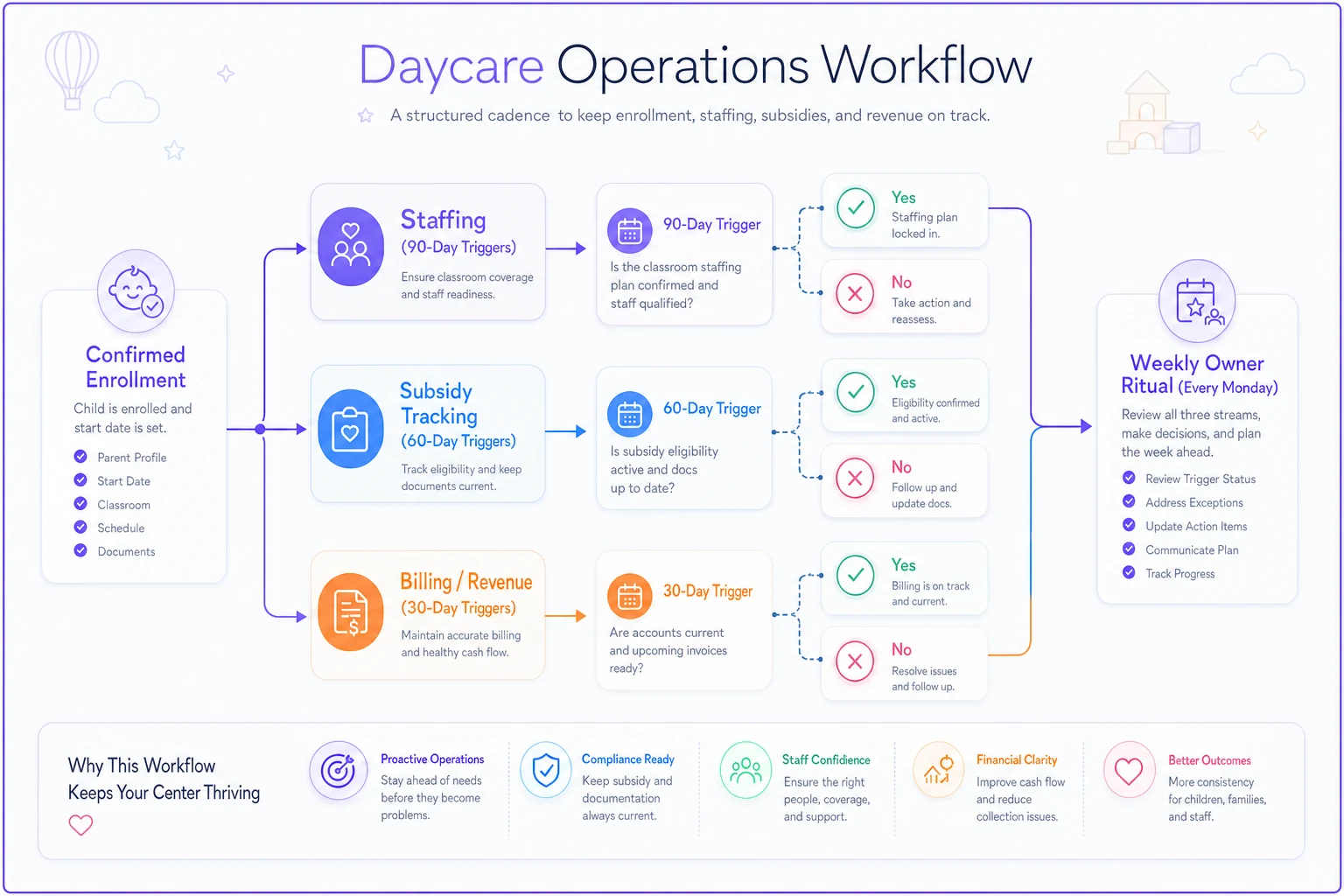
When the workflow is connected, the owner ritual becomes a decision-making moment rather than an information hunt.
A real scenario
A center running around 95 kids across four age groups was consistently surprised by its own payroll. Occupancy looked fine on paper — roughly 88% overall — but they kept ending months tighter than expected, sometimes by $4k–$6k.
Two things surfaced when they dug in. First, the blended occupancy number hid a real imbalance: infants were effectively full while the older toddler room was running near 70%. Second, around five subsidy authorizations had lapsed over a two-quarter stretch without anyone catching it until the reimbursements stopped — a slow leak of a few thousand a month.
They switched to the three-horizon ritual. Nothing complicated. A weekly 20-minute review: occupancy by room at 90 days, subsidy expirations at 60 days, billing readiness at 30 days.
The results showed up within a couple of months. The lapsed-subsidy problem basically stopped because expirations now surfaced with 60 days of runway — enough time to get re-authorization done before the gap. The toddler-room staffing got right-sized once they could see the under-enrollment separately, which trimmed some over-scheduling. Month-end surprises shrank to a range they could actually plan around. The owner described it as "I stopped finding out about problems from the bank statement."
That's the real win. Not a dramatic revenue jump — a center that stops bleeding in the gaps and stops being surprised by its own numbers.
Where automation actually fits
You can run this ritual on a spreadsheet, and plenty of centers do when they're starting out. It works — until the manual data entry between systems becomes the thing that breaks it. The spreadsheet is only as current as the last time someone updated it, and the whole model depends on signals surfacing early.
-
A confirmed enrollment automatically updating the occupancy projection and revenue forecast, instead of someone re-typing it.
-
Subsidy expiration dates triggering an alert at the 60-day mark without anyone remembering to check a list.
-
Staffing ratios recalculating against projected occupancy so the hiring trigger fires without manual intervention.
-
Billing-readiness flags surfacing missing paperwork before the invoice run, not after a short deposit.
The point isn't to replace the owner's judgment — it's to make sure the signal never dies on the way to the owner. When these connections are automated, the weekly ritual gets easier and more honest because the numbers are current without anyone babysitting them. Our platform handles this kind of cross-system triggering, but the principle matters more than any specific tool: automate the connections between enrollment, subsidy, and revenue so decisions surface on time.
For the deeper financial scaffolding underneath this, the financial governance playbook for owners and directors covers the controls, and the occupancy-driven forecasting approach with staffing triggers shows the staffing side in worked detail.
When this model makes sense — and when it doesn't
This makes sense when you're past the point where one person can hold the whole picture in their head — usually somewhere north of 60–70 kids, or whenever you have multiple age groups moving at different speeds, or meaningful subsidy revenue to track. The more moving parts, the more the ritual pays off.
This is overkill when you're a small, stable center where the director genuinely knows every family and every subsidy case by name. If the forecast-in-someone's-head has been reliably right for years, don't bolt on machinery you don't need yet. Build the habit light and let it grow with you.
Who should not do this as described: anyone who'll build the dashboard and then not run the weekly ritual. A dashboard without the recurring decision rhythm is worse than nothing — it creates a false sense of control. The ritual is the product. The view just serves it.
Getting started without boiling the ocean
Don't try to build the full connected system in week one. Start with the ritual on whatever data you already have.
-
Pick one recurring 20-minute slot per week. Same day, same time. Protect it.
-
Pull occupancy by room — not blended — for the 90-day horizon.
-
List every subsidy authorization expiring in the next 60 days.
-
Check staffing coverage against ratios for the next 30 days.
-
For each item that crossed a trigger line, write down the one decision it forces and who owns it.
Treat the weekly 20-minute slot like a staff meeting—same time each week and don't skip it.
Do that for a month with nothing more than a spreadsheet and your existing enrollment data. You'll feel the difference in how often you get surprised — and you'll know exactly which connections are worth automating once the manual version starts to strain.
The centers that run this well aren't the ones with the best software. They're the ones who turned "check the numbers" into a non-negotiable weekly decision rhythm, and then connected their systems so the rhythm stays honest. Enrollment, staffing, subsidy, and revenue were never separate problems. They're one system moving through time — and the owner's job is to see it early enough to steer.
Ready to transform your daycare operations?
Join hundreds of daycare centers using Carexly to save time, improve communication, and enhance child care quality.